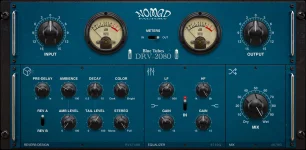
Nomad Factory released BlueVerb DRV-2080 v4 on September 7, 2026, with a redesigned interface and modernized processing for current systems. Older manuals still describe the original control layout in detail, so they remain useful, but only if you know which labels have moved.
The current BlueVerb DRV-2080 v4 control set keeps the same broad jobs of pre-delay, early reflections, decay, tone shaping, tail level, stereo width, EQ, input, output, and mix. Trouble starts when an old tutorial tells you to reach for Amount or Damping, and the current feature list uses different language. Matching the function matters more than matching the old knob name.
Nomad Factory’s current v4 page describes adjustable Ambience or Early Reflections and independent Ambience and Tail levels instead. It does not present Amount as a named feature in the same way. A returning user should read an old Amount instruction as guidance about the early-reflection level, not assume a control with the same printed label must still be present.
Spelling is another small trap. The older manual uses Ambiance, while the current product copy uses Ambience. Both point to the early-reflection side of BlueVerb, so searching an old PDF for the newer spelling can make a relevant section look absent when it is sitting there under the older label.
This is where interface language genuinely affects usability. Research on conceptual consistency in user interfaces found that the mapping between a user’s task and the system’s procedures matters alongside surface-level interaction consistency. In BlueVerb terms, remembering what the control does is more reliable than memorizing where a word appeared on a legacy panel.
The practical relationship is obvious enough for navigation, but the documentation does not provide a parameter-by-parameter migration chart proving that Damping was simply renamed and left technically unchanged. Nomad Factory also says v4 uses modernized processing. A safe reading is that Color is the current dark-to-bright tone control, while claims about identical internal behavior go beyond what the published material confirms.
This distinction matters when copying settings from an old tutorial. A direction such as “turn Damping to 30” may tell you the intended tonal direction, but it does not establish that entering the same numerical position in v4 will reproduce the old result exactly. Use the legacy value as a starting point and judge the actual decay tone by ear.
The built-in two-band EQ is less confusing because both old and current material retain separate low- and high-frequency gain controls. Old documentation even gives the legacy ranges, with low frequency from 50 to 800 Hz and high frequency from 1 to 8 kHz. Current product copy confirms adjustable LF and HF frequency and gain without promising that every old display convention remains unchanged.
Stereo Width also keeps the same basic purpose. The old manual describes the left side as mono and the right side as stereo, while the current page still lists adjustable Stereo Width. Rev A and Rev B likewise survive as the two processing modes, although current wording frames them more plainly as lower CPU usage through higher-quality processing.
Old screenshots are least reliable as maps of where your hand should go. Blue Tubes 4.1.0 added per-instance and per-plugin skin and scale support, and BlueVerb itself received a redesigned interface. A tutorial can still teach the signal-flow idea even when its panel proportions, skin, labels, or control placement no longer resemble what is open on your screen.
Presets and old walkthroughs are best approached by intent. Recreate the pre-delay, early-reflection balance, RT60, tonal direction, tail level, width, EQ, and wet-dry relationship in that order, then compare the sound rather than the screenshot. Legacy BlueVerb documentation still contains useful engineering information, but v4 is current enough that literal knob-for-knob imitation is no longer the safest way to use it.
The current BlueVerb DRV-2080 v4 control set keeps the same broad jobs of pre-delay, early reflections, decay, tone shaping, tail level, stereo width, EQ, input, output, and mix. Trouble starts when an old tutorial tells you to reach for Amount or Damping, and the current feature list uses different language. Matching the function matters more than matching the old knob name.
Old Ambiance and Amount wording needs translation
Legacy BlueVerb documentation splits the early part of the reverb into Ambiance and Amount. Ambiance changes the character of the early reflections, while Amount controls their level from zero to 100 percent. Older screenshots and tutorials therefore tend to discuss those two controls as a pair.Nomad Factory’s current v4 page describes adjustable Ambience or Early Reflections and independent Ambience and Tail levels instead. It does not present Amount as a named feature in the same way. A returning user should read an old Amount instruction as guidance about the early-reflection level, not assume a control with the same printed label must still be present.
Spelling is another small trap. The older manual uses Ambiance, while the current product copy uses Ambience. Both point to the early-reflection side of BlueVerb, so searching an old PDF for the newer spelling can make a relevant section look absent when it is sitting there under the older label.
This is where interface language genuinely affects usability. Research on conceptual consistency in user interfaces found that the mapping between a user’s task and the system’s procedures matters alongside surface-level interaction consistency. In BlueVerb terms, remembering what the control does is more reliable than memorizing where a word appeared on a legacy panel.
Damping and Color should not be treated as identical proof
The old manual gives Damping a very clear job. Turning it left makes the reverberation darker, and turning it right makes it brighter, with the control described specifically as high-frequency damping. Current BlueVerb v4 marketing instead lists a Color control running from Dark to Bright.The practical relationship is obvious enough for navigation, but the documentation does not provide a parameter-by-parameter migration chart proving that Damping was simply renamed and left technically unchanged. Nomad Factory also says v4 uses modernized processing. A safe reading is that Color is the current dark-to-bright tone control, while claims about identical internal behavior go beyond what the published material confirms.
This distinction matters when copying settings from an old tutorial. A direction such as “turn Damping to 30” may tell you the intended tonal direction, but it does not establish that entering the same numerical position in v4 will reproduce the old result exactly. Use the legacy value as a starting point and judge the actual decay tone by ear.
The built-in two-band EQ is less confusing because both old and current material retain separate low- and high-frequency gain controls. Old documentation even gives the legacy ranges, with low frequency from 50 to 800 Hz and high frequency from 1 to 8 kHz. Current product copy confirms adjustable LF and HF frequency and gain without promising that every old display convention remains unchanged.
Several core settings still translate cleanly
Some old BlueVerb instructions remain straightforward. The legacy manual gives pre-delay as zero to 999 milliseconds, while v4 describes pre-delay up to one second. Decay RT60 remains 0.5 to 10 seconds, and v4 still lists Tail independently from Ambience.Stereo Width also keeps the same basic purpose. The old manual describes the left side as mono and the right side as stereo, while the current page still lists adjustable Stereo Width. Rev A and Rev B likewise survive as the two processing modes, although current wording frames them more plainly as lower CPU usage through higher-quality processing.
Old screenshots are least reliable as maps of where your hand should go. Blue Tubes 4.1.0 added per-instance and per-plugin skin and scale support, and BlueVerb itself received a redesigned interface. A tutorial can still teach the signal-flow idea even when its panel proportions, skin, labels, or control placement no longer resemble what is open on your screen.
Presets and old walkthroughs are best approached by intent. Recreate the pre-delay, early-reflection balance, RT60, tonal direction, tail level, width, EQ, and wet-dry relationship in that order, then compare the sound rather than the screenshot. Legacy BlueVerb documentation still contains useful engineering information, but v4 is current enough that literal knob-for-knob imitation is no longer the safest way to use it.