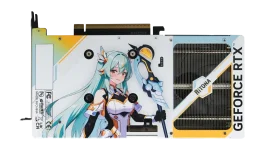
Palit's RTX 5060 Ti RiTONA OC measures 233.9 × 125.8 × 40 mm and occupies two expansion slots. On paper, that makes it a pretty compact RTX 5060 Ti, especially next to the long triple-fan cards that dominate product photos.
The 233.9 mm length is the easy number. Real fit comes down to three dimensions, whatever sits in front of the card, and whether your power cable has enough room to leave the connector without being crushed against the side panel.
The good news is Palit did not use a chunky power connector here. The RiTONA OC draws 180 W and uses one conventional 8-pin PCIe plug, so older power supplies are less likely to need an adapter hanging off the card.
A sensible check is to measure from the rear expansion slots to the nearest fixed obstruction along the card's path. Give yourself a little breathing room instead of treating 233.9 mm as a target you can hit exactly. A card technically fitting with a few millimeters left can still be annoying to install, remove, or cable later.
Height is the less obvious problem. The RiTONA OC stands 125.8 mm tall, and the 8-pin lead still has to bend away from the card somewhere. In a narrow case, the side panel can become the real limit even when the chassis has loads of length left.
Thickness is much simpler because the card is 40 mm thick and officially a two-slot design. You still need to look at what lives directly below it, especially on compact motherboards where a capture card, Wi-Fi card, or another expansion device may sit close to the GPU fans.
Air around the card matters too. Work on GPU cooling inside a complete workstation found that chassis airflow and surrounding components influence GPU temperature, which is a useful reminder not to confuse physical clearance with good cooling. A card can fit and still have a miserable time breathing.
If your side panel sits close to the top edge of the GPU, plug the cable in before assuming the build is finished. The connector itself is only part of the space claim. The cable, strain relief, and the first bend all sit outside the published 125.8 mm card height.
Small cases make this more obvious because every component starts negotiating for the same few centimeters. Front-mounted radiators steal GPU length, thick fans steal more, and PSU shrouds can make it awkward to approach the connector from below. None of those problems appear in the GPU dimensions.
Palit's RTX 5060 Ti RiTONA OC graphics card is therefore compact in the useful sense, but not magically case-proof. Check the occupied space around the card rather than matching one manufacturer number against another and hoping they describe the same thing.
RiTONA saves 28.2 mm in length. The other differences are tiny, with only 0.5 mm trimmed from height and 0.1 mm from thickness, so its compactness is overwhelmingly a length advantage rather than a radically smaller footprint in every direction.
This matters in cases where the front of the GPU is the pinch point. A radiator or front fan stack that blocks the regular Dual OC may still leave enough room for RiTONA, while a narrow side panel or crowded lower expansion area gains almost nothing from the shorter PCB and cooler.
Palit also fits two 102 mm fans to the shorter RiTONA card, compared with 95 mm fans on the regular Dual design. You are not getting a tiny low-profile board. You are getting a normal two-slot, full-height graphics card with roughly 28 mm chopped from the dimension that most often collides with front-mounted hardware.
The 233.9 mm length is the easy number. Real fit comes down to three dimensions, whatever sits in front of the card, and whether your power cable has enough room to leave the connector without being crushed against the side panel.
The good news is Palit did not use a chunky power connector here. The RiTONA OC draws 180 W and uses one conventional 8-pin PCIe plug, so older power supplies are less likely to need an adapter hanging off the card.
The published dimensions leave real clearance checks to you
Start with length because it is where the RiTONA has its biggest advantage. A case needs more than 233.9 mm of nominal GPU clearance if front fans, a radiator, pump hardware, drive cages, or thick cable bundles occupy the same space. Case manufacturers often quote a maximum with certain parts removed, so the biggest number on a spec sheet is not automatically the space available in your actual build.A sensible check is to measure from the rear expansion slots to the nearest fixed obstruction along the card's path. Give yourself a little breathing room instead of treating 233.9 mm as a target you can hit exactly. A card technically fitting with a few millimeters left can still be annoying to install, remove, or cable later.
Height is the less obvious problem. The RiTONA OC stands 125.8 mm tall, and the 8-pin lead still has to bend away from the card somewhere. In a narrow case, the side panel can become the real limit even when the chassis has loads of length left.
Thickness is much simpler because the card is 40 mm thick and officially a two-slot design. You still need to look at what lives directly below it, especially on compact motherboards where a capture card, Wi-Fi card, or another expansion device may sit close to the GPU fans.
Air around the card matters too. Work on GPU cooling inside a complete workstation found that chassis airflow and surrounding components influence GPU temperature, which is a useful reminder not to confuse physical clearance with good cooling. A card can fit and still have a miserable time breathing.
The power cable can spoil an otherwise clean fit
The single 8-pin connector is a nice practical choice because it avoids the bulk of a 12V-2x6 adapter setup. It does not make cable clearance irrelevant. Stiff-sleeved extensions can need a surprisingly wide turn before they settle into a clean route behind the motherboard tray.If your side panel sits close to the top edge of the GPU, plug the cable in before assuming the build is finished. The connector itself is only part of the space claim. The cable, strain relief, and the first bend all sit outside the published 125.8 mm card height.
Small cases make this more obvious because every component starts negotiating for the same few centimeters. Front-mounted radiators steal GPU length, thick fans steal more, and PSU shrouds can make it awkward to approach the connector from below. None of those problems appear in the GPU dimensions.
Palit's RTX 5060 Ti RiTONA OC graphics card is therefore compact in the useful sense, but not magically case-proof. Check the occupied space around the card rather than matching one manufacturer number against another and hoping they describe the same thing.
RiTONA is shorter than Palit's regular Dual OC
The cleanest comparison is Palit's own RTX 5060 Ti Dual OC 8GB. It measures 262.1 × 126.3 × 40.1 mm, while RiTONA comes in at 233.9 × 125.8 × 40 mm. Both are two-slot cards, both use one 8-pin connector, and both carry the same 180 W graphics power rating.RiTONA saves 28.2 mm in length. The other differences are tiny, with only 0.5 mm trimmed from height and 0.1 mm from thickness, so its compactness is overwhelmingly a length advantage rather than a radically smaller footprint in every direction.
This matters in cases where the front of the GPU is the pinch point. A radiator or front fan stack that blocks the regular Dual OC may still leave enough room for RiTONA, while a narrow side panel or crowded lower expansion area gains almost nothing from the shorter PCB and cooler.
Palit also fits two 102 mm fans to the shorter RiTONA card, compared with 95 mm fans on the regular Dual design. You are not getting a tiny low-profile board. You are getting a normal two-slot, full-height graphics card with roughly 28 mm chopped from the dimension that most often collides with front-mounted hardware.