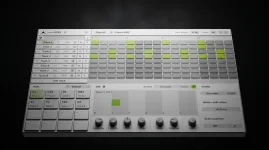
omniGRID lets its 16 MIDI tracks run with independent pattern lengths, which means several loops can drift against each other before meeting again. The feature sounds simple until a four-bar groove suddenly takes much longer than expected to return to its exact starting relationship.
Polymeter is not just a fancy way of saying odd rhythm. Two tracks can use the same step size and still create polymeter because their loop lengths differ. A 16-step kick pattern beside a 15-step percussion pattern keeps moving through new alignments even though both are locked to the same underlying grid.
The useful part of the omniGRID 16-track MIDI sequencer is not merely that tracks can be different lengths. You get to decide which parts stay predictable and which parts are allowed to wander, instead of turning the whole beat into one long mathematical exercise.
This is why random track lengths can disappoint. Some combinations look unusual in the interface but collapse into a short repeat almost immediately. Others create a composite cycle so long that a small percussion accent may not return to the same place against the kick for many bars.
You do not need advanced number theory to use the idea. Start with one stable length, then choose a second length that does not divide neatly into it. Sixteen against fifteen is an obvious example. Sixteen against twelve still shifts, but the relationship closes sooner because both lengths share a factor of four.
Producers often reach for prime numbers because they delay the realignment. Five against seven meets again after 35 steps, while seven against eleven needs 77. Three independent coprime lengths can produce a cycle far longer than you probably want in a club track, so restraint matters more than numerical cleverness.
Research on rhythmic complexity and meter perception describes how competing rhythmic patterns can weaken the acoustic evidence for a clear meter, leaving the listener to infer the underlying framework. In practical terms, complexity is easier to follow when at least one part keeps stating the pulse plainly.
A useful house or techno pattern might leave the kick on a conventional 16-step loop while a rim runs 15 steps and a shaker runs seven. The rim keeps arriving at a different point against the kick, while the shaker creates a faster secondary cycle. Nothing needs to sound obviously odd.
Density matters here. A seven-step track containing six hits will announce its changing position far more aggressively than one containing two. If the groove starts feeling busy, remove notes before changing lengths. Sparse drifting parts often create more movement because the ear has room to notice each new alignment.
Decide whether the pattern should preserve its phase across a section change or restart with the arrangement. A reset can make the next downbeat feel intentional, while continuous cycling keeps the relationship evolving underneath repeated sections. Neither choice is more advanced. They simply create different forms of continuity.
omniGRID also gives you probability, repeats, Euclidean generation, shuffle, and timing shift, but stacking those controls immediately can hide what the track lengths are doing. Get the length relationship working first. Add probability after you can hear the cycle, and use microtiming only once the structural movement already makes sense.
Export deserves the same attention. A long polymetric idea may need more MIDI than one visible loop in the DAW if you want the entire composite cycle preserved after drag-and-drop. Capture enough repetitions for the parts to reveal the relationship you actually liked, rather than exporting one short fragment and accidentally flattening the idea.
The strongest patterns usually have a hierarchy. One or two parts define the meter, a few parts drift around it, and the rest support those relationships instead of competing for independence. Sixteen available tracks do not need sixteen different lengths.
Polymeter is not just a fancy way of saying odd rhythm. Two tracks can use the same step size and still create polymeter because their loop lengths differ. A 16-step kick pattern beside a 15-step percussion pattern keeps moving through new alignments even though both are locked to the same underlying grid.
The useful part of the omniGRID 16-track MIDI sequencer is not merely that tracks can be different lengths. You get to decide which parts stay predictable and which parts are allowed to wander, instead of turning the whole beat into one long mathematical exercise.
Short coprime lengths create surprisingly long cycles
The easiest way to understand the movement is to watch where two loops meet. A five-step pattern and a seven-step pattern share no common factor other than one, so their full relationship repeats after 35 steps. Replace seven with ten and the combined cycle comes back much sooner because five divides evenly into ten.This is why random track lengths can disappoint. Some combinations look unusual in the interface but collapse into a short repeat almost immediately. Others create a composite cycle so long that a small percussion accent may not return to the same place against the kick for many bars.
You do not need advanced number theory to use the idea. Start with one stable length, then choose a second length that does not divide neatly into it. Sixteen against fifteen is an obvious example. Sixteen against twelve still shifts, but the relationship closes sooner because both lengths share a factor of four.
Producers often reach for prime numbers because they delay the realignment. Five against seven meets again after 35 steps, while seven against eleven needs 77. Three independent coprime lengths can produce a cycle far longer than you probably want in a club track, so restraint matters more than numerical cleverness.
One anchor track keeps the groove readable
A kick, clap, or another obvious pulse can act as the fixed reference while hats and percussion use shorter or stranger lengths. This gives the listener somewhere to stand. Without an anchor, several drifting parts can make the meter feel vague even when every note remains perfectly quantized.Research on rhythmic complexity and meter perception describes how competing rhythmic patterns can weaken the acoustic evidence for a clear meter, leaving the listener to infer the underlying framework. In practical terms, complexity is easier to follow when at least one part keeps stating the pulse plainly.
A useful house or techno pattern might leave the kick on a conventional 16-step loop while a rim runs 15 steps and a shaker runs seven. The rim keeps arriving at a different point against the kick, while the shaker creates a faster secondary cycle. Nothing needs to sound obviously odd.
Density matters here. A seven-step track containing six hits will announce its changing position far more aggressively than one containing two. If the groove starts feeling busy, remove notes before changing lengths. Sparse drifting parts often create more movement because the ear has room to notice each new alignment.
Reset points should be musical decisions
Long realignment cycles are useful inside a sequencer, but a track still has verses, drops, fills, and transitions. Letting every polymetric lane run indefinitely can make an arrangement feel accidental at the exact moment you need a section to land cleanly.Decide whether the pattern should preserve its phase across a section change or restart with the arrangement. A reset can make the next downbeat feel intentional, while continuous cycling keeps the relationship evolving underneath repeated sections. Neither choice is more advanced. They simply create different forms of continuity.
omniGRID also gives you probability, repeats, Euclidean generation, shuffle, and timing shift, but stacking those controls immediately can hide what the track lengths are doing. Get the length relationship working first. Add probability after you can hear the cycle, and use microtiming only once the structural movement already makes sense.
Export deserves the same attention. A long polymetric idea may need more MIDI than one visible loop in the DAW if you want the entire composite cycle preserved after drag-and-drop. Capture enough repetitions for the parts to reveal the relationship you actually liked, rather than exporting one short fragment and accidentally flattening the idea.
The strongest patterns usually have a hierarchy. One or two parts define the meter, a few parts drift around it, and the rest support those relationships instead of competing for independence. Sixteen available tracks do not need sixteen different lengths.