Ten expert drummers changed both snare timing and sound when performing pushed, on-beat, and laid-back rock patterns under controlled conditions. Timing is not a layer of random error sprinkled over a perfect grid. A drummer shapes it while the hands, feet, sticks, and cymbals keep imposing physical limits.
Programmed drums start sounding fake when those limits disappear. You can own a deeply sampled kit and vary every velocity, yet still write a part no player could execute. Three hand-played sounds at once may require a drummer with an extra arm.
This gets messy during fills. Producers often leave an eighth-note hi-hat running beneath fast toms, though both hands would normally leave the hats to play the fill. Muting two hat notes can sound more convincing than another pass with a humanize control.
Flams deserve the same logic. A flam is two closely spaced strokes, not one note copied with arbitrary delay, and those strokes occupy both hands when played on a single drum. Writing a snare flam while the same hands also strike two cymbals turns a realistic articulation into an impossible stack.
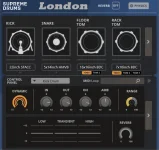
The Supreme Drums London collection of rock kit pieces gives programmed parts plenty of drum and cymbal choices, but choice increases the temptation to overfill the bar. Realism often comes from deleting the hit a drummer could not reach.
The controlled comparison of expert rock drumming styles recorded systematic changes in snare intensity and timbre when players performed pushed, on-beat, and laid-back patterns. Touch and timing moved together. A convincing edit can therefore need a slightly different velocity or articulation as well as a new note position.
Keep the main pulse more stable than the decorative notes. Expert percussionists show lower beat-tapping variability than non-percussionists, which corrects the idea that realistic drumming comes from scattering hits around the grid. Good players control time closely even when they choose to lean ahead or sit behind it.
Rock backbeats also need relationships rather than isolated offsets. If the snare sits a little behind the pulse, let that placement recur consistently enough to become part of the pocket. The kick can stay firmer against the bass while the hats carry smaller movement around both.
Fills should disturb those relationships for a reason. A drummer accelerating through toms may change stick height, simplify the kick, stop riding the hats, and land the next crash with more force. Moving only the tom notes while every other lane continues untouched leaves the body of the performance frozen.
Start with the phrase rather than a velocity lottery. Downbeats may receive firmer strokes, offbeats can relax, and a gradual increase in force can lead into a chorus or fill. Small variation can sit inside that shape, but the musical contour matters more than making every velocity number unique.
Open hats need cause and effect. A looser strike rings until the cymbals close or another articulation chokes it. Long open-hat samples should not keep washing beneath immediately closed strokes when the physical cymbals would already be touching.
Foot chicks create another trap. One foot cannot close the hi-hat cleanly while simultaneously operating a second pedal. Dense double-kick writing can therefore make careless hat programming physically implausible even when each MIDI lane looks sensible alone.
Ghost notes need similar restraint. Their job is usually to shape the space around the backbeat, and each one still consumes a hand, recovery time, and stick travel before the next accent. If a ghost note makes the following crash, tom, or flam impossible, lowering its velocity does not solve the problem.
A useful final pass is to mute the drum instrument and read the piano roll as movements rather than sounds. Track the left hand, right hand, left foot, and right foot through the bar. Any moment where one limb has been assigned two jobs is where the programmed drummer quietly disappears.
Programmed drums start sounding fake when those limits disappear. You can own a deeply sampled kit and vary every velocity, yet still write a part no player could execute. Three hand-played sounds at once may require a drummer with an extra arm.
A believable groove starts with four limbs
A drummer has two hands and two feet, so every simultaneous event spends part of a small physical budget. A kick, hi-hat pedal, snare, and crash can happen together. Adding a tom with another hand at the same instant means one of those earlier parts has to change.This gets messy during fills. Producers often leave an eighth-note hi-hat running beneath fast toms, though both hands would normally leave the hats to play the fill. Muting two hat notes can sound more convincing than another pass with a humanize control.
Flams deserve the same logic. A flam is two closely spaced strokes, not one note copied with arbitrary delay, and those strokes occupy both hands when played on a single drum. Writing a snare flam while the same hands also strike two cymbals turns a realistic articulation into an impossible stack.
The Supreme Drums London collection of rock kit pieces gives programmed parts plenty of drum and cymbal choices, but choice increases the temptation to overfill the bar. Realism often comes from deleting the hit a drummer could not reach.
Timing changes the stroke, not just the timestamp
Moving a MIDI note later changes only its timestamp. A human drummer can change the physical stroke as the feel moves. A laid-back snare is not automatically the same hit shifted several milliseconds to the right.The controlled comparison of expert rock drumming styles recorded systematic changes in snare intensity and timbre when players performed pushed, on-beat, and laid-back patterns. Touch and timing moved together. A convincing edit can therefore need a slightly different velocity or articulation as well as a new note position.
Keep the main pulse more stable than the decorative notes. Expert percussionists show lower beat-tapping variability than non-percussionists, which corrects the idea that realistic drumming comes from scattering hits around the grid. Good players control time closely even when they choose to lean ahead or sit behind it.
Rock backbeats also need relationships rather than isolated offsets. If the snare sits a little behind the pulse, let that placement recur consistently enough to become part of the pocket. The kick can stay firmer against the bass while the hats carry smaller movement around both.
Fills should disturb those relationships for a reason. A drummer accelerating through toms may change stick height, simplify the kick, stop riding the hats, and land the next crash with more force. Moving only the tom notes while every other lane continues untouched leaves the body of the performance frozen.
Hi-hats expose impossible programming
Hi-hats carry dynamics, articulation, and foot movement at the same time, so they reveal mechanical programming quickly. Eight identical closed-hat notes may be legal MIDI, but a real hand produces accents, rebounds, and small tonal changes even while trying to stay consistent.Start with the phrase rather than a velocity lottery. Downbeats may receive firmer strokes, offbeats can relax, and a gradual increase in force can lead into a chorus or fill. Small variation can sit inside that shape, but the musical contour matters more than making every velocity number unique.
Open hats need cause and effect. A looser strike rings until the cymbals close or another articulation chokes it. Long open-hat samples should not keep washing beneath immediately closed strokes when the physical cymbals would already be touching.
Foot chicks create another trap. One foot cannot close the hi-hat cleanly while simultaneously operating a second pedal. Dense double-kick writing can therefore make careless hat programming physically implausible even when each MIDI lane looks sensible alone.
Ghost notes need similar restraint. Their job is usually to shape the space around the backbeat, and each one still consumes a hand, recovery time, and stick travel before the next accent. If a ghost note makes the following crash, tom, or flam impossible, lowering its velocity does not solve the problem.
A useful final pass is to mute the drum instrument and read the piano roll as movements rather than sounds. Track the left hand, right hand, left foot, and right foot through the bar. Any moment where one limb has been assigned two jobs is where the programmed drummer quietly disappears.