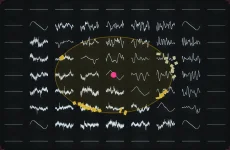
Morpheral Machines has launched The Swarm, a $59 wavetable synth that uses virtual bird behavior to make sounds change as notes play. Eduard Müller, the creator of Renoise, founded the new plugin company, which also debuted Desense, a free instrument built around interference.
Here's the clever bit. Each note can run 24 small sound generators called boids. They move across a flat grid of waveforms, and each plays whatever wave sits beneath it. Nearby boids affect how the group moves, which keeps the tone from staying fixed.
Users can draw their wave shapes, blend them, or turn audio files into new ones. The synth picks different cycles from a sample and puts waves with similar shapes near each other. Grid sizes range from 3 x 3 to 13 x 13.
And the movement gets quite deep. There are 12 types of attractors that can pull, repel, spin, or move the groups along less stable paths. As many as nine predators can disrupt them. Every note shares the same space but follows a different path.
Those movements also drive the synth's controls. Position, spacing, group alignment, and distance can affect other settings through 32 modulation routes for each voice. Even the speed and order of the boids can change through that system.
On the audio side, every voice gets band-limited oscillators with optional FM. There's a sub oscillator, a noise source, five filter types, and a waveshaper with folding and a crusher that follows pitch.
Effects get their share of detail. An eight-tap delay for each voice can work as chorus or reverb, with panning and detuning tied to the moving group. A seed control can also repeat the random behavior for the same result across takes.
About 50 presets cover basses, leads, pads, and keys. Players also get MPE, per-note expression in CLAP and VST 3, and MTS-ESP support for alternate tuning.
Windows and Linux users can run VST 3 or CLAP, while macOS gets those formats and AU. The launch deal is $59 or €59, after which the listed price rises to $79 or €79.