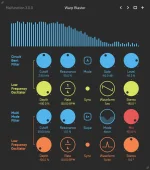
Sinevibes has released Malfunction 3.0 for $29, giving producers a circuit-bent filter effect built for harsh distortion and glitchy audio. The plugin runs on macOS, Windows, and Linux, with support for VST3, AU, and AAX formats.
The main trick is a digital filter with its internal signal paths altered on purpose. Instead of keeping audio clean, the design creates rough tones, sharp edges, and odd changes in timbre. Even a basic sound can turn into a far more complex texture.
Two character settings give users different takes on that distortion. There's also 4× oversampling to help cut unwanted aliasing, while an input gate lets users set how loud a signal must be before it gets through.
For more control, a second filter offers five choices. Low-pass and high-pass modes handle the upper and lower parts of the spectrum, while band-pass, notch, and peaking modes provide other ways to shape the output. Users can stack four stages for slopes reaching 48 dB per octave.
And the motion controls are quite packed. Two stereo LFOs offer 15 wave shapes, with both positive and negative ranges. They can follow a project's tempo and playback position, while phase controls and adjustable stereo offsets help create different movement on each side.
Sinevibes has also added lag smoothing across all continuous controls. That helps avoid clicks when settings change, whether a user tweaks them by hand or drives them through modulation.
Routing is flexible as well. Malfunction can accept mono audio and keep it mono, spread a single channel into stereo, or process a full stereo signal.