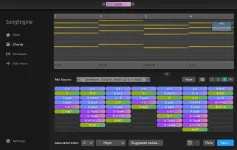
SongEngine’s Associated scale can change scale-aware pads and some presets, but changing its root or scale name does not transpose existing chords. Your MIDI notes stay where they are while SongEngine changes the harmonic context used around them.
It is an easy setting to misread because several nearby features do react when the scale changes. A producer can switch from C major to E major, watch available Chord Pads update, and reasonably assume the timeline has been transposed too. It has not.
Borrowed chords expose the difference quickly. SongEngine marks a Chord Pad when it contains pitches outside the current scale, giving you a warning without forcing the chord back into a diatonic shape. A chromatic chord can remain exactly as programmed while the surrounding scale context changes.
Some presets on the Packages page also use the Associated scale. In practical terms, the setting can influence material generated from your progression even though the progression itself remains untouched. You are changing the reference frame SongEngine uses for certain musical decisions, not rewriting the source chords.
Version 1.7 makes the split harder to miss through SongEngine’s scale-aware chord generators. Generator-based Chord Pad sources recalculate when you choose another Associated scale, so the available pad chords can change immediately while chords already sitting on the progression timeline keep their original pitches.
Suppose a saved pad collection was created around C major while the current Associated scale is E major. SongEngine can adapt the collection so its available pads fit E major, yet a C major chord already placed in the progression does not silently become E major. The source palette moves. The existing progression does not.
Version 1.7 makes the behavior more visible because its diatonic generators offer chords relevant to the selected scale. Changing the scale can therefore produce an obvious visual change in the pad area, especially on pages using the newer four-note or seven-note generators. It is still a change to available harmonic choices rather than a pitch shift applied to your finished sequence.
Lock scale controls what happens when you reroll a generated progression. When it is active, SongEngine keeps generation tied to the chosen Associated scale. If you want a fresh progression in a particular scale, SongEngine also provides a dedicated Generate for specific scale route from the starting page, which avoids treating the scale selector as a makeshift transpose control.
An incorrect guess does not automatically mean the detector has failed. Some chord loops genuinely support more than one plausible tonal center, and research on ambiguous key centers found that metric placement can influence which chord listeners hear as central even when the chord set remains unchanged. A short MIDI loop can therefore be harmonically underdetermined in ways a filename or a longer musical context would resolve.
SongEngine’s MIDI-to-Chord Pad converter gives you a practical way to remove some of that uncertainty before import. A filename ending in (C) is treated as C major, while (Am) is treated as A minor, letting the file carry scale information alongside the notes. This is especially useful when you are converting folders of progressions where several loops share pitches but serve different tonal roles.
Check the Associated scale before judging scale-aware generators, imported pad collections, or presets that depend on harmonic context. A progression can sound unchanged after you fix its Associated scale while SongEngine’s surrounding choices suddenly make far more sense, because the notes were never the problem. The label was.
It is an easy setting to misread because several nearby features do react when the scale changes. A producer can switch from C major to E major, watch available Chord Pads update, and reasonably assume the timeline has been transposed too. It has not.
Associated scale changes context, not chord pitches
On the Chords page, SongEngine uses the Associated scale as information about the progression rather than as a transpose command. The colored markers beside the active chord show which pitches belong to the selected scale, so changing the setting can alter how existing notes are interpreted without moving a single note.Borrowed chords expose the difference quickly. SongEngine marks a Chord Pad when it contains pitches outside the current scale, giving you a warning without forcing the chord back into a diatonic shape. A chromatic chord can remain exactly as programmed while the surrounding scale context changes.
Some presets on the Packages page also use the Associated scale. In practical terms, the setting can influence material generated from your progression even though the progression itself remains untouched. You are changing the reference frame SongEngine uses for certain musical decisions, not rewriting the source chords.
Version 1.7 makes the split harder to miss through SongEngine’s scale-aware chord generators. Generator-based Chord Pad sources recalculate when you choose another Associated scale, so the available pad chords can change immediately while chords already sitting on the progression timeline keep their original pitches.
Scale-aware pads react while the timeline stays put
Chord Pad sources behave in two noticeably different ways. Generator sources build pads algorithmically for the current Associated scale, while saved chord collections can be transposed so their pads fit the newly selected scale. Neither behavior means existing timeline chords have been globally transposed.Suppose a saved pad collection was created around C major while the current Associated scale is E major. SongEngine can adapt the collection so its available pads fit E major, yet a C major chord already placed in the progression does not silently become E major. The source palette moves. The existing progression does not.
Version 1.7 makes the behavior more visible because its diatonic generators offer chords relevant to the selected scale. Changing the scale can therefore produce an obvious visual change in the pad area, especially on pages using the newer four-note or seven-note generators. It is still a change to available harmonic choices rather than a pitch shift applied to your finished sequence.
Lock scale controls what happens when you reroll a generated progression. When it is active, SongEngine keeps generation tied to the chosen Associated scale. If you want a fresh progression in a particular scale, SongEngine also provides a dedicated Generate for specific scale route from the starting page, which avoids treating the scale selector as a makeshift transpose control.
Imported MIDI can carry the wrong harmonic label
SongEngine tries to detect the scale when you import a MIDI chord progression, but its manual explicitly allows for the guess being wrong. You can correct the Associated scale manually, and doing so fixes the harmonic label SongEngine works from without changing the imported chord pitches.An incorrect guess does not automatically mean the detector has failed. Some chord loops genuinely support more than one plausible tonal center, and research on ambiguous key centers found that metric placement can influence which chord listeners hear as central even when the chord set remains unchanged. A short MIDI loop can therefore be harmonically underdetermined in ways a filename or a longer musical context would resolve.
SongEngine’s MIDI-to-Chord Pad converter gives you a practical way to remove some of that uncertainty before import. A filename ending in (C) is treated as C major, while (Am) is treated as A minor, letting the file carry scale information alongside the notes. This is especially useful when you are converting folders of progressions where several loops share pitches but serve different tonal roles.
Check the Associated scale before judging scale-aware generators, imported pad collections, or presets that depend on harmonic context. A progression can sound unchanged after you fix its Associated scale while SongEngine’s surrounding choices suddenly make far more sense, because the notes were never the problem. The label was.