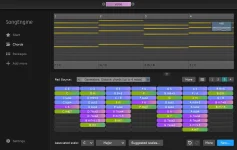
SongEngine 1.7 adds three diatonic Chord Pad generators capped at four, five, or seven notes for the currently selected scale. The number is a ceiling, not a promise that every pad will contain exactly that many pitches.
You can treat those three choices as different levels of harmonic density. Four-note material keeps the chord identity easy to hear, five-note material introduces stronger upper color, and seven-note material opens the door to the fullest diatonic stacks.
The useful part is not picking the biggest setting and leaving it there. A dense chord can sound gorgeous alone and still crowd a vocal, bass line, lead synth, or neighboring chord once the arrangement starts moving.
SongEngine's four-note generator therefore makes a sensible starting point when you want more character than plain triads but still need space around the harmony. Pads remain compact enough to audition quickly, and their chord quality is usually easier to judge against a bass part or melody.
This matters because SongEngine can use your chord progression as the harmonic basis for generated basslines, arpeggios, and phrases. Starting with a readable chord shape gives those later choices a cleaner foundation, especially when you are still deciding whether the progression itself works.
The four-note ceiling is also useful when your instrument already has a busy spectrum. A wide pad patch, distorted electric piano, or layered synth can turn one extra chord tone into several new partials, so fewer MIDI notes do not always produce a small sound.
For a first pass, the SongEngine 1.7 chord tools make the four-note set the safer place to judge movement before adding more harmonic weight. You can hear the progression first, then decide where richer color earns its space.
Five notes are often where a progression starts sounding deliberately voiced rather than merely harmonized. Major ninth and minor ninth colors can feel softer or more suspended, but the effect depends heavily on register, spacing, inversion, instrument tone, and whatever the melody is doing.
Controlled listening research has even found cases where mildly dissonant seventh and ninth chords were preferred over more consonant alternatives. The useful lesson from research on single-chord preference is not that ninths are automatically better, but that added tension can be attractive instead of being a flaw to remove.
In production terms, the fifth note is worth keeping when it has a job. It might soften a major chord, thicken a sustained keyboard part, or give an arpeggiator another pitch to cycle through. If you cannot hear what it contributes, deleting it is often cleaner than defending it because the chord name looks sophisticated.
Full stacks are not automatically useful voicings. The natural eleventh can rub hard against a major third, closely packed notes can blur in the middle register, and the bass or melody may already supply pitches you are doubling inside the chord.
SongEngine's seven-note generator is therefore better treated as a larger palette than a command to use seven simultaneous notes. Audition the richer options, then listen for the notes that define the chord's function, the extension you actually like, and any pitch that conflicts with the arrangement.
Flow mode adds another practical wrinkle because SongEngine can adjust pad notes against the existing progression to reduce large jumps between chords. The first chord's voicing acts as the reference, so a dense starting shape can influence how later pads move even when the chord names themselves look perfectly sensible.
Seven-note options make the most sense when you want to search for color, not maximum size. Start dense if the sound invites it, then remove notes until the harmony keeps its character without stepping on the bass, melody, or groove.
You can treat those three choices as different levels of harmonic density. Four-note material keeps the chord identity easy to hear, five-note material introduces stronger upper color, and seven-note material opens the door to the fullest diatonic stacks.
The useful part is not picking the biggest setting and leaving it there. A dense chord can sound gorgeous alone and still crowd a vocal, bass line, lead synth, or neighboring chord once the arrangement starts moving.
Four-note pads keep the harmony readable
A four-note tertian chord is often a seventh chord, built by adding another third above a triad. In C major, Cmaj7 gives you C, E, G, and B, while Dm7 gives you D, F, A, and C. Those extra sevenths add color without turning the chord into a wall of pitches.SongEngine's four-note generator therefore makes a sensible starting point when you want more character than plain triads but still need space around the harmony. Pads remain compact enough to audition quickly, and their chord quality is usually easier to judge against a bass part or melody.
This matters because SongEngine can use your chord progression as the harmonic basis for generated basslines, arpeggios, and phrases. Starting with a readable chord shape gives those later choices a cleaner foundation, especially when you are still deciding whether the progression itself works.
The four-note ceiling is also useful when your instrument already has a busy spectrum. A wide pad patch, distorted electric piano, or layered synth can turn one extra chord tone into several new partials, so fewer MIDI notes do not always produce a small sound.
For a first pass, the SongEngine 1.7 chord tools make the four-note set the safer place to judge movement before adding more harmonic weight. You can hear the progression first, then decide where richer color earns its space.
Five-note pads bring color without filling every gap
A five-note tertian stack reaches the ninth when the chord is built in consecutive thirds. Cmaj9, for example, adds D above Cmaj7, producing C, E, G, B, and D. The extra note changes the chord's surface color while the underlying root and quality remain recognizable.Five notes are often where a progression starts sounding deliberately voiced rather than merely harmonized. Major ninth and minor ninth colors can feel softer or more suspended, but the effect depends heavily on register, spacing, inversion, instrument tone, and whatever the melody is doing.
Controlled listening research has even found cases where mildly dissonant seventh and ninth chords were preferred over more consonant alternatives. The useful lesson from research on single-chord preference is not that ninths are automatically better, but that added tension can be attractive instead of being a flaw to remove.
In production terms, the fifth note is worth keeping when it has a job. It might soften a major chord, thicken a sustained keyboard part, or give an arpeggiator another pitch to cycle through. If you cannot hear what it contributes, deleting it is often cleaner than defending it because the chord name looks sophisticated.
Seven-note pads expose the whole scale and the voicing problem
Stacking diatonic thirds far enough can produce a seven-note thirteenth chord containing every pitch class of a seven-note scale. In C major, the theoretical stack C, E, G, B, D, F, A reaches all seven scale tones without leaving the key.Full stacks are not automatically useful voicings. The natural eleventh can rub hard against a major third, closely packed notes can blur in the middle register, and the bass or melody may already supply pitches you are doubling inside the chord.
SongEngine's seven-note generator is therefore better treated as a larger palette than a command to use seven simultaneous notes. Audition the richer options, then listen for the notes that define the chord's function, the extension you actually like, and any pitch that conflicts with the arrangement.
Flow mode adds another practical wrinkle because SongEngine can adjust pad notes against the existing progression to reduce large jumps between chords. The first chord's voicing acts as the reference, so a dense starting shape can influence how later pads move even when the chord names themselves look perfectly sensible.
Seven-note options make the most sense when you want to search for color, not maximum size. Start dense if the sound invites it, then remove notes until the harmony keeps its character without stepping on the bass, melody, or groove.