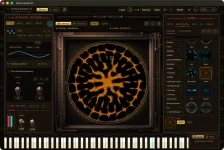
Sonicrama V2 now runs on Windows 10 and 11 as well as macOS 11 or later, with its visual engine leaning directly on the graphics hardware. On Windows, you need 64-bit support and a DirectX 12 graphics card. On Mac, the requirement is a Metal-capable GPU.
Those details matter more here than they do for a synth with a decorative spectrum display. The Sonicrama V2 system requirements sit behind a cymatics engine that solves plate behavior and moves hundreds of thousands of particles while you play, so the graphics path is part of the instrument rather than window dressing.
Compute shaders are built for highly parallel jobs, which suits large particle fields and repeated simulation steps. The point is well established in compute-shader particle simulation work, where parallel GPU execution is used to accelerate particle-based fluid calculations. Sonicrama applies the same broad hardware idea to its own modal and particle workload, although its physics model is different.
Pre-release testing gives one useful clue without turning into a promised minimum specification. The developer reported that an older Windows laptop with integrated Intel graphics could run the build, then specifically sought testing on NVIDIA and AMD machines, including systems driving 4K displays. Treat that as evidence of breadth, not a guarantee that every old integrated GPU will deliver the same frame rate.
Display resolution matters because the interface is doing more than drawing knobs. A higher-resolution screen increases the number of pixels the graphics stack must feed, while the particle and modal work continues underneath. If your production machine already struggles with animated plugin interfaces at 4K, Sonicrama is a poor place to assume the GPU will somehow become irrelevant.
NVIDIA, AMD, and Intel branding alone does not answer the compatibility question. What matters first is whether the installed card and driver expose the required DirectX 12 path correctly. Keeping graphics drivers current is especially sensible on a plugin whose GPU workload is more ambitious than meters, oscilloscopes, and animated backgrounds.
Windows users can load VST3 or CLAP builds, and a standalone version is available as well. Audio Unit remains a macOS format, so seeing AU in a retailer's format list should not be read as a Windows option. Changing from VST3 to CLAP also does not remove the GPU requirement because the same visual engine still has to run.
One detail from the development period is worth keeping in proportion. NVIDIA and AMD systems received extra attention late in testing because the developer's own Windows hardware was Intel-based, not because Intel graphics were declared unsupported. Anyone buying for a studio PC should separate a request for broader testing from an actual compatibility exclusion.
Logic users can use the AU build, while VST3 and CLAP give you options in hosts that support them. Ableton Live, Bitwig, and Reaper sit among the named compatible hosts, although exact format choice depends on the host and operating system you are running.
The interesting part is where the workload lands. Sonicrama does not simply dump all synthesis onto the graphics card and free the CPU from audio duties. The GPU handles the visual physics and particle work, while audio processing remains its own concern, so a strong graphics card will not rescue an overloaded audio buffer or an underpowered processor.
Buying by headline GPU model would be overkill unless you already know your machine is near its limits. The confirmed requirements are more useful than guesswork about prestige hardware. Check the operating system, plugin format, graphics API support, and driver health first, then use the demo on the exact machine and DAW where you plan to work.
Those details matter more here than they do for a synth with a decorative spectrum display. The Sonicrama V2 system requirements sit behind a cymatics engine that solves plate behavior and moves hundreds of thousands of particles while you play, so the graphics path is part of the instrument rather than window dressing.
The GPU requirement is part of the instrument
Most soft synth buyers look first at CPU speed, RAM, operating system, and plugin format. Sonicrama V2 adds another check because its visual core performs live compute work on the GPU, not merely image playback. A machine can be perfectly comfortable with ordinary VST instruments and still deserve a closer look before you assume Sonicrama will behave the same way.Compute shaders are built for highly parallel jobs, which suits large particle fields and repeated simulation steps. The point is well established in compute-shader particle simulation work, where parallel GPU execution is used to accelerate particle-based fluid calculations. Sonicrama applies the same broad hardware idea to its own modal and particle workload, although its physics model is different.
Pre-release testing gives one useful clue without turning into a promised minimum specification. The developer reported that an older Windows laptop with integrated Intel graphics could run the build, then specifically sought testing on NVIDIA and AMD machines, including systems driving 4K displays. Treat that as evidence of breadth, not a guarantee that every old integrated GPU will deliver the same frame rate.
Display resolution matters because the interface is doing more than drawing knobs. A higher-resolution screen increases the number of pixels the graphics stack must feed, while the particle and modal work continues underneath. If your production machine already struggles with animated plugin interfaces at 4K, Sonicrama is a poor place to assume the GPU will somehow become irrelevant.
Windows support depends on DirectX 12
The current Windows build supports Windows 10 and Windows 11 in 64-bit form, with Windows 10 21H2 listed as the lower supported release. The practical hardware gate is DirectX 12 graphics support. An old workstation may have plenty of CPU headroom for audio yet fail here because the visual engine needs a modern graphics API.NVIDIA, AMD, and Intel branding alone does not answer the compatibility question. What matters first is whether the installed card and driver expose the required DirectX 12 path correctly. Keeping graphics drivers current is especially sensible on a plugin whose GPU workload is more ambitious than meters, oscilloscopes, and animated backgrounds.
Windows users can load VST3 or CLAP builds, and a standalone version is available as well. Audio Unit remains a macOS format, so seeing AU in a retailer's format list should not be read as a Windows option. Changing from VST3 to CLAP also does not remove the GPU requirement because the same visual engine still has to run.
One detail from the development period is worth keeping in proportion. NVIDIA and AMD systems received extra attention late in testing because the developer's own Windows hardware was Intel-based, not because Intel graphics were declared unsupported. Anyone buying for a studio PC should separate a request for broader testing from an actual compatibility exclusion.
macOS support covers Intel and Apple Silicon
Sonicrama V2 supports macOS 11 or later, and ships as a Universal 2 build, so both Intel Macs and Apple Silicon machines are inside the supported architecture range. A Metal-capable GPU is still required. Apple Silicon is therefore not mandatory simply because the instrument uses GPU compute.Logic users can use the AU build, while VST3 and CLAP give you options in hosts that support them. Ableton Live, Bitwig, and Reaper sit among the named compatible hosts, although exact format choice depends on the host and operating system you are running.
The interesting part is where the workload lands. Sonicrama does not simply dump all synthesis onto the graphics card and free the CPU from audio duties. The GPU handles the visual physics and particle work, while audio processing remains its own concern, so a strong graphics card will not rescue an overloaded audio buffer or an underpowered processor.
Buying by headline GPU model would be overkill unless you already know your machine is near its limits. The confirmed requirements are more useful than guesswork about prestige hardware. Check the operating system, plugin format, graphics API support, and driver health first, then use the demo on the exact machine and DAW where you plan to work.