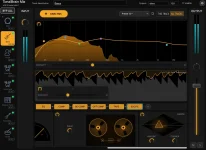
TonalBrain supports up to 24 tracks in one analysis and recommends multitrack sessions rather than finished stereo mixes. You do not need to feed it every channel in a crowded project, but you do need to preserve the musical relationships you want it to judge. A sensible setup starts with the parts that actually compete for space.
The whole-session TonalBrain Mix workflow works best when kick, bass, lead vocal, snare, and other defining elements remain visible as separate inputs. TonalBrain can then compare those sources while setting EQ, compression, de-essing, width, and other processing. Folding everything into a few broad stems too early removes some of the source-level context the system is designed to use.
Start by protecting relationships where one source can mask or overpower another. Kick and bass are an obvious pair, while lead vocal against guitars, synths, or dense backing vocals can matter just as much. Keeping those elements separate gives the analysis distinct sources instead of one premixed block.
The logic behind cross-adaptive multitrack processing is precisely this dependence between sources. Processing decisions for one channel can be informed by features extracted from several others, which is different from treating each track as an isolated problem. TonalBrain uses its own system, but the underlying reason for preserving useful source separation is straightforward.
Not every layer deserves an individual slot. Four stacked claps, several nearly identical percussion loops, or a bank of background textures may already function as one musical object in your arrangement. TonalBrain explicitly recommends bussing layered elements together first, so grouping those parts can save analysis slots without hiding a relationship you actually need the system to inspect.
A percussion stem containing shakers, tambourines, and supporting loops may be perfectly reasonable if those parts already behave as a single layer. Combining kick, bass, and low synth into one stem is a different decision because their internal competition disappears from TonalBrain's view. You can still process the combined result, but the analysis no longer has separate access to each source.
The same principle applies to vocals. A stack of tightly blended backing vocals can make sense as one bus, while the lead usually deserves its own slot because it has a different role and different masking relationships. Large sessions become easier once you stop asking which channels are technically separate and start asking which sounds need separate decisions.
For a clean routing scheme, avoid representing the same musical material as both an individual TonalBrain track and a grouped TonalBrain stem unless you have a deliberate reason. Pick the level at which you want the system to make its decision. Otherwise, you create multiple processing points around overlapping material and make later adjustments harder to reason about.
This matters when the problem lives inside the balance rather than across the finished mix. A buried vocal, crowded low end, or harsh guitar may call for a change to one source instead of a broad move across everything. Stereo mastering tools are built for the latter stage, where the mix balance is largely committed and processing targets the complete program.
You can therefore treat the 24-track ceiling as a selection problem rather than a demand to flatten the session. Keep the sources whose relationships matter, group layers that already behave as one unit, and leave finished stereo mastering to a tool designed for that job. In a large arrangement, preserving the right 20 tracks can reveal more useful context than feeding the system 20 oversized stems.
The whole-session TonalBrain Mix workflow works best when kick, bass, lead vocal, snare, and other defining elements remain visible as separate inputs. TonalBrain can then compare those sources while setting EQ, compression, de-essing, width, and other processing. Folding everything into a few broad stems too early removes some of the source-level context the system is designed to use.
Key tracks deserve their own place in the analysis
A 12-track song is simple. Put TonalBrain on the important channels, analyze the session, and keep the arrangement readable. A 48-track production needs more judgment because treating every doubled vocal, percussion layer, texture, and effect return as equally important would run past the 24-track limit.Start by protecting relationships where one source can mask or overpower another. Kick and bass are an obvious pair, while lead vocal against guitars, synths, or dense backing vocals can matter just as much. Keeping those elements separate gives the analysis distinct sources instead of one premixed block.
The logic behind cross-adaptive multitrack processing is precisely this dependence between sources. Processing decisions for one channel can be informed by features extracted from several others, which is different from treating each track as an isolated problem. TonalBrain uses its own system, but the underlying reason for preserving useful source separation is straightforward.
Not every layer deserves an individual slot. Four stacked claps, several nearly identical percussion loops, or a bank of background textures may already function as one musical object in your arrangement. TonalBrain explicitly recommends bussing layered elements together first, so grouping those parts can save analysis slots without hiding a relationship you actually need the system to inspect.
Stems are useful when they represent one musical job
A stem is not automatically a compromise. TonalBrain says drum buses and other stem groups can be used effectively, which makes them practical in sessions that are already organized around submixes. The useful distinction is whether the stem represents one coherent job or conceals several parts that still need independent balancing.A percussion stem containing shakers, tambourines, and supporting loops may be perfectly reasonable if those parts already behave as a single layer. Combining kick, bass, and low synth into one stem is a different decision because their internal competition disappears from TonalBrain's view. You can still process the combined result, but the analysis no longer has separate access to each source.
The same principle applies to vocals. A stack of tightly blended backing vocals can make sense as one bus, while the lead usually deserves its own slot because it has a different role and different masking relationships. Large sessions become easier once you stop asking which channels are technically separate and start asking which sounds need separate decisions.
For a clean routing scheme, avoid representing the same musical material as both an individual TonalBrain track and a grouped TonalBrain stem unless you have a deliberate reason. Pick the level at which you want the system to make its decision. Otherwise, you create multiple processing points around overlapping material and make later adjustments harder to reason about.
A finished stereo mix removes the context TonalBrain wants
TonalBrain can technically receive a stereo signal, but its own guidance points users toward multitrack sessions and recommends a dedicated mastering tool for completed mixes. Once drums, bass, vocals, and instruments have been summed into one stereo file, the plugin no longer receives those sources as independent participants. It can only process the combined signal presented to it.This matters when the problem lives inside the balance rather than across the finished mix. A buried vocal, crowded low end, or harsh guitar may call for a change to one source instead of a broad move across everything. Stereo mastering tools are built for the latter stage, where the mix balance is largely committed and processing targets the complete program.
You can therefore treat the 24-track ceiling as a selection problem rather than a demand to flatten the session. Keep the sources whose relationships matter, group layers that already behave as one unit, and leave finished stereo mastering to a tool designed for that job. In a large arrangement, preserving the right 20 tracks can reveal more useful context than feeding the system 20 oversized stems.