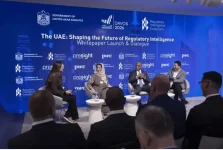
The UAE just turned regulation into an AI-powered live system and is casually pitching it in Davos as homework for everyone else.
UAE turns rules into a live AI system
UAE turns rules into a live AI system
- At the fifty-sixth World Economic Forum Annual Meeting in Davos, attendees are handed a UAE government whitepaper called The UAE Shaping the Future of Regulatory Intelligence, from a static rulebook to a living, AI-powered regulatory ecosystem.
- The launch takes a topic that usually lives in legal backrooms and pushes it into the center of global policy conversation.
- Instead of treating regulation as a fixed stack of text, the document frames it as a responsive ecosystem that belongs in what it calls the Intelligent Age.
- The General Secretariat of the UAE Cabinet sits in the driver's seat, pulling Presight, a G42 company, and PricewaterhouseCoopers into one project team.
- Presight brings the data and AI firepower, while PwC shows up with regulatory design, legal, and consulting experience at a national scale.
- Together, this trio maps out an applied model for a Regulatory Intelligence Ecosystem that relies on data, the vision of UAE leadership, and the values of UAE society.
- In her keynote, Her Excellency Maryam bint Ahmed Al Hammadi describes a world where technology and business models move so fast that old-style regulatory cycles simply cannot keep up.
- She paints the UAE plan as the first living, evolving Regulatory Intelligence Ecosystem, driven by people, constantly adapting, and aimed at a better and more prosperous life for everyone in the UAE.
- The whitepaper is positioned as both visionary and practical, spelling out how an AI-powered regulatory ecosystem can boost government effectiveness and raise the quality of life for residents and businesses.
- She also links the project to the global competitiveness of the UAE, arguing that smarter regulation is part of how the country holds its position on the world stage.
- The speech doubles as an open invitation, asking governments, thought leaders, experts, and private sector pioneers to join a global conversation on responsible innovation.
- From the Presight side, Chief Executive Officer Thomas Pramotedham frames the UAE as acting like an AI native nation rather than a late adopter.
- He describes the new regulatory ecosystem as built on intelligence, adaptability, and trust, setting a benchmark for how governments can use AI to lift public services without losing responsibility.
- His comments focus on a future-focused mindset that refuses to wait for change, instead trying to shape it with a model other countries can study as AI becomes central to governance.
- Hani Ashkar, Middle East Senior Partner at PwC Middle East, presents the collaboration as a world-first initiative that shows how serious the UAE is about intelligence-led regulation.
- From the PwC angle, NewLaw and GenAI capabilities are being applied at a national scale to design an integrated regulatory ecosystem that ties laws, outcomes, and public services into one connected picture.
- PwC describes the endgame as a global benchmark for responsible, future-ready lawmaking rather than a one-off national experiment.
- Readers flipping through the whitepaper run into a Regulatory Intelligence Glossary that is described as the first of its kind.
- That glossary is meant to give legislators, policymakers, and technology developers a shared language and methodology, so everyone stops talking past each other when they deal with regulation and AI.
- The document also introduces a Unified Regulatory Digital Twin, which it describes as a live digital version of the entire UAE regulatory ecosystem.
- In that setup, all components and data sit inside one model that monitors changes in real time, analyzes information, and proposes legislative amendments instead of waiting for slow manual review.
- The same digital twin is expected to interact with services in the field, connect to enforcement and judicial mechanisms, and simulate impacts on the economy and society in real time.
- The whitepaper does not hand regulation over to machines; instead, it presents a Sovereign Governance in the Loop framework that keeps humans in control.
- Under that framework, AI is defined as an assistant rather than a replacement for legislators, so humans remain the decision makers at every critical step from data to final decision.
- The model is explicitly tied back to constitutional principles and the legal system of the UAE, with AI outputs required to stay consistent with that foundation.
- The document also leans into the human side of the Intelligent Age, proposing hybrid roles that blend legal expertise with technology skills for the next generation of professionals.
- To keep the ecosystem evolving in a controlled way, the whitepaper describes a Regulatory Intelligence Innovation Loop that governs how new AI use cases are proposed, evaluated, piloted, and rolled out.
- The UAE positions the Regulatory Intelligence Ecosystem as a globally relevant discipline, not a local experiment, and designs it with openness and interoperability in mind.
- Bilingual accessibility is built into the vision, so the ecosystem can speak to different audiences without losing precision.
- The project is framed as an explicit invitation to international partners who want to work on next-generation, intelligence-led regulation that keeps pace with rapid change.
- Throughout the description, the UAE ties this work back to constitutional principles and the welfare of people, signaling that faster regulation and stronger protections are meant to move together.