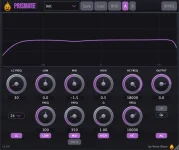
Mäag Audio explicitly states that frequencies below its selected Air Band setting are affected by the shelf’s transitional slope. A 40 kHz label therefore does not mean the EQ somehow waits until 40 kHz before doing anything.
A shelf is a curve, not a frequency gate. Its response moves gradually from one gain region to another, so part of the audible treble can rise even when the control is parked at 20 or 40 kHz. The number on the knob tells you where the filter is referenced, not the first frequency it touches.
This is why a very high shelf can sound gentler than a shelf placed at 8 or 10 kHz. The lower setting pushes more of the audible top end farther up the curve, while a 20 or 40 kHz setting may leave those same frequencies on a shallower section. Less of the presence and lower-treble region gets dragged along.
The printed frequency is also not perfectly interchangeable between different EQs. Developers can define shelf frequency, corner frequency, midpoint, turnover, Q, and slope in different ways, then use different filter topologies behind the control. Copying “20 kHz, plus 3 dB” from one plugin to another does not guarantee the same response.
The engineering definition is less mysterious. Shelving filter transition behavior describes a response that moves continuously between lower and upper gain regions instead of flipping at one frequency. A shelf setting is therefore best treated as a reference for the curve, not a border painted across the spectrum.
Mäag’s own EQ4 documentation is unusually clear on this point. Its Air Band offers settings as high as 40 kHz and explicitly notes that frequencies below the selected shelf point are affected because of the transitional slope. The mechanism already has an ordinary amplitude-response explanation.
Some explanations pin the audible effect mainly on phase rotation below 20 kHz. A minimum-phase shelf can certainly alter phase as its magnitude response changes, but phase is not required to explain why the control changes audible treble. The manufacturer’s stated transition below the selected frequency supplies the simpler mechanism first.
This distinction matters when judging Prismate’s high-frequency EQ controls. Prismate’s main high shelf reaches 20 kHz, while Prismate Raw reduces the idea to one AIR control for fast top-end enhancement. You still need to judge the resulting curve and sound rather than treating the control label as a hard boundary.
A 20 kHz shelf can therefore alter material well below 20 kHz without pretending that your ears suddenly acquired ultrasonic range. How far downward it reaches depends on the filter shape, gain, slope, and implementation. Two plugins carrying the same frequency label can feel surprisingly different for exactly this reason.
An exciter can. Harmonic exciters and saturation-based processors generate new spectral content from lower frequencies, so they can brighten a source whose extreme top end is genuinely sparse. They can also create intermodulation products, aliasing, or an artificial edge when pushed hard, depending on the design.
The distinction becomes useful on dull recordings. If the source already has clean high-frequency information but feels veiled, a broad air shelf may expose what is there with very little fuss. If the recording simply rolls off hard before the top octave, boosting the shelf may mostly raise noise while leaving the wanted sound stubbornly dull.
Air controls also differ in how much level they add overall. A broad high shelf can make a source seem more exciting partly because its total energy rises, especially on cymbals, bright synths, and dense mixes. Level-matched comparison helps separate the tonal change from the easy psychological win of “slightly louder.”
A high shelf set above the obvious treble range is therefore less mysterious than its branding suggests. The useful part lives in the slope, the source material, and the implementation. Once those are separated, a 20 or 40 kHz control stops looking supernatural and starts behaving like what it is: a deliberately broad filter with audible consequences below its printed number.
A shelf is a curve, not a frequency gate. Its response moves gradually from one gain region to another, so part of the audible treble can rise even when the control is parked at 20 or 40 kHz. The number on the knob tells you where the filter is referenced, not the first frequency it touches.
An air shelf starts working before its printed frequency
A high shelf has a transition region where gain changes progressively before the response settles onto its upper plateau. Move the shelf frequency higher and more of that transition moves upward with it. Audible frequencies can still sit on the lower part of the slope.This is why a very high shelf can sound gentler than a shelf placed at 8 or 10 kHz. The lower setting pushes more of the audible top end farther up the curve, while a 20 or 40 kHz setting may leave those same frequencies on a shallower section. Less of the presence and lower-treble region gets dragged along.
The printed frequency is also not perfectly interchangeable between different EQs. Developers can define shelf frequency, corner frequency, midpoint, turnover, Q, and slope in different ways, then use different filter topologies behind the control. Copying “20 kHz, plus 3 dB” from one plugin to another does not guarantee the same response.
The engineering definition is less mysterious. Shelving filter transition behavior describes a response that moves continuously between lower and upper gain regions instead of flipping at one frequency. A shelf setting is therefore best treated as a reference for the curve, not a border painted across the spectrum.
Ultrasonic labels do not require ultrasonic hearing
The familiar 40 kHz Air Band setting causes needless confusion because 40 kHz sits beyond conventional human hearing. None of this requires a listener to perceive a 40 kHz tone. The audible result can come from the portion of the shelf transition that remains below 20 kHz.Mäag’s own EQ4 documentation is unusually clear on this point. Its Air Band offers settings as high as 40 kHz and explicitly notes that frequencies below the selected shelf point are affected because of the transitional slope. The mechanism already has an ordinary amplitude-response explanation.
Some explanations pin the audible effect mainly on phase rotation below 20 kHz. A minimum-phase shelf can certainly alter phase as its magnitude response changes, but phase is not required to explain why the control changes audible treble. The manufacturer’s stated transition below the selected frequency supplies the simpler mechanism first.
This distinction matters when judging Prismate’s high-frequency EQ controls. Prismate’s main high shelf reaches 20 kHz, while Prismate Raw reduces the idea to one AIR control for fast top-end enhancement. You still need to judge the resulting curve and sound rather than treating the control label as a hard boundary.
A 20 kHz shelf can therefore alter material well below 20 kHz without pretending that your ears suddenly acquired ultrasonic range. How far downward it reaches depends on the filter shape, gain, slope, and implementation. Two plugins carrying the same frequency label can feel surprisingly different for exactly this reason.
Air EQ and exciters solve different problems
A shelf can only turn up frequency content that is already present in the signal. If a vocal contains useful breath, harmonics, room detail, microphone noise, or hiss in the upper range, the shelf raises some mixture of those things. It does not manufacture a new octave of sparkle.An exciter can. Harmonic exciters and saturation-based processors generate new spectral content from lower frequencies, so they can brighten a source whose extreme top end is genuinely sparse. They can also create intermodulation products, aliasing, or an artificial edge when pushed hard, depending on the design.
The distinction becomes useful on dull recordings. If the source already has clean high-frequency information but feels veiled, a broad air shelf may expose what is there with very little fuss. If the recording simply rolls off hard before the top octave, boosting the shelf may mostly raise noise while leaving the wanted sound stubbornly dull.
Air controls also differ in how much level they add overall. A broad high shelf can make a source seem more exciting partly because its total energy rises, especially on cymbals, bright synths, and dense mixes. Level-matched comparison helps separate the tonal change from the easy psychological win of “slightly louder.”
A high shelf set above the obvious treble range is therefore less mysterious than its branding suggests. The useful part lives in the slope, the source material, and the implementation. Once those are separated, a 20 or 40 kHz control stops looking supernatural and starts behaving like what it is: a deliberately broad filter with audible consequences below its printed number.