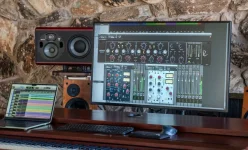
Rupert Neve Designs built the 551 around three EQ bands drawn from different vintage circuits rather than copying a single 1073 topology. The distinction gets lost easily because the 1073 name carries so much weight, and the 551 still sounds and behaves like a deliberate piece of Neve-family engineering. Its lineage is broader, though.
The low band takes its cue from the 1064, the midrange follows the 1073, and the top end uses a newer hybrid design. RND then wrapped those ideas in the hardware 551, which arrived in 2014 as a 500 Series version of the EQ architecture used in the Shelford family. The plug-in recreates that hardware while adding software-only conveniences.
This mixed ancestry matters when you place the 551 beside the three-plugin Rupert Neve Designs launch. You are not getting a vintage console strip with a new faceplate. You are getting a modern EQ whose individual sections deliberately borrow from different chapters of Rupert Neve’s work.
The middle is where the 1073 connection becomes direct. Six switched center frequencies cover 200 Hz through 6 kHz, while the proportional Q becomes narrower as you apply more boost or cut. RND documents a typical Q of about 2 at maximum boost and roughly 3.5 with Hi Q engaged, with the curve widening again at gentler settings, so the band can move from broad tone shaping toward more focused correction without becoming a fully surgical parametric EQ.
RND describes the high band differently again. Its 8 kHz and 16 kHz choices can run as shelves or peaks, but the underlying approach combines inductor and capacitor behavior instead of simply recreating one vintage high-frequency circuit. You can use it for broad lift, a more concentrated upper-band push, or a controlled cut without pretending the section came straight from a 1073.
The fixed 80 Hz high-pass filter adds another modern wrinkle. Pairing it with the low EQ lets you remove sub-bass while still shaping useful weight higher up, which is more flexible than treating the bottom end as one blunt shelf. It is a small control on the panel, but it changes how easily the 551 can clean and rebuild the low end in one pass.
Magnetic-core inductors can introduce nonlinear behavior as signal conditions change, and measured distortion in audio filter inductors gives useful engineering context for why modeling one involves more than tracing a static frequency curve. It does not tell you what a 551 will do to a vocal or drum bus. It does show why an inductor can be part of the behavior, not merely a label on the faceplate.
The plug-in follows the 551 hardware closely enough that RND describes it as a faithful recreation, including modeled inductors, transformers, and Class A gain blocks. Software adds true M/S operation, output control, and input/output metering, so the plug-in is not frozen at the limits of the 500 Series module. Those additions extend routing and control without changing where the EQ bands came from, and in M/S mode channel A handles Mid while channel B handles Side.
RND also places the 551 hardware very close to the EQ used in the Shelford Channel and the penthouse modules of its 5088 console. This placement is more useful than the vague idea of “Neve-style EQ” because it tells you which later RND family the circuit actually belongs to. The 551 sits downstream from the classics, not inside one of them.
Treating it as a 1073 substitute can lead you to the wrong expectations. The low section behaves differently, the high section has its own hybrid design, and the extra curve choices give you moves the old modules were never built to offer. On a dense vocal, bass-heavy drum bus, or full mix, those differences affect how you work long before nostalgia enters the room.
The low band takes its cue from the 1064, the midrange follows the 1073, and the top end uses a newer hybrid design. RND then wrapped those ideas in the hardware 551, which arrived in 2014 as a 500 Series version of the EQ architecture used in the Shelford family. The plug-in recreates that hardware while adding software-only conveniences.
This mixed ancestry matters when you place the 551 beside the three-plugin Rupert Neve Designs launch. You are not getting a vintage console strip with a new faceplate. You are getting a modern EQ whose individual sections deliberately borrow from different chapters of Rupert Neve’s work.
The 551 borrows from more than one Neve design
The 1064 influence lives in the low band. Four selectable frequencies at 35, 60, 100, and 220 Hz give you broad control over weight and body, and the band can operate as either a shelf or a peak. The lower choices reach into deep bass, while 100 and 220 Hz let the same section work higher into punch and body, so the switchable curve already takes the circuit beyond a strict period copy.The middle is where the 1073 connection becomes direct. Six switched center frequencies cover 200 Hz through 6 kHz, while the proportional Q becomes narrower as you apply more boost or cut. RND documents a typical Q of about 2 at maximum boost and roughly 3.5 with Hi Q engaged, with the curve widening again at gentler settings, so the band can move from broad tone shaping toward more focused correction without becoming a fully surgical parametric EQ.
RND describes the high band differently again. Its 8 kHz and 16 kHz choices can run as shelves or peaks, but the underlying approach combines inductor and capacitor behavior instead of simply recreating one vintage high-frequency circuit. You can use it for broad lift, a more concentrated upper-band push, or a controlled cut without pretending the section came straight from a 1073.
The fixed 80 Hz high-pass filter adds another modern wrinkle. Pairing it with the low EQ lets you remove sub-bass while still shaping useful weight higher up, which is more flexible than treating the bottom end as one blunt shelf. It is a small control on the panel, but it changes how easily the 551 can clean and rebuild the low end in one pass.
The circuit choices matter more than the badge
Calling the 551 an inductor EQ can make it sound as though every useful characteristic comes from coils alone. In practice, the design combines inductors, capacitors, transformers, discrete Class A gain stages, switched frequencies, and the surrounding filter topology. RND also says the hardware uses custom-wound inductors rather than generic off-the-shelf parts.Magnetic-core inductors can introduce nonlinear behavior as signal conditions change, and measured distortion in audio filter inductors gives useful engineering context for why modeling one involves more than tracing a static frequency curve. It does not tell you what a 551 will do to a vocal or drum bus. It does show why an inductor can be part of the behavior, not merely a label on the faceplate.
The plug-in follows the 551 hardware closely enough that RND describes it as a faithful recreation, including modeled inductors, transformers, and Class A gain blocks. Software adds true M/S operation, output control, and input/output metering, so the plug-in is not frozen at the limits of the 500 Series module. Those additions extend routing and control without changing where the EQ bands came from, and in M/S mode channel A handles Mid while channel B handles Side.
RND also places the 551 hardware very close to the EQ used in the Shelford Channel and the penthouse modules of its 5088 console. This placement is more useful than the vague idea of “Neve-style EQ” because it tells you which later RND family the circuit actually belongs to. The 551 sits downstream from the classics, not inside one of them.
Treating it as a 1073 substitute can lead you to the wrong expectations. The low section behaves differently, the high section has its own hybrid design, and the extra curve choices give you moves the old modules were never built to offer. On a dense vocal, bass-heavy drum bus, or full mix, those differences affect how you work long before nostalgia enters the room.