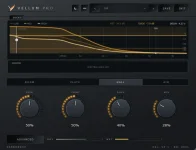
CarbonDSP’s free Vellum and $20 Vellum Pro are separate Windows VST3 reverbs, and the free plugin remains available alongside Pro. The paid version adds far more control, but it does not simply replace the free one for every vocal session.
Free Vellum is still built around a narrow job. You pick Room, Plate, Hall, or Air, then work mainly with Size, Tone, Duck, and Mix while the plugin moves several internal parameters along curated ranges.
The practical split becomes clearer beside Vellum Pro’s frequency-smart reverb design. Pro is designed to handle vocals, drums, bass, guitars, keys, strings, buses, and more, while free Vellum keeps its identity as a voice-first reverb.
Vellum also keeps its ducking straightforward. The wet reverb level drops while the vocal is present, then rises again in the gaps, while the underlying decay continues behind the words. For a lead vocal where you mainly want a stable space and less wash over the lyric, that workflow can be faster than opening a larger system.
Free Vellum has also moved on since its original release. Version 1.1.0 added stereo input, a control for how long the low end rings, and lower CPU use, so choosing the free version does not mean choosing an abandoned first draft.
Its advanced panel still exposes extra offsets plus separate dry and wet trims when the four macros are not enough. You can therefore push past the basic front panel without turning the plugin into the sort of parameter-heavy reverb where every vocal starts with ten minutes of setup.
Its published CPU figure is now about 1.2 percent of one core at 48 kHz. Pro is listed at roughly 0.7 percent under the same sample-rate reference, which is useful context, although those figures should not be treated as a controlled head-to-head benchmark inside every DAW.
This difference matters when you want the room to stay audible during the performance. Broadband ducking can clear a vocal effectively, but it also pulls down bright air, low bloom, and unrelated parts of the reverb whenever the detector reacts.
Pro can leave more of those non-conflicting regions alone. The idea lines up with established work on frequency masking inside multitrack mixes, where competing spectral energy is treated as a frequency-dependent problem rather than a single overall level problem.
Vellum Pro also changes its recovery around consonants. Sharp plosives and sibilants can trigger faster recovery behavior than sustained vocal material, which gives you another route to keeping articulation forward without forcing the entire wet field to breathe at the same rate.
For vocals, this is the real dividing line. Free Vellum is well suited to broad, predictable wet-level ducking, while Pro gives you finer control when you want a long or bright reverb to remain present around the voice instead of disappearing whenever the singer enters.
Pro also separates room size from decay more deliberately and lets you draw decay behavior across six frequency bands. Those controls matter when the same reverb has to move from a vocal to percussion, bass, a mix bus, or a deliberately unnatural sound without carrying a vocal-first set of assumptions into every source.
Impulse-response matching pushes the gap further. Pro can inspect an imported impulse response, estimate traits including decay, predelay, and early-reflection behavior, then move its own algorithmic engine toward the closest fit it can produce rather than turning into a convolution reverb.
None of those additions make the free plugin obsolete for someone who mostly wants a quick vocal room with simple controls. Pro earns the extra complexity when you need spectral ducking, source-dependent behavior, independently shaped decay, or one reverb architecture that can stay useful across most of a session.
Free Vellum is still built around a narrow job. You pick Room, Plate, Hall, or Air, then work mainly with Size, Tone, Duck, and Mix while the plugin moves several internal parameters along curated ranges.
The practical split becomes clearer beside Vellum Pro’s frequency-smart reverb design. Pro is designed to handle vocals, drums, bass, guitars, keys, strings, buses, and more, while free Vellum keeps its identity as a voice-first reverb.
Free Vellum remains deliberately narrow
The free plugin’s simplicity is not just a smaller feature list. Its four front-panel controls are macros, so changing Size or Tone moves several internal values together instead of asking you to build the room one parameter at a time.Vellum also keeps its ducking straightforward. The wet reverb level drops while the vocal is present, then rises again in the gaps, while the underlying decay continues behind the words. For a lead vocal where you mainly want a stable space and less wash over the lyric, that workflow can be faster than opening a larger system.
Free Vellum has also moved on since its original release. Version 1.1.0 added stereo input, a control for how long the low end rings, and lower CPU use, so choosing the free version does not mean choosing an abandoned first draft.
Its advanced panel still exposes extra offsets plus separate dry and wet trims when the four macros are not enough. You can therefore push past the basic front panel without turning the plugin into the sort of parameter-heavy reverb where every vocal starts with ten minutes of setup.
Its published CPU figure is now about 1.2 percent of one core at 48 kHz. Pro is listed at roughly 0.7 percent under the same sample-rate reference, which is useful context, although those figures should not be treated as a controlled head-to-head benchmark inside every DAW.
Vellum Pro changes what ducking can leave untouched
The main upgrade is not simply “more ducking.” Free Vellum lowers the finished wet return as one signal, while Pro measures where the source and reverb are competing and reduces the tail only in the relevant frequency regions.This difference matters when you want the room to stay audible during the performance. Broadband ducking can clear a vocal effectively, but it also pulls down bright air, low bloom, and unrelated parts of the reverb whenever the detector reacts.
Pro can leave more of those non-conflicting regions alone. The idea lines up with established work on frequency masking inside multitrack mixes, where competing spectral energy is treated as a frequency-dependent problem rather than a single overall level problem.
Vellum Pro also changes its recovery around consonants. Sharp plosives and sibilants can trigger faster recovery behavior than sustained vocal material, which gives you another route to keeping articulation forward without forcing the entire wet field to breathe at the same rate.
For vocals, this is the real dividing line. Free Vellum is well suited to broad, predictable wet-level ducking, while Pro gives you finer control when you want a long or bright reverb to remain present around the voice instead of disappearing whenever the singer enters.
Pro becomes more useful once the session gets wider
Seven source engines are the other major break from the free version. Voice, Drums, Bass and Low, Guitar and Keys, Strings and Orchestral, Bus and Glue, and Design alter how the controls behave internally, while Auto can suggest an engine without switching it for you.Pro also separates room size from decay more deliberately and lets you draw decay behavior across six frequency bands. Those controls matter when the same reverb has to move from a vocal to percussion, bass, a mix bus, or a deliberately unnatural sound without carrying a vocal-first set of assumptions into every source.
Impulse-response matching pushes the gap further. Pro can inspect an imported impulse response, estimate traits including decay, predelay, and early-reflection behavior, then move its own algorithmic engine toward the closest fit it can produce rather than turning into a convolution reverb.
None of those additions make the free plugin obsolete for someone who mostly wants a quick vocal room with simple controls. Pro earns the extra complexity when you need spectral ducking, source-dependent behavior, independently shaped decay, or one reverb architecture that can stay useful across most of a session.