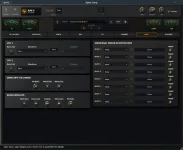
Apex Amp’s Turbo Synth PRO is a 50-parameter synth engine that sits directly inside the plugin’s guitar signal chain. It takes guitar input into a multi-oscillator section rather than requiring a MIDI pickup, keyboard, or separate guitar-to-MIDI box.
Your dry signal reaches the synth before the tube preamp and cabinet stages in Apex’s published routing. The Apex Amp v1.2.0 update fixed hanging synth notes when DAW transport stops, but the more useful story is how much control sits behind those notes while playback is running.
Turbo Synth can behave like a separate instrument or become part of the guitar rig itself. Apex provides parallel and serial routing choices, several response modes, dual oscillators, a sub-harmonic layer, filtering, modulation, chord generation, and a synced arpeggiator.
Dynamic Envelope Follower mode follows the incoming performance rather than forcing every note into the same fixed contour. Static ADSR Gate gives you the more familiar attack, decay, sustain, and release behavior of a keyboard synth, while Pizzicato Pluck uses an adjustable short decay for clipped, percussive voices.
Those choices matter before you touch oscillator waveforms. A sustained lead patch needs a very different response from a kalimba-like pluck, even if both start from the same guitar note and use the same oscillator pitch.
Clean input becomes useful here for a practical reason. A guitar synth driven from audio has to interpret a performance that contains pick transients, string noise, vibrato, slides, and overlapping decay. Keeping unwanted strings quiet gives the tracker a simpler signal to work from, especially on parts where the synth sound needs crisp starts.
Pitch bends also remain part of the performance instead of becoming fixed MIDI notes entered on a grid. Apex demonstrates real-time pitch movement from the guitar, which makes slides and bends useful sound-design controls rather than details that must be recreated later.
Apex identifies those main oscillator shapes as anti-aliased PolyBLEP waveforms. Research on band-limited oscillator design shows why this matters, since PolyBLEP methods reduce aliasing around discontinuities in digitally generated waveforms such as saw and square waves.
The distinction is audible when brighter synth tones climb the neck. A raw digital saw can throw unwanted mirrored frequencies into the signal, while band-limited generation is designed to control those artifacts before filters or effects try to hide them.
Oscillator choice is only the starting layer. Turbo Synth also includes a state-variable morph filter, hard sync, linear FM, wavefolding, ring modulation, unison detune, and a modulation matrix that can route oscillator and envelope movement into other synth parameters.
The sub layer is useful when the guitar part needs weight without asking the amp section to manufacture it through extra gain. Noise can handle attacks, grit, or synthetic percussion, while the two main oscillators carry the pitched body of the sound.
Studio Split is the cleaner choice when you want a recognizable guitar tone beside a synth layer. Independent synth level, pan, voice width, clean DI blend, and mic panning let you build separation without printing two unrelated performances.
Stompbox mode is rougher by design. Feeding the synth into the tube path lets the preamp, power section, cabinet, and later effects reshape the generated voice along with the rest of the rig, so distortion becomes part of the synth tone rather than a parallel guitar sound.
The auto-chord harmonizer pushes the engine further from ordinary pitch tracking. A single played note can generate power chords, major or minor voicings, seventh chords, or octave stacks, while the arpeggiator can turn those generated notes into tempo-synced patterns.
Start with one oscillator, no harmonizer, and a simple response mode when tracking feels unclear. Add the second oscillator, chord generation, or arpeggiation only after the basic note response feels dependable, because each layer makes it harder to hear whether a problem began with the performance, the tracker, or the synth patch.
Your dry signal reaches the synth before the tube preamp and cabinet stages in Apex’s published routing. The Apex Amp v1.2.0 update fixed hanging synth notes when DAW transport stops, but the more useful story is how much control sits behind those notes while playback is running.
Turbo Synth can behave like a separate instrument or become part of the guitar rig itself. Apex provides parallel and serial routing choices, several response modes, dual oscillators, a sub-harmonic layer, filtering, modulation, chord generation, and a synced arpeggiator.
Dry guitar input controls more than pitch
Apex describes Turbo Synth as using real-time pitch tracking from the guitar signal, with no special pickup required. Playing a note gives the engine pitch information, but the response section also decides how the synth reacts to the shape of what you play.Dynamic Envelope Follower mode follows the incoming performance rather than forcing every note into the same fixed contour. Static ADSR Gate gives you the more familiar attack, decay, sustain, and release behavior of a keyboard synth, while Pizzicato Pluck uses an adjustable short decay for clipped, percussive voices.
Those choices matter before you touch oscillator waveforms. A sustained lead patch needs a very different response from a kalimba-like pluck, even if both start from the same guitar note and use the same oscillator pitch.
Clean input becomes useful here for a practical reason. A guitar synth driven from audio has to interpret a performance that contains pick transients, string noise, vibrato, slides, and overlapping decay. Keeping unwanted strings quiet gives the tracker a simpler signal to work from, especially on parts where the synth sound needs crisp starts.
Pitch bends also remain part of the performance instead of becoming fixed MIDI notes entered on a grid. Apex demonstrates real-time pitch movement from the guitar, which makes slides and bends useful sound-design controls rather than details that must be recreated later.
PolyBLEP oscillators build the actual synth voice
Turbo Synth does not simply pitch-shift your guitar and call the result synthesis. Its engine includes OSC 1, OSC 2, a sub-harmonic stack, and noise, with nine oscillator shapes including saw, square, pulse, triangle, sine, ramp, DoubleSaw, Supersaw, and trapezoid.Apex identifies those main oscillator shapes as anti-aliased PolyBLEP waveforms. Research on band-limited oscillator design shows why this matters, since PolyBLEP methods reduce aliasing around discontinuities in digitally generated waveforms such as saw and square waves.
The distinction is audible when brighter synth tones climb the neck. A raw digital saw can throw unwanted mirrored frequencies into the signal, while band-limited generation is designed to control those artifacts before filters or effects try to hide them.
Oscillator choice is only the starting layer. Turbo Synth also includes a state-variable morph filter, hard sync, linear FM, wavefolding, ring modulation, unison detune, and a modulation matrix that can route oscillator and envelope movement into other synth parameters.
The sub layer is useful when the guitar part needs weight without asking the amp section to manufacture it through extra gain. Noise can handle attacks, grit, or synthetic percussion, while the two main oscillators carry the pitched body of the sound.
Routing decides whether the guitar stays separate
Apex gives Turbo Synth two routing modes that change its role considerably. Studio Split keeps the amped guitar and stereo synth as parallel streams, while Stompbox mode places the synth in a serial front-of-tube path before the amp.Studio Split is the cleaner choice when you want a recognizable guitar tone beside a synth layer. Independent synth level, pan, voice width, clean DI blend, and mic panning let you build separation without printing two unrelated performances.
Stompbox mode is rougher by design. Feeding the synth into the tube path lets the preamp, power section, cabinet, and later effects reshape the generated voice along with the rest of the rig, so distortion becomes part of the synth tone rather than a parallel guitar sound.
The auto-chord harmonizer pushes the engine further from ordinary pitch tracking. A single played note can generate power chords, major or minor voicings, seventh chords, or octave stacks, while the arpeggiator can turn those generated notes into tempo-synced patterns.
Start with one oscillator, no harmonizer, and a simple response mode when tracking feels unclear. Add the second oscillator, chord generation, or arpeggiation only after the basic note response feels dependable, because each layer makes it harder to hear whether a problem began with the performance, the tracker, or the synth patch.