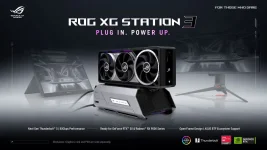
ASUS has introduced the ROG XG Station 3, an external GPU dock that lets compatible laptops use desktop graphics cards over Thunderbolt 5. Its open-frame design puts the GPU on show, while the connection offers up to 80Gbps of data transfer in both directions.
Bandwidth Boost raises the stated limit to 120Gbps for heavy video traffic. That gives the dock a fast link to the laptop, though ASUS has not shared benchmark results that show how much graphics speed users gain.
And the GPU support is fairly broad. NVIDIA GeForce RTX 50 and RTX PRO 6000 cards are on the list, along with AMD Radeon RX 9000 and Intel Arc models. Buyers still need to check exact card compatibility before building a setup.
There's a special feature for ASUS BTF hardware as well. The dock has a GC-HPWR slot that can feed power to supported BTF 2.5 graphics cards, with RTX 5080 and RTX 5090 variants among the examples.
That setup removes the need for a visible PCIe power lead on those cards. Regular GPUs still work with the dock, but their cables remain exposed due to the open layout.
Laptop charging gets a useful boost. The main Thunderbolt 5 connection can deliver up to 140W through USB Power Delivery, letting compatible notebooks draw power from the dock while using its graphics link.
A second Thunderbolt 5 port can feed accessories with up to 36W. It also supports a chain of three 4K displays, giving users a way to run several screens from their desk setup.
Peripheral access is covered by two USB-C connections on the front. Each offers 10Gbps transfer speeds, making them handy for external drives and other devices.
ASUS has added Aura Sync lighting as well. Paired with the exposed GPU, it gives the XG Station 3 a look aimed at users who want their desktop hardware visible rather than hidden inside a closed case.
But one great detail is still missing. ASUS has not stated the dock's power supply rating or given a minimum PSU requirement. That matters because high-end graphics cards can draw a lot of power under load.
The announcement also leaves the full setup requirements unclear. Buyers will need more details on power hardware and supported GPU models before choosing parts for the dock.
Another catch is the external connection itself. Thunderbolt 5 has plenty of bandwidth, but it cannot guarantee that a graphics card will match its performance when installed directly on a desktop motherboard.
Actual results will depend on the laptop, graphics card, drivers, and type of task. Gaming, video work, and other GPU-heavy jobs may each react differently to the external link.
For people who travel with a laptop but want more graphics power at their desk, the XG Station 3 offers a way to use one computer in both settings. The extra display connections and laptop charging help make that setup practical.
ASUS has not given a retail price or release schedule. Until those details and independent tests arrive, the dock's hardware features are clear, but its overall cost and real-world performance remain open questions.