Dolby Atmos loudness is measured from a dedicated 5.1 loudness re-render, not directly from the full immersive speaker feed you are monitoring. This distinction matters because delivery metering and level-matched listening solve different problems, even when both involve numbers that look like loudness.
A comparison tool tries to stop louder from winning during a listening judgment. Delivery metering checks whether the finished Atmos program meets a defined measurement method after the renderer has turned beds and objects into a known channel layout. Mixing the two jobs together can leave you with a fair A/B test and the wrong delivery reading.
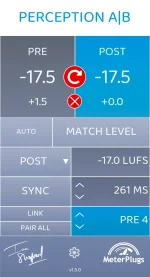
A level-matched Perception AB listening chain can tell you whether processing genuinely improves the sound without a level jump steering your ears. It cannot replace the Atmos loudness pass, because the delivery figure comes from a specific render path with its own rules.
Dolby uses a dedicated 5.1 loudness re-render for this job. The complete Atmos mix is rendered to that 5.1 path and then measured with standard loudness algorithms. The principle lines up with rendered immersive loudness measurement, where object-based material is evaluated after rendering rather than by treating the raw objects as conventional channels.
This is why a meter sitting on a random 7.1.4 bus is not automatically measuring Atmos delivery loudness. It may be showing a perfectly valid reading for that bus, but it is measuring whatever reaches that point rather than the dedicated render Dolby uses for the master. The same warning applies to a stereo or binaural monitor feed.
For Atmos music, Dolby's current guidance lists -18 dB LKFS integrated and a maximum true peak of -1 dBTP. Integrated means the program is measured over its complete duration rather than judged from the loudest short section. Post-production, podcasts, and other deliverables can use different targets, so the destination specification still controls the final pass.
The loudness re-render includes limiting intended to reflect the relevant encoding behavior. A regular 5.1 re-render can therefore produce a different true-peak value, especially when the signal is close to the ceiling. Feeding the normal 5.1 output into a third-party meter may look sensible while quietly creating a QC mismatch.
This detail matters when you leave the Dolby Atmos Renderer and meter in another application. Dolby's documented workflow is to route the dedicated 5.1 loudness re-render to the meter, not simply grab any available 5.1 output. Integrated loudness and true peak should be checked from the intended measurement path.
The LFE channel adds another trap. Under the BS.1770 method used for Atmos loudness, LFE content is not included in the loudness calculation. A heavy LFE passage can therefore sound physically substantial in the room without pushing the integrated reading in the way an equally strong main-channel signal would.
The delivery meter answers a narrower question. It tells you how the rendered master behaves under the required loudness method, not whether your compressor, EQ, saturation stage, or immersive bus treatment improved the mix. One measurement protects the listening decision, while the other protects the deliverable.
Keep both stages separate in practice. Match Pre and Post while making processing choices, then measure the finished Atmos master through the dedicated loudness path with the final render settings in place. If the delivery reading misses the required ceiling, change the master deliberately and repeat the measurement rather than treating the earlier A/B match as proof of compliance.
A comparison tool tries to stop louder from winning during a listening judgment. Delivery metering checks whether the finished Atmos program meets a defined measurement method after the renderer has turned beds and objects into a known channel layout. Mixing the two jobs together can leave you with a fair A/B test and the wrong delivery reading.
A level-matched Perception AB listening chain can tell you whether processing genuinely improves the sound without a level jump steering your ears. It cannot replace the Atmos loudness pass, because the delivery figure comes from a specific render path with its own rules.
Atmos loudness starts after rendering
Object-based material does not begin as one fixed set of loudspeaker channels. Beds, objects, positions, trims, and render settings all contribute to what the listener eventually receives, so loudness measurement needs a stable reference output rather than an arbitrary point inside the mix.Dolby uses a dedicated 5.1 loudness re-render for this job. The complete Atmos mix is rendered to that 5.1 path and then measured with standard loudness algorithms. The principle lines up with rendered immersive loudness measurement, where object-based material is evaluated after rendering rather than by treating the raw objects as conventional channels.
This is why a meter sitting on a random 7.1.4 bus is not automatically measuring Atmos delivery loudness. It may be showing a perfectly valid reading for that bus, but it is measuring whatever reaches that point rather than the dedicated render Dolby uses for the master. The same warning applies to a stereo or binaural monitor feed.
For Atmos music, Dolby's current guidance lists -18 dB LKFS integrated and a maximum true peak of -1 dBTP. Integrated means the program is measured over its complete duration rather than judged from the loudest short section. Post-production, podcasts, and other deliverables can use different targets, so the destination specification still controls the final pass.
The loudness re-render is not ordinary 5.1
A standard 5.1 re-render and the 5.1 loudness re-render can come from the same Atmos master and still produce different metering results. Dolby built the loudness version specifically to keep measurements made with external meters aligned with measurements used in its encoding workflow.The loudness re-render includes limiting intended to reflect the relevant encoding behavior. A regular 5.1 re-render can therefore produce a different true-peak value, especially when the signal is close to the ceiling. Feeding the normal 5.1 output into a third-party meter may look sensible while quietly creating a QC mismatch.
This detail matters when you leave the Dolby Atmos Renderer and meter in another application. Dolby's documented workflow is to route the dedicated 5.1 loudness re-render to the meter, not simply grab any available 5.1 output. Integrated loudness and true peak should be checked from the intended measurement path.
The LFE channel adds another trap. Under the BS.1770 method used for Atmos loudness, LFE content is not included in the loudness calculation. A heavy LFE passage can therefore sound physically substantial in the room without pushing the integrated reading in the way an equally strong main-channel signal would.
Level matching still belongs earlier in the decision
A/B level matching remains useful because processing often changes gain before it changes quality. A limiter that comes back louder can feel more exciting, while an EQ move with a small gain increase can appear clearer even when the tonal decision itself is worse. Matching those states lets you judge the processing without confusing preference with level.The delivery meter answers a narrower question. It tells you how the rendered master behaves under the required loudness method, not whether your compressor, EQ, saturation stage, or immersive bus treatment improved the mix. One measurement protects the listening decision, while the other protects the deliverable.
Keep both stages separate in practice. Match Pre and Post while making processing choices, then measure the finished Atmos master through the dedicated loudness path with the final render settings in place. If the delivery reading misses the required ceiling, change the master deliberately and repeat the measurement rather than treating the earlier A/B match as proof of compliance.