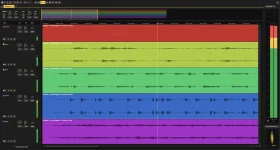
Acoustica 8's AudioFill replaces a selected damaged region with an estimate built from the audio immediately before and after it. The tool is meant for clicks, discontinuities, and other short impulsive problems, but version 8's rebuilt interpolation can handle larger gaps than before.
The useful part is not simply that AudioFill can generate more material. Acoustica 8's rebuilt audio repair system gives you two source modes, Music and Speech, while Acon still tells you to select the shortest region that fully contains the defect. Selection discipline matters because every extra millisecond asks the algorithm to invent more of something you actually wanted to preserve.
Zooming in is worth the trouble. A sharp digital tick, edit discontinuity, mouth click, or tiny dropout can look insignificant at normal timeline scale, yet the damaged samples may occupy only a sliver of what you first highlighted. Repairing the whole visible bump can soften a transient or alter the shape of a consonant even when the obvious defect disappears.
The same logic applies when version 8 succeeds on a longer damaged section. Larger capacity does not turn AudioFill into a license to select generously. Research on audio inpainting for missing signal regions treats damaged samples as missing information that must be reconstructed from surrounding structure, which is exactly why preserving as much original audio as possible remains sensible.
You also need clean boundaries. If the selection starts halfway through a drum attack or ends inside a strong vocal transition, the material surrounding the gap may describe two very different events. Moving the edges closer to the actual defect can give the repair a much more coherent neighborhood without changing any processing setting.
Speech mode is the obvious first choice for spoken-word repairs, but keep the job local. Removing a mouth click between syllables is a very different task from replacing a missing word, and interpolation cannot recover linguistic information that no longer exists. A plausible texture is not the same thing as reconstructing the original performance.
Music mode has a similar boundary. It can repair a click across a held note, a short glitch in ambience, or another localized interruption where the surrounding signal contains useful continuity. A gap that wipes out a unique snare hit, chord change, or melodic event asks for information the neighboring audio may not contain.
Longer repairs deserve an audition in context rather than solo. A filled region can sound smooth by itself yet disturb timing, stereo movement, room decay, or the attack pattern once playback crosses the edit. Listen through the transition at normal speed, then compare against nearby repetitions if the material has them.
Manual drawing is useful when the defect is tiny, and AudioFill keeps changing too much around it. Instead of asking an algorithm to estimate a replacement region, you can redraw a few troublesome samples so the waveform crosses the damaged spot without the abrupt discontinuity that caused the click.
The method is deliberately narrow. Hand-drawing several milliseconds of complex music or speech quickly becomes guesswork, and matching stereo channels by eye adds another chance to create an imbalance. Its strength is microscopic correction, not rebuilding meaningful missing content.
AudioFill also pairs naturally with Acoustica 8's Find Similar Event tool when the same short defect repeats through a recording. Find Similar can locate matching events and preserve the original selection shape as it moves between them, letting you inspect repeated clicks before applying the same repair process. A higher tolerance finds looser matches, so checking what it selected matters before processing every occurrence at once.
When a repair still sounds wrong, shrinking the selection is usually more informative than repeatedly changing modes. If both Speech and Music fail on the same tiny region, waveform drawing gives you a controlled fallback without replacing clean audio on either side.
The useful part is not simply that AudioFill can generate more material. Acoustica 8's rebuilt audio repair system gives you two source modes, Music and Speech, while Acon still tells you to select the shortest region that fully contains the defect. Selection discipline matters because every extra millisecond asks the algorithm to invent more of something you actually wanted to preserve.
Short selections give AudioFill better evidence
AudioFill works from context on both sides of the selection. If a click lasts only a few milliseconds, grabbing half a second around it throws away clean information and makes the repair unnecessarily ambitious. A tighter selection leaves more trustworthy audio at the boundaries and gives the interpolation less missing material to reconstruct.Zooming in is worth the trouble. A sharp digital tick, edit discontinuity, mouth click, or tiny dropout can look insignificant at normal timeline scale, yet the damaged samples may occupy only a sliver of what you first highlighted. Repairing the whole visible bump can soften a transient or alter the shape of a consonant even when the obvious defect disappears.
The same logic applies when version 8 succeeds on a longer damaged section. Larger capacity does not turn AudioFill into a license to select generously. Research on audio inpainting for missing signal regions treats damaged samples as missing information that must be reconstructed from surrounding structure, which is exactly why preserving as much original audio as possible remains sensible.
You also need clean boundaries. If the selection starts halfway through a drum attack or ends inside a strong vocal transition, the material surrounding the gap may describe two very different events. Moving the edges closer to the actual defect can give the repair a much more coherent neighborhood without changing any processing setting.
Speech and Music modes need different expectations
AudioFill has separate Speech and Music modes because the source material behaves differently over time. Speech contains rapidly changing consonants, vowels, pauses, and pitch movement, while music can contain sustained tones, percussion, harmony, dense mixes, or repeating textures. Choosing the matching mode gives the algorithm the source assumption Acon was designed for.Speech mode is the obvious first choice for spoken-word repairs, but keep the job local. Removing a mouth click between syllables is a very different task from replacing a missing word, and interpolation cannot recover linguistic information that no longer exists. A plausible texture is not the same thing as reconstructing the original performance.
Music mode has a similar boundary. It can repair a click across a held note, a short glitch in ambience, or another localized interruption where the surrounding signal contains useful continuity. A gap that wipes out a unique snare hit, chord change, or melodic event asks for information the neighboring audio may not contain.
Longer repairs deserve an audition in context rather than solo. A filled region can sound smooth by itself yet disturb timing, stereo movement, room decay, or the attack pattern once playback crosses the edit. Listen through the transition at normal speed, then compare against nearby repetitions if the material has them.
Manual waveform repair still matters
Acon still keeps freehand waveform drawing in Acoustica 8 and explicitly positions it as a last resort when automatic interpolation does not behave as expected. The pencil only becomes usable after you zoom into a very short time span where individual waveform detail can be edited directly.Manual drawing is useful when the defect is tiny, and AudioFill keeps changing too much around it. Instead of asking an algorithm to estimate a replacement region, you can redraw a few troublesome samples so the waveform crosses the damaged spot without the abrupt discontinuity that caused the click.
The method is deliberately narrow. Hand-drawing several milliseconds of complex music or speech quickly becomes guesswork, and matching stereo channels by eye adds another chance to create an imbalance. Its strength is microscopic correction, not rebuilding meaningful missing content.
AudioFill also pairs naturally with Acoustica 8's Find Similar Event tool when the same short defect repeats through a recording. Find Similar can locate matching events and preserve the original selection shape as it moves between them, letting you inspect repeated clicks before applying the same repair process. A higher tolerance finds looser matches, so checking what it selected matters before processing every occurrence at once.
When a repair still sounds wrong, shrinking the selection is usually more informative than repeatedly changing modes. If both Speech and Music fail on the same tiny region, waveform drawing gives you a controlled fallback without replacing clean audio on either side.