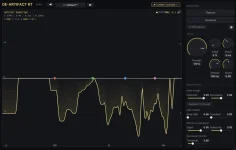
Intrect splits incoming audio into harmonic and percussive streams before its model decides what artifact energy to subtract from each side. The distinction matters because a smeared vocal sustain and a crackly snare hit are not the same cleanup job, even when both sound rough.
The useful bit inside de-artifact’s harmonic and percussive controls is not extra complexity for its own sake. Harmonic strength leans into vocals, synths, pads, and held notes, while Percussive strength leans into drums, clicks, attacks, and other fast events.
You can leave both at the default and get sensible results on a lot of material. Problems start when one half of the mix is obviously dirtier than the other and you keep raising global Strength anyway.
A held synth chord gives the harmonic side something fairly stable to follow. A snare crack is brief and broadband, so it lands much more naturally on the percussive side. This is why watery vocals often respond better to more Harmonic reduction than to simply hammering the whole signal.
Percussion has its own failure mode. Metallic hi-hat fizz, brittle claps, and crackle around a snare attack can need more Percussive reduction, but the wanted transient lives in the same neighborhood. Push too far, and the kit stops sounding clean and starts sounding sanded down.
The distinction gets messy with instruments that do both jobs. Piano has a sharp attack followed by a sustained note, guitars have pick noise plus harmonic decay, and vocals carry consonants before vowels. HPSS is sorting behavior, not reading instrument labels.
Noise also refuses to behave neatly. Material that is neither clearly horizontal nor clearly vertical in a spectrogram can spill into both sides, which is why a technically stronger split does not automatically mean a more natural result.
Strong is not a quality switch. If Normal already puts the ugly sustain where Harmonic can catch it and keeps the drum attack intact, changing modes just because Strong sounds more serious is busywork.
Use it when the controls feel strangely coupled. A good clue is raising Harmonic to fix a smeared vocal and hearing the snare lose edge at the same time, or raising Percussive for cymbal grit and noticing the vocal suddenly gets thinner.
Once the split behaves better, leave global Strength alone for a moment. Fix the side that actually needs help, then check the residual. If drum hits, vocal body, or bass fundamentals become easy to follow there, the setting has gone past cleanup.
Dense reverbs deserve extra caution. A long bright tail can look sustained enough to lean harmonic, while its early reflections contain transient energy. Cleaning one side aggressively can change the shape of the space even when the dry sound survives.
This matters most when the snare gets smaller before the crackle is actually gone. Raising Percussive again usually makes the trade worse. More transient protection can preserve the front of the hit while letting the model keep working on the brittle residue around it.
The reverse applies to smeared pads, vocals, and synth sustains. Those sounds usually do not need extra transient protection to solve their main problem, so the cleaner move is often a Harmonic adjustment, followed by a residual check and a normal bypass comparison.
A mixed master needs restraint because both streams contain useful information at once. Start close to the default, move Harmonic or Percussive only when you can name the defect, and stop when the unwanted texture drops below the point where you notice it in the song.
The useful bit inside de-artifact’s harmonic and percussive controls is not extra complexity for its own sake. Harmonic strength leans into vocals, synths, pads, and held notes, while Percussive strength leans into drums, clicks, attacks, and other fast events.
You can leave both at the default and get sensible results on a lot of material. Problems start when one half of the mix is obviously dirtier than the other and you keep raising global Strength anyway.
Sustains and attacks leave different spectral shapes
HPSS works because sustained pitched material tends to run across time, while short percussive events spread energy quickly across frequencies. The classic median-filter harmonic and percussive split uses those different shapes to build masks for each component.A held synth chord gives the harmonic side something fairly stable to follow. A snare crack is brief and broadband, so it lands much more naturally on the percussive side. This is why watery vocals often respond better to more Harmonic reduction than to simply hammering the whole signal.
Percussion has its own failure mode. Metallic hi-hat fizz, brittle claps, and crackle around a snare attack can need more Percussive reduction, but the wanted transient lives in the same neighborhood. Push too far, and the kit stops sounding clean and starts sounding sanded down.
The distinction gets messy with instruments that do both jobs. Piano has a sharp attack followed by a sustained note, guitars have pick noise plus harmonic decay, and vocals carry consonants before vowels. HPSS is sorting behavior, not reading instrument labels.
Noise also refuses to behave neatly. Material that is neither clearly horizontal nor clearly vertical in a spectrogram can spill into both sides, which is why a technically stronger split does not automatically mean a more natural result.
Strong separation helps when a dense mix blurs the split
De-artifact offers Normal and Strong separation, using wider median filtering in Strong mode so the harmonic and percussive controls land more precisely. On a crowded mix, this can make a useful difference because hats, vocals, synths, and reverbs are all competing in the same upper spectrum.Strong is not a quality switch. If Normal already puts the ugly sustain where Harmonic can catch it and keeps the drum attack intact, changing modes just because Strong sounds more serious is busywork.
Use it when the controls feel strangely coupled. A good clue is raising Harmonic to fix a smeared vocal and hearing the snare lose edge at the same time, or raising Percussive for cymbal grit and noticing the vocal suddenly gets thinner.
Once the split behaves better, leave global Strength alone for a moment. Fix the side that actually needs help, then check the residual. If drum hits, vocal body, or bass fundamentals become easy to follow there, the setting has gone past cleanup.
Dense reverbs deserve extra caution. A long bright tail can look sustained enough to lean harmonic, while its early reflections contain transient energy. Cleaning one side aggressively can change the shape of the space even when the dry sound survives.
Transient protection matters more on drum-heavy material
De-artifact has a separate Transient control because percussive cleanup has an obvious failure point. Sudden level jumps are part of the musical event, so the plug-in can back reduction away from them rather than treating every sharp edge as disposable artifact energy.This matters most when the snare gets smaller before the crackle is actually gone. Raising Percussive again usually makes the trade worse. More transient protection can preserve the front of the hit while letting the model keep working on the brittle residue around it.
The reverse applies to smeared pads, vocals, and synth sustains. Those sounds usually do not need extra transient protection to solve their main problem, so the cleaner move is often a Harmonic adjustment, followed by a residual check and a normal bypass comparison.
A mixed master needs restraint because both streams contain useful information at once. Start close to the default, move Harmonic or Percussive only when you can name the defect, and stop when the unwanted texture drops below the point where you notice it in the song.