Bitcrusher processor order can change the result because each stage receives whatever the previous stage already altered, mixed, filtered, or held. Reusing the same knob values does not guarantee the same output once the signal path changes.
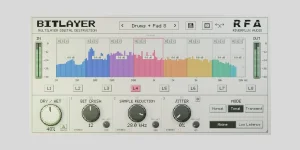
BITLAYER makes this unusually visible because its bit depth, sample-rate, and jitter processors can be reordered inside each band. The BITLAYER multiband degradation stages also have individual mixing controls, so the next processor may receive a blend rather than a completely crushed signal.
There is one boring but important caveat. Processor order is not automatically audible just because two blocks changed places, and a simple bitcrusher can contain operations that sometimes give the same numbers either way.
Flip the order, and the quantizer receives only the values the rate reducer kept. With those simplified operations, the retained samples can land on the same quantized values, so bit depth before sample rate reduction may sound identical to sample rate reduction before bit depth.
Real processors often stop being this tidy. A rate reducer may filter before decimation, interpolate between samples, smooth held values, or use another anti-aliasing scheme. Quantization can also sit beside clipping, gain, dither, or a wet-dry blend instead of acting as one isolated rounding step.
Once a nonlinear stage creates new spectral content, later filtering and resampling have something different to work on. Antialiasing work on nonlinear audio processing documents the broader problem clearly, since nonlinear processing can expand bandwidth and create components that alias in a discrete-time system.
A filter before a nonlinear stage only removes content that existed before the distortion. Put comparable filtering afterward and it can also remove some of the new high-frequency material created by the nonlinear operation. Same controls, different job.
If you need the distinction first, bitcrusher jitter changes timing rather than sample rate. In a reordered chain, the useful question becomes what signal the jitter stage is disturbing and what the next processor does with those irregularly timed values.
Jitter before sample rate reduction can feed an already unstable sequence into a regular rate-reduction stage. Put the fixed reduction first and the jitter processor instead works from material whose update pattern has already been simplified. The exact difference depends on how the plugin implements both stages, so there is no honest universal claim that one order is always rougher.
Per-processor mix matters here too. A processor at 50 percent is not merely doing half as much math. It is blending altered and less-altered material before the next stage sees the signal, which changes the next processor's input even when its own control value stays fixed.
BITLAYER's public descriptions confirm reorderable bit depth, sample-rate, and jitter stages, but they do not publish the internal DSP equations. Treat the order control as something to audition rather than a promise that a specific sequence always creates a specific artifact.
Start with a source that makes the artifact obvious. Bright percussion, a sustained synth with upper harmonics, or a bass with a clean attack gives you more useful evidence than a full mix where five other things can hide the difference.
Listen for changes in the attack, the stability of ringing tones, the amount of high-frequency spray, and whether the texture repeats predictably. Level-match the versions as closely as practical because a brighter or denser chain can seem better simply because it feels louder.
Extreme settings make the difference easier to locate, but they are not where you have to leave it. Once one order produces the behavior you actually want, back the bit depth, sample-rate reduction, or jitter toward the point where the source still reads clearly.
Processor order earns its keep when it solves a specific problem. If two arrangements sound the same, keep the simpler decision and move on. If one preserves the attack while another smears it, or one turns a stable alias tone into a rougher texture, the chain has given you a real reason to care about the order.
BITLAYER makes this unusually visible because its bit depth, sample-rate, and jitter processors can be reordered inside each band. The BITLAYER multiband degradation stages also have individual mixing controls, so the next processor may receive a blend rather than a completely crushed signal.
There is one boring but important caveat. Processor order is not automatically audible just because two blocks changed places, and a simple bitcrusher can contain operations that sometimes give the same numbers either way.
Simple crusher stages can sometimes commute
Imagine a basic quantizer that only snaps each sample to a fixed amplitude grid. Pair it with a crude rate reducer that simply keeps every nth sample and holds the value until the next update. Put bit depth before sample rate reduction, and the rate reducer keeps already-quantized values.Flip the order, and the quantizer receives only the values the rate reducer kept. With those simplified operations, the retained samples can land on the same quantized values, so bit depth before sample rate reduction may sound identical to sample rate reduction before bit depth.
Real processors often stop being this tidy. A rate reducer may filter before decimation, interpolate between samples, smooth held values, or use another anti-aliasing scheme. Quantization can also sit beside clipping, gain, dither, or a wet-dry blend instead of acting as one isolated rounding step.
Once a nonlinear stage creates new spectral content, later filtering and resampling have something different to work on. Antialiasing work on nonlinear audio processing documents the broader problem clearly, since nonlinear processing can expand bandwidth and create components that alias in a discrete-time system.
A filter before a nonlinear stage only removes content that existed before the distortion. Put comparable filtering afterward and it can also remove some of the new high-frequency material created by the nonlinear operation. Same controls, different job.
Jitter makes processor order less interchangeable
Jitter complicates the chain because it changes sampling timing rather than only snapping amplitudes to another grid. A fixed downsampler follows a regular schedule, while jitter introduces variation into when updates happen.If you need the distinction first, bitcrusher jitter changes timing rather than sample rate. In a reordered chain, the useful question becomes what signal the jitter stage is disturbing and what the next processor does with those irregularly timed values.
Jitter before sample rate reduction can feed an already unstable sequence into a regular rate-reduction stage. Put the fixed reduction first and the jitter processor instead works from material whose update pattern has already been simplified. The exact difference depends on how the plugin implements both stages, so there is no honest universal claim that one order is always rougher.
Per-processor mix matters here too. A processor at 50 percent is not merely doing half as much math. It is blending altered and less-altered material before the next stage sees the signal, which changes the next processor's input even when its own control value stays fixed.
BITLAYER's public descriptions confirm reorderable bit depth, sample-rate, and jitter stages, but they do not publish the internal DSP equations. Treat the order control as something to audition rather than a promise that a specific sequence always creates a specific artifact.
A controlled comparison exposes the useful order
Pick one band and temporarily remove the distractions. Keep its gain, crossover position, routing, and overall wet level fixed, then compare two processor orders without changing the individual degradation amounts.Start with a source that makes the artifact obvious. Bright percussion, a sustained synth with upper harmonics, or a bass with a clean attack gives you more useful evidence than a full mix where five other things can hide the difference.
Listen for changes in the attack, the stability of ringing tones, the amount of high-frequency spray, and whether the texture repeats predictably. Level-match the versions as closely as practical because a brighter or denser chain can seem better simply because it feels louder.
Extreme settings make the difference easier to locate, but they are not where you have to leave it. Once one order produces the behavior you actually want, back the bit depth, sample-rate reduction, or jitter toward the point where the source still reads clearly.
Processor order earns its keep when it solves a specific problem. If two arrangements sound the same, keep the simpler decision and move on. If one preserves the attack while another smears it, or one turns a stable alias tone into a rougher texture, the chain has given you a real reason to care about the order.