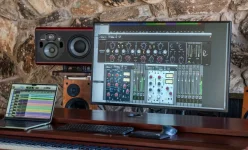
Portico II normally places its Stereo Field Editor before the compressor and limiter, while SFE POST moves the entire section behind both dynamics stages. Silk still comes afterward in either routing, so the switch is not simply moving the SFE to the very end of the plug-in. It changes which version of the stereo signal the compressor and limiter receive.
The difference matters once Width or Depth moves away from neutral. Those controls alter the relationship between the Mid and Side information, and the available filters can concentrate that change in a selected part of the spectrum. A spatial adjustment made before dynamics can therefore influence the level and shape of the signal entering them, while the same adjustment made afterward cannot rewrite gain reduction that already happened.
This is separate from the Portico II mid-side compressor routing because the channel mode decides how the dynamics section interprets its two paths, while SFE POST decides where the spatial processing sits in the chain. You can use Stereo, Dual Mono, or M/S dynamics and still make a separate pre-or-post decision for the SFE. Treating those controls as one feature makes troubleshooting harder than it needs to be.
Mid-side width processing itself is straightforward in principle. Raising the Side level relative to Mid increases stereo width, while lowering it narrows the image, a relationship described in this mid-side stereo width control. Portico II complicates the practical result because its SFE can make those changes before a compressor and limiter whose reactions depend on the signal arriving at their inputs.
The limiter follows the same routing consequence. Any peak changes created by the SFE happen before limiting, so the limiter gets a chance to respond to the spatially altered signal. This can be useful when you want the final limiter stage to police peaks after your width and depth decisions rather than before them.
Pre-dynamics placement also means an aggressive SFE move may appear to change compressor character when the compressor is really reacting to a new input balance. A quick comparison can fool you if you flip SFE settings without watching gain reduction. Match the apparent loudness, then check whether the compressor or limiter meters moved before deciding the spatial setting itself caused the tonal difference.
There is a trade-off. Because the SFE now sits after the limiter, a width or depth change can alter the reconstructed left and right peaks after the limiter has already done its job. A setting that stayed comfortably below a peak target before the SFE move can produce a different peak structure afterward, so the Portico II limiter is no longer the final authority over the signal leaving the plug-in.
This becomes more important on dense masters where side energy rises sharply during choruses. A modest width lift may barely affect average loudness yet still reshape isolated left or right peaks, especially when cymbals, reverbs, or hard-panned percussion dominate the Side component.
Silk remains after the SFE in both routings, which is easy to miss when concentrating on the POST label. Moving the Stereo Field Editor does not place it after the harmonic output stage. If strict peak control matters, check the signal after the plug-in with the same SFE setting you intend to keep, especially when the spatial move is large, or the master is already running close to its ceiling.
The difference matters once Width or Depth moves away from neutral. Those controls alter the relationship between the Mid and Side information, and the available filters can concentrate that change in a selected part of the spectrum. A spatial adjustment made before dynamics can therefore influence the level and shape of the signal entering them, while the same adjustment made afterward cannot rewrite gain reduction that already happened.
The switch changes what the dynamics actually hear
With SFE POST disengaged, the order is Stereo Field Editor, compressor, limiter, Silk, then output. You shape the stereo field first, and the dynamics react to the result. A wider side component, a reduced center component, or a frequency-focused SFE move can alter the material presented to the compressor and limiter even when none of their own controls have changed.This is separate from the Portico II mid-side compressor routing because the channel mode decides how the dynamics section interprets its two paths, while SFE POST decides where the spatial processing sits in the chain. You can use Stereo, Dual Mono, or M/S dynamics and still make a separate pre-or-post decision for the SFE. Treating those controls as one feature makes troubleshooting harder than it needs to be.
Mid-side width processing itself is straightforward in principle. Raising the Side level relative to Mid increases stereo width, while lowering it narrows the image, a relationship described in this mid-side stereo width control. Portico II complicates the practical result because its SFE can make those changes before a compressor and limiter whose reactions depend on the signal arriving at their inputs.
Pre-dynamics SFE can change compression without touching it
Suppose a chorus contains wide guitars and reverbs while the vocal, kick, and bass sit firmly in the center. Increase Width before the dynamics section, and the side-heavy material arrives at the compressor at a different level relationship than before. Gain reduction can change even though threshold, ratio, attack, release, and channel mode remain untouched.The limiter follows the same routing consequence. Any peak changes created by the SFE happen before limiting, so the limiter gets a chance to respond to the spatially altered signal. This can be useful when you want the final limiter stage to police peaks after your width and depth decisions rather than before them.
Pre-dynamics placement also means an aggressive SFE move may appear to change compressor character when the compressor is really reacting to a new input balance. A quick comparison can fool you if you flip SFE settings without watching gain reduction. Match the apparent loudness, then check whether the compressor or limiter meters moved before deciding the spatial setting itself caused the tonal difference.
Post-dynamics SFE keeps spatial moves out of gain reduction
Engage SFE POST and the order becomes compressor, limiter, Stereo Field Editor, Silk, then output. The dynamics now work on the incoming stereo signal before Width, Depth, or their frequency-focused processing changes it. You can reshape the image without asking the compressor to recalculate its response around every SFE adjustment.There is a trade-off. Because the SFE now sits after the limiter, a width or depth change can alter the reconstructed left and right peaks after the limiter has already done its job. A setting that stayed comfortably below a peak target before the SFE move can produce a different peak structure afterward, so the Portico II limiter is no longer the final authority over the signal leaving the plug-in.
This becomes more important on dense masters where side energy rises sharply during choruses. A modest width lift may barely affect average loudness yet still reshape isolated left or right peaks, especially when cymbals, reverbs, or hard-panned percussion dominate the Side component.
Silk remains after the SFE in both routings, which is easy to miss when concentrating on the POST label. Moving the Stereo Field Editor does not place it after the harmonic output stage. If strict peak control matters, check the signal after the plug-in with the same SFE setting you intend to keep, especially when the spatial move is large, or the master is already running close to its ceiling.