Virtual analog research models audio hardware by translating circuit behavior into mathematical systems that can run fast enough for real-time processing. A circuit-modeled plugin starts with electrical relationships inside the design instead of treating the device only as an input-output sound signature.
In practice, the model may represent resistors, capacitors, transformers, valves, transistors, diodes, or other parts along with the way they connect. Developers then turn those relationships into equations a computer can solve repeatedly while audio passes through the plugin. The point is not to draw a nicer EQ curve.
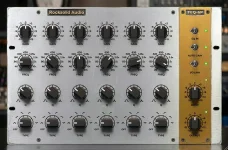
The distinction matters because analog circuits can change their response with signal level, frequency, previous state, and the behavior of neighboring components. Rocksolid Audio describes its real-time circuit simulation design as calculating parts of the TEQ-6P signal path while audio is running. A static response alone cannot describe every kind of nonlinear or state-dependent behavior.
Circuit modeling becomes interesting when the original device does things that cannot be reduced to one fixed transfer curve. A nonlinear component can create different harmonic content as level changes, while reactive parts such as capacitors introduce frequency-dependent behavior and stored state. Feedback paths can make one stage affect another instead of behaving like isolated processing blocks.
White-box modeling gives developers a route to preserve those relationships because the model knows something about the circuit structure. Component-wise virtual analog modeling can even use measured input-output data to refine uncertain component values while retaining the known topology. The useful part is the combination of structure and calibration, not the label printed on the plugin page.
So circuit modeling should not be read as shorthand for authentic, while captures or neural models mean approximate. A good black-box model can reproduce a device closely over the conditions represented in its measurements. A weak circuit model can miss badly if the component values, device equations, parasitics, or calibration are wrong.
The practical difference is interpretability. With a circuit-aware model, changing a resistor value or replacing a nonlinear device has a defined place in the modeled system. With a black-box model, internal parameters usually do not correspond directly to physical parts, even when the audible result is convincing.
This also changes how controls can be implemented. If a knob alters a resistance in the original circuit, a structural model can potentially change the corresponding parameter and let the rest of the modeled network respond. A sampled or learned model needs another mechanism for handling continuously variable controls, often through interpolation, conditioning, or additional training data.
Developers therefore choose numerical methods, simplify sections, approximate device behavior, split circuits into manageable blocks, or optimize calculations for real-time use. Wave Digital Filters and nodal approaches are two established families used in virtual analog work, but neither name guarantees a particular level of fidelity. Implementation choices still decide a great deal.
Exact component values create another problem. Schematics may specify nominal values while an individual physical unit can depart from them through ordinary manufacturing tolerances. Research on white-box modeling specifically treats uncertain component values as an accuracy limit rather than assuming a schematic alone settles the matter.
A useful listening test therefore goes beyond asking whether a modeled EQ matches one swept frequency-response plot. Level-dependent harmonics, intermodulation, transient behavior, control interaction, stereo matching, and repeatability can reveal different parts of the model. A plugin can match a curve beautifully and still behave differently once the signal starts pushing the circuitry it claims to represent.
In practice, the model may represent resistors, capacitors, transformers, valves, transistors, diodes, or other parts along with the way they connect. Developers then turn those relationships into equations a computer can solve repeatedly while audio passes through the plugin. The point is not to draw a nicer EQ curve.
The distinction matters because analog circuits can change their response with signal level, frequency, previous state, and the behavior of neighboring components. Rocksolid Audio describes its real-time circuit simulation design as calculating parts of the TEQ-6P signal path while audio is running. A static response alone cannot describe every kind of nonlinear or state-dependent behavior.
Circuit topology preserves interactions a curve cannot show
A conventional digital EQ can reproduce a target frequency response extremely well without pretending to be the original hardware. Feed it a quiet signal or a louder one within its linear operating range and the shape of the filter remains predictable. For many jobs, that is exactly what you want.Circuit modeling becomes interesting when the original device does things that cannot be reduced to one fixed transfer curve. A nonlinear component can create different harmonic content as level changes, while reactive parts such as capacitors introduce frequency-dependent behavior and stored state. Feedback paths can make one stage affect another instead of behaving like isolated processing blocks.
White-box modeling gives developers a route to preserve those relationships because the model knows something about the circuit structure. Component-wise virtual analog modeling can even use measured input-output data to refine uncertain component values while retaining the known topology. The useful part is the combination of structure and calibration, not the label printed on the plugin page.
Circuit modeling and black-box modeling solve different problems
Black-box modeling takes another route. Instead of rebuilding the known circuit internally, a developer can measure how hardware responds and train or fit a system to reproduce the observed input-output behavior. Modern black-box methods can model nonlinear effects and, with suitable architectures, behavior that develops over time.So circuit modeling should not be read as shorthand for authentic, while captures or neural models mean approximate. A good black-box model can reproduce a device closely over the conditions represented in its measurements. A weak circuit model can miss badly if the component values, device equations, parasitics, or calibration are wrong.
The practical difference is interpretability. With a circuit-aware model, changing a resistor value or replacing a nonlinear device has a defined place in the modeled system. With a black-box model, internal parameters usually do not correspond directly to physical parts, even when the audible result is convincing.
This also changes how controls can be implemented. If a knob alters a resistance in the original circuit, a structural model can potentially change the corresponding parameter and let the rest of the modeled network respond. A sampled or learned model needs another mechanism for handling continuously variable controls, often through interpolation, conditioning, or additional training data.
Real-time circuit simulation still involves compromises
Running an electrical model inside a DAW is not the same job as running an unrestricted engineering simulation offline. Audio processing has a deadline for every buffer, so the solver must produce stable results quickly enough to avoid glitches. Complex circuits with several nonlinear devices can become computationally expensive.Developers therefore choose numerical methods, simplify sections, approximate device behavior, split circuits into manageable blocks, or optimize calculations for real-time use. Wave Digital Filters and nodal approaches are two established families used in virtual analog work, but neither name guarantees a particular level of fidelity. Implementation choices still decide a great deal.
Exact component values create another problem. Schematics may specify nominal values while an individual physical unit can depart from them through ordinary manufacturing tolerances. Research on white-box modeling specifically treats uncertain component values as an accuracy limit rather than assuming a schematic alone settles the matter.
A useful listening test therefore goes beyond asking whether a modeled EQ matches one swept frequency-response plot. Level-dependent harmonics, intermodulation, transient behavior, control interaction, stereo matching, and repeatability can reveal different parts of the model. A plugin can match a curve beautifully and still behave differently once the signal starts pushing the circuitry it claims to represent.