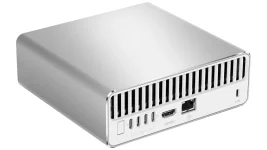
NVIDIA lists RTX Spark with a 256-bit coherent memory interface delivering 300 GB/s of bandwidth between its shared memory pool and the processors. MSI, meanwhile, advertises EdgeMesa N AI+ with up to one petaFLOP of FP4 AI performance, which is a very different kind of number.
Peak compute tells you how much low-precision math the hardware can theoretically chew through under the right workload. Local language-model generation often hits another wall first, because the machine has to keep feeding model weights and cache data through memory while tokens arrive one after another.
The EdgeMesa N AI+ RTX Spark platform gives you up to 128GB of unified memory, so unusually large models can fit locally. Capacity answers whether a workload can live in memory. Bandwidth helps decide how quickly the hardware can keep moving that workload once generation starts.
Single-user decoding is where flashy compute figures can lose some of their shine. The GPU may have plenty of tensor throughput available, yet it still needs model weights and active state delivered quickly enough to keep those execution units busy. The GPU can sit underused while memory transfers dominate each decode step.
A rough 70-billion-parameter model stored at four bits needs about 35GB just for its raw weights before quantization metadata and runtime overhead enter the picture. Streaming 35GB against a theoretical 300 GB/s interface already shows why bandwidth can become a hard constraint. Real inference will not turn the full interface rating directly into useful model traffic either.
This is also why model capacity and model speed should not be blended into one claim. EdgeMesa may hold a model that would never fit inside a normal 16GB or 24GB graphics card, while generation can still feel slower than expected if every token requires moving a huge amount of weight data through the same memory subsystem.
The gain is not automatically proportional to the reduction in file size. Kernels still have work to do, quantization formats add metadata, values may need unpacking or dequantization, and different inference engines can use the same hardware very differently. A bad four-bit path can leave performance sitting on the table.
The broader behavior is well established in work on autoregressive decoding limits, where token generation is described as memory-bandwidth bounded and highly sequential.
Context length pushes on a different part of the memory bill. The KV cache grows as the conversation gets longer, and attention has more state to deal with, so two runs using the same model and quantization can behave differently simply because one prompt is much larger. Tokens per second without a context length is already missing useful information.
Batching changes the picture again. Serving several requests together can reuse weight movement more effectively and raise hardware utilization, while a single person chatting with one local model usually cares about batch-one latency. Benchmark numbers taken from a throughput-oriented server setup can therefore make a desktop chatbot look faster on paper than it feels at the keyboard.
Software will decide a chunk of the missing performance. CUDA kernels, TensorRT paths, llama.cpp builds, quantization formats, Windows scheduling, model architecture, and memory allocation can all change how much of the available bandwidth reaches useful inference work. Thermals and the desktop power envelope can matter during longer runs as well.
A useful EdgeMesa benchmark therefore needs to separate prompt processing from token generation and name the model, quantization, context length, batch size, and backend. A single petaFLOP number cannot supply those details, and 300 GB/s cannot predict them by itself.
The revealing result will be sustained batch-one generation on models large enough to stress the unified pool. If two models both fit inside 128GB but one moves half as much weight data per generated token, their practical speed can diverge sharply even though the same Blackwell GPU performs the math.
Peak compute tells you how much low-precision math the hardware can theoretically chew through under the right workload. Local language-model generation often hits another wall first, because the machine has to keep feeding model weights and cache data through memory while tokens arrive one after another.
The EdgeMesa N AI+ RTX Spark platform gives you up to 128GB of unified memory, so unusually large models can fit locally. Capacity answers whether a workload can live in memory. Bandwidth helps decide how quickly the hardware can keep moving that workload once generation starts.
Token generation keeps pulling data through memory
LLM inference has two noticeably different phases. Prompt processing can feed lots of work through the GPU in parallel, while autoregressive decoding produces the response sequentially, with each new token depending on what came before it.Single-user decoding is where flashy compute figures can lose some of their shine. The GPU may have plenty of tensor throughput available, yet it still needs model weights and active state delivered quickly enough to keep those execution units busy. The GPU can sit underused while memory transfers dominate each decode step.
A rough 70-billion-parameter model stored at four bits needs about 35GB just for its raw weights before quantization metadata and runtime overhead enter the picture. Streaming 35GB against a theoretical 300 GB/s interface already shows why bandwidth can become a hard constraint. Real inference will not turn the full interface rating directly into useful model traffic either.
This is also why model capacity and model speed should not be blended into one claim. EdgeMesa may hold a model that would never fit inside a normal 16GB or 24GB graphics card, while generation can still feel slower than expected if every token requires moving a huge amount of weight data through the same memory subsystem.
Quantization cuts traffic but does not create free speed
Quantization gets interesting here for two reasons. Smaller weights let larger models fit, but they can also reduce the amount of data that needs to move during decoding. Going from a higher-precision representation to four-bit weights can therefore attack both the capacity problem and the bandwidth problem at once.The gain is not automatically proportional to the reduction in file size. Kernels still have work to do, quantization formats add metadata, values may need unpacking or dequantization, and different inference engines can use the same hardware very differently. A bad four-bit path can leave performance sitting on the table.
The broader behavior is well established in work on autoregressive decoding limits, where token generation is described as memory-bandwidth bounded and highly sequential.
Context length pushes on a different part of the memory bill. The KV cache grows as the conversation gets longer, and attention has more state to deal with, so two runs using the same model and quantization can behave differently simply because one prompt is much larger. Tokens per second without a context length is already missing useful information.
Batching changes the picture again. Serving several requests together can reuse weight movement more effectively and raise hardware utilization, while a single person chatting with one local model usually cares about batch-one latency. Benchmark numbers taken from a throughput-oriented server setup can therefore make a desktop chatbot look faster on paper than it feels at the keyboard.
The 300 GB/s figure is a ceiling, not a benchmark
NVIDIA's 300 GB/s number describes the RTX Spark memory interface, not measured EdgeMesa application throughput. MSI currently lists the unified-memory capacity, processor, GPU, and AI-compute figure for EdgeMesa, but it does not publish sustained memory-bandwidth measurements or a full table of retail LLM generation results.Software will decide a chunk of the missing performance. CUDA kernels, TensorRT paths, llama.cpp builds, quantization formats, Windows scheduling, model architecture, and memory allocation can all change how much of the available bandwidth reaches useful inference work. Thermals and the desktop power envelope can matter during longer runs as well.
A useful EdgeMesa benchmark therefore needs to separate prompt processing from token generation and name the model, quantization, context length, batch size, and backend. A single petaFLOP number cannot supply those details, and 300 GB/s cannot predict them by itself.
The revealing result will be sustained batch-one generation on models large enough to stress the unified pool. If two models both fit inside 128GB but one moves half as much weight data per generated token, their practical speed can diverge sharply even though the same Blackwell GPU performs the math.