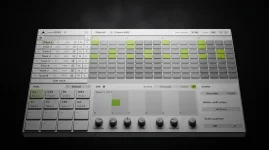
omniGRID can generate Euclidean patterns independently on each of its 16 MIDI tracks, with pulse and offset controls for every lane. The attraction is speed. You choose how many hits belong in a cycle and let the sequencer distribute them instead of drawing every trigger yourself.
A Euclidean pattern spreads its active steps as evenly as possible across the available positions. Four pulses across sixteen steps gives you a rigid, familiar spacing, while five across sixteen has to alternate the gaps because sixteen cannot divide cleanly by five.
The useful part of omniGRID's 16-track Euclidean sequencer is what happens after generation. Manual steps can live beside generated hits, each track can use its own length, and the result can be edited instead of treated as a finished rhythm.
This works particularly well for hats, shakers, toms, and small percussion parts. A sparse Euclidean drum pattern can add movement around a straight kick without challenging the kick for ownership of the beat. Put too many pulses on every lane and the mathematical neatness becomes irrelevant because the groove is simply busy.
Offset does a different job. It moves the generated pattern around the cycle while preserving its internal distribution, so a rhythm that clashes with the downbeat may fit after a small rotation. The number of hits has not changed. Their relationship to the rest of the beat has.
The underlying idea is well established in research on evenly distributed rhythmic onsets, which showed that Euclidean construction can reproduce many established musical timelines. The practical lesson is less grand. Even distribution can produce useful material, but placement against your other parts still decides whether it grooves.
This is especially useful in house and techno, where repetition is often the point rather than a problem to eliminate. A four-on-the-floor kick does not need algorithmic assistance simply because the option exists. The generator earns its place on parts where evenly distributed hits create motion you would not have drawn as quickly by hand.
Different track lengths can make those generated parts travel. A seven-step percussion lane against a sixteen-step kick will keep returning in different positions before the relationship repeats. Add another unequal length and the composite cycle grows again, even though each lane remains simple. A second percussion lane can use another length, but its job should still be obvious when you solo it.
Density needs watching once those lengths diverge. Seven steps with five pulses is already a crowded lane, and repeated against a stable sixteen-step frame it can feel more assertive than expected. Fewer pulses often reveal the shifting alignment more clearly because each hit has enough space to register.
Start with pulses, offset, and track length. Once the basic cycle has a clear role, probability can make secondary hits appear less predictably without changing the underlying distribution. Repeats can then create occasional bursts on steps that deserve more emphasis.
A useful failure test is brutally simple. Mute the kick and listen to the generated percussion alone, then bring the kick back. If the percussion suddenly sounds as though it is fighting for every subdivision, reduce its pulse count before touching probability or shuffle. More randomness rarely fixes excess density.
The same caution applies to sixteen available tracks. Several Euclidean lanes can interlock beautifully, but each additional generator adds another repeating structure the listener has to parse. Keep a few parts fixed, let a smaller group move, and reserve the stranger cycle lengths for sounds that can disappear without taking the groove with them. If a lane only sounds interesting when everything else is muted, it may be adding complexity rather than useful motion.
A Euclidean pattern spreads its active steps as evenly as possible across the available positions. Four pulses across sixteen steps gives you a rigid, familiar spacing, while five across sixteen has to alternate the gaps because sixteen cannot divide cleanly by five.
The useful part of omniGRID's 16-track Euclidean sequencer is what happens after generation. Manual steps can live beside generated hits, each track can use its own length, and the result can be edited instead of treated as a finished rhythm.
Pulse count should control density before anything else
Pulse count is the first control to reach for because it changes how crowded the lane feels without asking you to invent a new rhythm note by note. A low pulse count leaves large gaps. Raise it, and those gaps shrink, so the same cycle starts behaving more like constant motion than occasional punctuation.This works particularly well for hats, shakers, toms, and small percussion parts. A sparse Euclidean drum pattern can add movement around a straight kick without challenging the kick for ownership of the beat. Put too many pulses on every lane and the mathematical neatness becomes irrelevant because the groove is simply busy.
Offset does a different job. It moves the generated pattern around the cycle while preserving its internal distribution, so a rhythm that clashes with the downbeat may fit after a small rotation. The number of hits has not changed. Their relationship to the rest of the beat has.
The underlying idea is well established in research on evenly distributed rhythmic onsets, which showed that Euclidean construction can reproduce many established musical timelines. The practical lesson is less grand. Even distribution can produce useful material, but placement against your other parts still decides whether it grooves.
Manual anchors stop generated parts from taking over
omniGRID supports Euclidean and manual step layering on the same track, which is more useful than treating generation as an all-or-nothing mode. Keep the hits that define the phrase and let the generator handle the less important movement around them. A manually placed clap or accent can remain fixed while surrounding percussion changes.This is especially useful in house and techno, where repetition is often the point rather than a problem to eliminate. A four-on-the-floor kick does not need algorithmic assistance simply because the option exists. The generator earns its place on parts where evenly distributed hits create motion you would not have drawn as quickly by hand.
Different track lengths can make those generated parts travel. A seven-step percussion lane against a sixteen-step kick will keep returning in different positions before the relationship repeats. Add another unequal length and the composite cycle grows again, even though each lane remains simple. A second percussion lane can use another length, but its job should still be obvious when you solo it.
Density needs watching once those lengths diverge. Seven steps with five pulses is already a crowded lane, and repeated against a stable sixteen-step frame it can feel more assertive than expected. Fewer pulses often reveal the shifting alignment more clearly because each hit has enough space to register.
Probability and repeats belong later in the process
omniGRID also gives individual steps probability and repeat controls, but both can hide whether the Euclidean pattern itself is working. Probability removes certainty from selected events. Repeats add extra activity around an event. Using both before the pulse distribution feels right makes it harder to hear which layer of variation is helping.Start with pulses, offset, and track length. Once the basic cycle has a clear role, probability can make secondary hits appear less predictably without changing the underlying distribution. Repeats can then create occasional bursts on steps that deserve more emphasis.
A useful failure test is brutally simple. Mute the kick and listen to the generated percussion alone, then bring the kick back. If the percussion suddenly sounds as though it is fighting for every subdivision, reduce its pulse count before touching probability or shuffle. More randomness rarely fixes excess density.
The same caution applies to sixteen available tracks. Several Euclidean lanes can interlock beautifully, but each additional generator adds another repeating structure the listener has to parse. Keep a few parts fixed, let a smaller group move, and reserve the stranger cycle lengths for sounds that can disappear without taking the groove with them. If a lane only sounds interesting when everything else is muted, it may be adding complexity rather than useful motion.