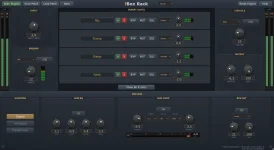
fBox Rack can host up to eight VST3 effects, with every slot switchable between series and parallel operation on Windows. It is not just a folder for plug-ins, though, because the hosted effects sit inside a larger channel strip with its own input, summing, bus, and output stages.
The useful bit is deciding which parts of that strip you actually need. Every stage after the preamp starts switched off, so Rack can behave like a fairly clean host before you start adding console color, compression, saturation, or output shaping.
You also are not locked into fBox processors. Third-party VST3 effects can fill the slots, which makes the broader fBox Audio Windows setup more interesting if you already own a pile of plug-ins and would rather reorganize them than replace them.
Series routing is the normal choice when one processor should feed the next. An EQ can trim mud before a compressor, a compressor can feed a saturator, and a delay can sit at the end if you want every earlier decision printed into its repeats. Order matters because every processor receives whatever the previous one already changed.
Parallel slots are useful when you want processed signal without forcing the entire track through the same treatment. Heavy compression, ugly distortion, narrow filtering, or obvious modulation can sit beside the main path instead of replacing it, while the per-slot level control lets you decide how much of that branch belongs in the result.
Rack gives every slot its own bypass, mute, solo, level, and meter, which makes troubleshooting less annoying than a long anonymous insert chain. Solo a branch, hear what it is actually contributing, then pull its level back until it helps instead of taking over.
Rack includes a latency-matched global mix for blending the whole chain with the original signal. Frequency-dependent phase shifts can still matter with nonlinear or phase-altering processors, a problem covered in phase response and automatic signal alignment, but basic delay mismatch is not something you should have to patch manually around the Rack.
This makes the global mix useful for more than classic parallel compression. You can build a deliberately aggressive eight-slot chain, drive the preamp, add bus saturation, push the output stage, then bring the whole result underneath the untouched signal instead of watering down every processor one by one.
Per-slot parallel routing solves a different problem. It lets you decide which individual processors belong beside the main path, while the global mix controls how much of the completed Rack chain sits against the original input. Keeping those two levels separate avoids the usual mess where every wet-dry control starts fighting every other one.
After the slots, the summing stage offers Digital, Analogue, and Transformer modes, followed by bus EQ, compression, saturation, and the console output stage. This is where Rack can turn several unrelated plug-ins into one deliberately voiced channel, but switching everything on by habit is an easy way to lose the reason you chose those plug-ins in the first place.
Start with the problem, not the panel. A vocal chain that already has enough density may only need clean hosting and a little output shaping, while a drum bus might benefit from transformer summing, bus compression, and a harder saturation mode. There is no prize for using every stage.
Three plug-ins are deliberately excluded from Rack slots, namely fTape, fBox Console, and fBox Rack itself. CPU load also depends on whatever you host inside it, and Eco, Studio, and Master quality tiers give you another practical lever when a creative session becomes heavier than expected.
Patch cards save the settings together with the particular Rack unit, which matters because each instance carries its own serial-based character. Once a chain lands exactly where you want it, saving the patch preserves more than knob positions and makes the Rack easier to treat as one repeatable processor instead of eight loose effects.
The useful bit is deciding which parts of that strip you actually need. Every stage after the preamp starts switched off, so Rack can behave like a fairly clean host before you start adding console color, compression, saturation, or output shaping.
You also are not locked into fBox processors. Third-party VST3 effects can fill the slots, which makes the broader fBox Audio Windows setup more interesting if you already own a pile of plug-ins and would rather reorganize them than replace them.
The rack starts clean before you add character
A sensible first pass is boring on purpose. Load the effects you already trust, leave the extra console stages off, and get the chain working before you start seasoning the signal with the preamp, summing modes, bus EQ, compression, saturation, or output stage.Series routing is the normal choice when one processor should feed the next. An EQ can trim mud before a compressor, a compressor can feed a saturator, and a delay can sit at the end if you want every earlier decision printed into its repeats. Order matters because every processor receives whatever the previous one already changed.
Parallel slots are useful when you want processed signal without forcing the entire track through the same treatment. Heavy compression, ugly distortion, narrow filtering, or obvious modulation can sit beside the main path instead of replacing it, while the per-slot level control lets you decide how much of that branch belongs in the result.
Rack gives every slot its own bypass, mute, solo, level, and meter, which makes troubleshooting less annoying than a long anonymous insert chain. Solo a branch, hear what it is actually contributing, then pull its level back until it helps instead of taking over.
Parallel processing needs more than a wet-dry knob
Parallel chains get messy when the processed path arrives later than the dry path. A few samples of mismatch can change the combined frequency response, especially once a plug-in adds internal latency or phase shift, so a blend can sound thinner or stranger even when neither path sounds broken alone.Rack includes a latency-matched global mix for blending the whole chain with the original signal. Frequency-dependent phase shifts can still matter with nonlinear or phase-altering processors, a problem covered in phase response and automatic signal alignment, but basic delay mismatch is not something you should have to patch manually around the Rack.
This makes the global mix useful for more than classic parallel compression. You can build a deliberately aggressive eight-slot chain, drive the preamp, add bus saturation, push the output stage, then bring the whole result underneath the untouched signal instead of watering down every processor one by one.
Per-slot parallel routing solves a different problem. It lets you decide which individual processors belong beside the main path, while the global mix controls how much of the completed Rack chain sits against the original input. Keeping those two levels separate avoids the usual mess where every wet-dry control starts fighting every other one.
The console stages are optional for a reason
The preamp comes first and offers Clean, Warm, Hot, and Valve modes, so it can change how hard the hosted plug-ins are being hit before they do anything. If a compressor or distortion plug-in already reacts strongly to input level, adding preamp drive can alter its behavior rather than merely adding color afterward.After the slots, the summing stage offers Digital, Analogue, and Transformer modes, followed by bus EQ, compression, saturation, and the console output stage. This is where Rack can turn several unrelated plug-ins into one deliberately voiced channel, but switching everything on by habit is an easy way to lose the reason you chose those plug-ins in the first place.
Start with the problem, not the panel. A vocal chain that already has enough density may only need clean hosting and a little output shaping, while a drum bus might benefit from transformer summing, bus compression, and a harder saturation mode. There is no prize for using every stage.
Three plug-ins are deliberately excluded from Rack slots, namely fTape, fBox Console, and fBox Rack itself. CPU load also depends on whatever you host inside it, and Eco, Studio, and Master quality tiers give you another practical lever when a creative session becomes heavier than expected.
Patch cards save the settings together with the particular Rack unit, which matters because each instance carries its own serial-based character. Once a chain lands exactly where you want it, saving the patch preserves more than knob positions and makes the Rack easier to treat as one repeatable processor instead of eight loose effects.