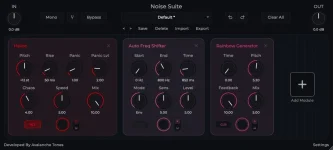
Avalanche Tones gives both Noise Suite and Chainsaw Suite ten active module slots, but the two plugins are built around different problems. Chainsaw Suite is mostly about constructing the heavy guitar tone itself, while Noise Suite is about bending, interrupting, and moving that tone once you already have something solid.
The overlap can make the choice look fuzzier than it really is. Both have tools such as gating and octave processing, and both let you reorder modules instead of accepting a fixed signal path. The useful split appears when you look at what dominates each module list.
Chainsaw Suite leans into distortion, overdrive, fuzz, EQ, compression, tone shaping, amp captures, and parallel routing. Noise Suite leans into pitch shifting, frequency shifting, ring modulation, freezing, tape stops, glitches, and feedback-heavy delay. Chainsaw Suite shapes the core tone. Noise Suite changes its movement and behavior.
The two NAM loader slots are the biggest clue about its role. A NAM capture can represent the nonlinear response of real guitar gear, so it belongs close to the foundation of a digital rig rather than acting like a decorative effect on top. Real-time neural amplifier modeling has shown how neural networks can reproduce nonlinear guitar amplifier and distortion behavior while remaining practical for real-time use.
Chainsaw Suite also gives you two parallel lanes. Parallel routing matters when one guitar sound needs two jobs at once. You can keep one path tight and relatively clean while another carries uglier distortion, extra midrange, or a more extreme capture, then blend the result instead of forcing every processor through the same serial chain.
If the problem is weak pick attack, ugly low-end buildup, the wrong distortion texture, or a captured amp that needs shaping before it sits in the mix, Chainsaw Suite is the more obvious place to start.
This is where Noise Suite’s experimental processing toolkit separates itself from Chainsaw Suite. You can automate every parameter and map controls to MIDI, so the weird part does not need to stay permanently switched on. A pitch burst can hit one note. A freeze can catch the end of a chord. Feedback can climb for half a bar and disappear before the next palm-muted section.
Noise Suite can still damage tone in static ways, but treating it as another distortion rack misses most of the point. Its stronger use is motion. The effect chain can become part of the arrangement rather than something you dial once and forget.
Heavy guitar benefits from this split because constant chaos gets boring quickly. A stable core tone gives the listener something to lock onto, while short bursts of pitch movement, glitching, freezing, or feedback can make specific transitions feel much larger.
Order is still open. A Noise Suite effect placed before the amp stage can make the capture react to the processed signal, which can be nastier than adding the same effect afterward. A transpose or octave effect may also track better before heavy distortion. There is no reason to lock every unusual processor at the end.
Buying only one comes down to the missing piece in the rig. If you already have an amp sim and distortion chain you like, Noise Suite adds the less ordinary stuff. If your weird effects are covered but your base guitar tone still needs routing, gain shaping, captures, and parallel processing, Chainsaw Suite fills the more fundamental gap.
Both currently cost $39.99, and both have seven-day trials, so testing the exact weak point in your existing setup makes more sense than treating them as two versions of the same plugin.
The overlap can make the choice look fuzzier than it really is. Both have tools such as gating and octave processing, and both let you reorder modules instead of accepting a fixed signal path. The useful split appears when you look at what dominates each module list.
Chainsaw Suite leans into distortion, overdrive, fuzz, EQ, compression, tone shaping, amp captures, and parallel routing. Noise Suite leans into pitch shifting, frequency shifting, ring modulation, freezing, tape stops, glitches, and feedback-heavy delay. Chainsaw Suite shapes the core tone. Noise Suite changes its movement and behavior.
Chainsaw Suite handles the core guitar tone
Chainsaw Suite currently has 20 modules, with up to 10 loaded at once. Nine are distortion, overdrive, or fuzz processors, and the rest include EQ, pedal-style tone shaping, compression, gating, bit crushing, octave processing, and Neural Amp Modeler loading.The two NAM loader slots are the biggest clue about its role. A NAM capture can represent the nonlinear response of real guitar gear, so it belongs close to the foundation of a digital rig rather than acting like a decorative effect on top. Real-time neural amplifier modeling has shown how neural networks can reproduce nonlinear guitar amplifier and distortion behavior while remaining practical for real-time use.
Chainsaw Suite also gives you two parallel lanes. Parallel routing matters when one guitar sound needs two jobs at once. You can keep one path tight and relatively clean while another carries uglier distortion, extra midrange, or a more extreme capture, then blend the result instead of forcing every processor through the same serial chain.
If the problem is weak pick attack, ugly low-end buildup, the wrong distortion texture, or a captured amp that needs shaping before it sits in the mix, Chainsaw Suite is the more obvious place to start.
Noise Suite handles movement and controlled damage
Noise Suite has 18 modules and the same ten-module ceiling, but its center of gravity is completely different. Transpose, semitone doubling, pitch shifting, frequency shifting, ring modulation, tape stop, freeze, glitch delay, and self-oscillating delay are there to make the signal change over time.This is where Noise Suite’s experimental processing toolkit separates itself from Chainsaw Suite. You can automate every parameter and map controls to MIDI, so the weird part does not need to stay permanently switched on. A pitch burst can hit one note. A freeze can catch the end of a chord. Feedback can climb for half a bar and disappear before the next palm-muted section.
Noise Suite can still damage tone in static ways, but treating it as another distortion rack misses most of the point. Its stronger use is motion. The effect chain can become part of the arrangement rather than something you dial once and forget.
Heavy guitar benefits from this split because constant chaos gets boring quickly. A stable core tone gives the listener something to lock onto, while short bursts of pitch movement, glitching, freezing, or feedback can make specific transitions feel much larger.
Using both keeps the jobs separate
Running both does not mean filling twenty slots because twenty slots exist. A sensible chain can stay surprisingly small. Chainsaw Suite can handle the gate, drive, tone shaping, amp capture, and any parallel blend needed for the basic sound. Noise Suite can sit later and handle the moments where the guitar needs to bend, stall, repeat, or fall apart.Order is still open. A Noise Suite effect placed before the amp stage can make the capture react to the processed signal, which can be nastier than adding the same effect afterward. A transpose or octave effect may also track better before heavy distortion. There is no reason to lock every unusual processor at the end.
Buying only one comes down to the missing piece in the rig. If you already have an amp sim and distortion chain you like, Noise Suite adds the less ordinary stuff. If your weird effects are covered but your base guitar tone still needs routing, gain shaping, captures, and parallel processing, Chainsaw Suite fills the more fundamental gap.
Both currently cost $39.99, and both have seven-day trials, so testing the exact weak point in your existing setup makes more sense than treating them as two versions of the same plugin.