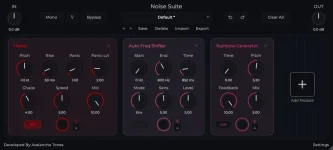
A Rainbow Machine-style effect needs more than a pitch shifter and a delay sitting next to each other on a guitar track. The weird climbing, falling, slightly broken movement happens because the shifted sound gets recycled through a feedback path instead of simply appearing once after the dry note.
Plenty of plugin searches miss this distinction. You find harmonizers, shimmer reverbs, octave delays, and modulation plugins that can all get somewhere nearby, but a normal serial chain often sounds too tidy because each processor only sees the signal once.
Software actually gives you a useful advantage here. You can separate the pieces, decide exactly what gets fed back, automate the dangerous parts, and keep the dry guitar untouched while the warped return gets as ugly as you want.
Delay time changes the personality just as much. Very short settings smear the shifted copy against the original note, while longer times make the repetitions obvious enough to feel rhythmic. Moving delay time can also create its own pitch bend because the read position inside the delay buffer is changing speed, a basic behavior covered in delay-line modulation changes pitch and timing.
A useful software chain therefore needs control over three separate things. You need the transposition amount, the time before the processed sound returns, and the amount of processed audio allowed back into the loop. Those controls decide whether you get a quick metallic twitch, a rising cascade, or a feedback howl that eats the riff.
A single plugin is convenient, but it is not automatically the closest match. The Rainbow Machine also has separate shifted voices, tracking lag, tone shaping, and regeneration behavior. Building the effect from multiple processors gives you more freedom to decide which stages are repeated and which stay outside the loop.
This is where modular pitch and feedback processing becomes useful. A modular effects environment lets you treat pitch shift, short delay, filtering, frequency movement, and feedback as ingredients instead of accepting one developer's fixed signal path.
The practical setup is pretty simple in a DAW that allows feedback routing. Keep the main guitar dry, send a copy to an effects return, place delay and pitch processing on the return, then route part of the processed output back toward the same effect path. Some DAWs prevent direct feedback loops, so a plugin with an internal feedback network is safer and much less fiddly.
Filtering inside the loop matters for the same reason. Every pass can emphasize harsh top end or muddy low frequencies, so trimming those areas before the signal returns keeps later repeats from turning into a solid wall. Tone shaping outside the loop changes the final color, but tone shaping inside it changes what the next generation of repeats receives.
Automation is another software advantage that basic pedal replacement lists barely touch. Feedback can sit low during the riff, jump for one accent, then disappear before the next palm-muted hit. Pitch can move at the same time, and the wet return can be muted completely between bursts without touching the dry amp tone.
Latency deserves a quick check too. A plugin chain with look-ahead, oversampling, or heavy processing can add enough delay to make short feedback effects feel softer and less immediate than expected. Disable unnecessary high-latency stages while dialing the effect, then recheck timing if you turn them back on.
Plenty of plugin searches miss this distinction. You find harmonizers, shimmer reverbs, octave delays, and modulation plugins that can all get somewhere nearby, but a normal serial chain often sounds too tidy because each processor only sees the signal once.
Software actually gives you a useful advantage here. You can separate the pieces, decide exactly what gets fed back, automate the dangerous parts, and keep the dry guitar untouched while the warped return gets as ugly as you want.
The pedal sound starts as a routing problem
Put a pitch shifter before an ordinary delay, and every repeat usually carries the same shifted interval. Put the pitch shifter inside the delay's feedback path and each returning repeat can be shifted again, so the interval accumulates as the loop keeps circulating. A modest upward shift can therefore turn into a staircase rather than one static harmony.Delay time changes the personality just as much. Very short settings smear the shifted copy against the original note, while longer times make the repetitions obvious enough to feel rhythmic. Moving delay time can also create its own pitch bend because the read position inside the delay buffer is changing speed, a basic behavior covered in delay-line modulation changes pitch and timing.
A useful software chain therefore needs control over three separate things. You need the transposition amount, the time before the processed sound returns, and the amount of processed audio allowed back into the loop. Those controls decide whether you get a quick metallic twitch, a rising cascade, or a feedback howl that eats the riff.
One plugin can work, but routing gives you control
Some plugins already put pitch shifting inside their delay feedback network. ValhallaDelay is an obvious example because its Pitch modes combine delay, semitone shifting, feedback, filtering, and modulation inside one effect. Its RichPitch mode can also mix shifted and detuned material, which helps when a pure octave staircase sounds too clean.A single plugin is convenient, but it is not automatically the closest match. The Rainbow Machine also has separate shifted voices, tracking lag, tone shaping, and regeneration behavior. Building the effect from multiple processors gives you more freedom to decide which stages are repeated and which stay outside the loop.
This is where modular pitch and feedback processing becomes useful. A modular effects environment lets you treat pitch shift, short delay, filtering, frequency movement, and feedback as ingredients instead of accepting one developer's fixed signal path.
The practical setup is pretty simple in a DAW that allows feedback routing. Keep the main guitar dry, send a copy to an effects return, place delay and pitch processing on the return, then route part of the processed output back toward the same effect path. Some DAWs prevent direct feedback loops, so a plugin with an internal feedback network is safer and much less fiddly.
Controlled feedback sounds stranger than maximum feedback
Cranking feedback to the ceiling is fun for about ten seconds. The loop quickly fills with repeated transpositions, accumulated noise, and level buildup until the original guitar becomes irrelevant. Lower feedback usually gives you a more useful burst because the effect has time to mutate without taking over the entire bar.Filtering inside the loop matters for the same reason. Every pass can emphasize harsh top end or muddy low frequencies, so trimming those areas before the signal returns keeps later repeats from turning into a solid wall. Tone shaping outside the loop changes the final color, but tone shaping inside it changes what the next generation of repeats receives.
Automation is another software advantage that basic pedal replacement lists barely touch. Feedback can sit low during the riff, jump for one accent, then disappear before the next palm-muted hit. Pitch can move at the same time, and the wet return can be muted completely between bursts without touching the dry amp tone.
Latency deserves a quick check too. A plugin chain with look-ahead, oversampling, or heavy processing can add enough delay to make short feedback effects feel softer and less immediate than expected. Disable unnecessary high-latency stages while dialing the effect, then recheck timing if you turn them back on.