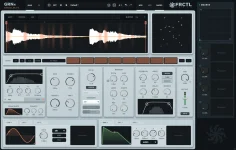
GRN4 adds a third LFO and a third envelope, plus MIDI triggering and a MIDIENV source built from played-note amplitude. Those additions matter because MIDI no longer has to stop at retuning grains. A held note can now shape movement elsewhere in the patch.
The useful split is between triggering an envelope and using MIDIENV itself. A MIDI-triggered envelope starts a programmed ADSR shape when note input arrives, while MIDIENV follows the amplitude envelope FRCTL derives from the notes being played. They may react to the same performance, but they are not doing the same job.
Inside GRN4's expanded MIDI modulation system, every continuous knob can act as a modulation target, including controls in the modulation and macro sections. MIDI performance can therefore reach much further than pitch. You can use a note to alter a grain parameter, then use the same performance to change how another modulator behaves.
This is useful when the source audio and the control gesture should be independent. Freeze a buffer, hold a chord, and a MIDI-triggered envelope can move a target even though the captured audio itself is not producing a fresh transient. The note becomes the timing instruction while the frozen material remains the sound being processed.
A slow attack routed to a selection edge can gradually narrow the playable region after the note begins. Send another envelope to filter resonance or grain density and the same note event can produce a more involved movement without recording several automation lanes. Each assignment still has its own depth, so one gesture does not force every destination through the same range.
Envelope triggering also behaves differently from using MIDI notes solely for pitch. Pitch Mode decides how held notes retune spawning grains, while the new trigger option decides when a modulation envelope begins. Separating those jobs makes it possible to keep pitch behavior restrained while letting the note event create larger changes elsewhere.
This idea has deep roots in electronic instruments. Keyboard-responsive digital envelope control has long used note and touch information to scale envelopes that can control gain or filter behavior. GRN4 applies the broader principle inside a granular effect, where the derived note envelope can steer continuous parameters rather than serving only as an amplitude contour.
Route MIDIENV to a macro and one performance-shaped source can move several destinations already assigned to that macro. Route it directly to a continuous grain control and the relationship becomes more immediate. The choice is whether the played note should influence one parameter or become a higher-level performance control.
MIDIENV also avoids one limitation of fixed automation. A drawn DAW curve keeps moving according to the timeline, while a note-derived envelope responds to how long you actually hold the note. Live playing can stay elastic without abandoning repeatable modulation routing.
A held note could raise a macro that already controls several grain settings. Another route could change a continuous control inside an LFO or envelope section, letting existing motion react to the performance instead of running identically every time. Complex patches need fewer separate DAW automation lanes when those relationships are built inside GRN4.
Restraint matters once modulation starts affecting modulation. Large depths can make a patch hard to predict because one source changes a control that is already moving another target. Start with one MIDI-derived route, keep its depth modest, and play several short and long notes before stacking another one.
MIDI triggering works well when you need a fresh programmed shape at each note onset. MIDIENV is better suited to movement that should follow the note's own amplitude behavior, while LFOs can keep providing motion underneath. Keeping those jobs distinct makes a performance patch much easier to tune without flattening everything into the same repeated gesture.
The useful split is between triggering an envelope and using MIDIENV itself. A MIDI-triggered envelope starts a programmed ADSR shape when note input arrives, while MIDIENV follows the amplitude envelope FRCTL derives from the notes being played. They may react to the same performance, but they are not doing the same job.
Inside GRN4's expanded MIDI modulation system, every continuous knob can act as a modulation target, including controls in the modulation and macro sections. MIDI performance can therefore reach much further than pitch. You can use a note to alter a grain parameter, then use the same performance to change how another modulator behaves.
MIDI triggering gives envelopes a deliberate start point
Earlier GRN envelopes could react to incoming audio or fire from grain activity. MIDI triggering adds a cleaner performance cue because the envelope begins from note input rather than waiting for an audio threshold or another grain event. Attack, decay, sustain, and release still determine the shape you draw.This is useful when the source audio and the control gesture should be independent. Freeze a buffer, hold a chord, and a MIDI-triggered envelope can move a target even though the captured audio itself is not producing a fresh transient. The note becomes the timing instruction while the frozen material remains the sound being processed.
A slow attack routed to a selection edge can gradually narrow the playable region after the note begins. Send another envelope to filter resonance or grain density and the same note event can produce a more involved movement without recording several automation lanes. Each assignment still has its own depth, so one gesture does not force every destination through the same range.
Envelope triggering also behaves differently from using MIDI notes solely for pitch. Pitch Mode decides how held notes retune spawning grains, while the new trigger option decides when a modulation envelope begins. Separating those jobs makes it possible to keep pitch behavior restrained while letting the note event create larger changes elsewhere.
MIDIENV follows the note's amplitude shape
FRCTL describes MIDIENV as a modulation source made from the amplitude envelope of the notes being played. Instead of launching another independently shaped envelope, it exposes the performance's existing rise, sustain, and release behavior as control data. A short note and a held note can therefore produce different modulation histories without drawing separate automation.This idea has deep roots in electronic instruments. Keyboard-responsive digital envelope control has long used note and touch information to scale envelopes that can control gain or filter behavior. GRN4 applies the broader principle inside a granular effect, where the derived note envelope can steer continuous parameters rather than serving only as an amplitude contour.
Route MIDIENV to a macro and one performance-shaped source can move several destinations already assigned to that macro. Route it directly to a continuous grain control and the relationship becomes more immediate. The choice is whether the played note should influence one parameter or become a higher-level performance control.
MIDIENV also avoids one limitation of fixed automation. A drawn DAW curve keeps moving according to the timeline, while a note-derived envelope responds to how long you actually hold the note. Live playing can stay elastic without abandoning repeatable modulation routing.
Modulating modulators creates another layer of movement
GRN4's wider target system includes the modulators and macros themselves. A MIDI-derived source can therefore influence controls that are already creating movement rather than stopping at density, pitch, cutoff, or a selection boundary. One performance gesture can alter the behavior of another modulation process.A held note could raise a macro that already controls several grain settings. Another route could change a continuous control inside an LFO or envelope section, letting existing motion react to the performance instead of running identically every time. Complex patches need fewer separate DAW automation lanes when those relationships are built inside GRN4.
Restraint matters once modulation starts affecting modulation. Large depths can make a patch hard to predict because one source changes a control that is already moving another target. Start with one MIDI-derived route, keep its depth modest, and play several short and long notes before stacking another one.
MIDI triggering works well when you need a fresh programmed shape at each note onset. MIDIENV is better suited to movement that should follow the note's own amplitude behavior, while LFOs can keep providing motion underneath. Keeping those jobs distinct makes a performance patch much easier to tune without flattening everything into the same repeated gesture.