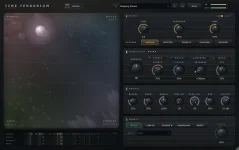
Time Terrarium runs four delay habitats at once, and its central orb decides how much incoming audio feeds each corner.
The Time Terrarium delay system makes more sense once you stop treating the orb as a fancy XY pad. Its job is tied to where fresh audio enters the four habitats. Park it close to one corner, and that habitat gets most of the input. Move it between corners and the incoming signal blends across them instead.
Each habitat can hold a different echo species, so moving the orb changes which delay character gets fed before you touch the global delay time or feedback. With the default Moss, Water, Crystal, and Ash setup, a small move can shift the balance from tape-heavy repeats toward ping-pong, shimmer, or reverse material. You are changing the input distribution, not just moving a marker around the interface.
Orbit modes automate that input balance. Circle, Figure 8, Pendulum, and Drift move the orb over time, while Depth controls how far it travels. The orbit can run from half a bar to 16 bars. With Sync enabled and the host running, movement follows the host's bar position instead of behaving like an unrelated free-running animation.
A slow synced orbit can make identical notes enter different habitat blends at different points in the arrangement. The source performance can stay the same while the routing changes underneath it. Parking the orb removes the moving input balance, which helps when you want to hear what one habitat is doing before adding motion.
The habitat lanes show the repeats a single note would produce with the current settings. They are best read as a routing preview, not proof that every later repeat will behave exactly like the first one. In complex delays, delay taps and feedback do different jobs, and Time Terrarium adds another layer by allowing repeats to move between habitats.
You can leave the orb parked while Migrate keeps changing the character of repeats already circulating. You can also move the orb while keeping Migrate restrained, changing where each new sound enters without automatically forcing the existing tail through a sequence of habitats.
Those controls can be combined, but they are not substitutes. Orb motion changes the feed into the system. Migrate changes what happens to material on later passes. Keeping those jobs separate makes patches easier to debug because you can hear whether a changing texture comes from new input being routed differently or old repeats entering another habitat.
The available product material does not specify Time Terrarium's internal DSP topology, so assuming a particular network under the hood would be guesswork. The broader idea of recirculating signal through interconnected delay-line networks is well established, but the useful part here is simpler. Time Terrarium exposes the routing musically without asking you to manage a matrix of internal connections.
A restrained orbit works when the delay needs motion without constantly changing identity. Keep the orb near one corner, lower Depth, and the neighbouring habitat becomes a secondary colour rather than an equal partner. Wider movement changes the input distribution more dramatically, especially when very different species occupy adjacent corners.
Migration can make the tail evolve even after the orb has moved somewhere else. Fresh notes may enter one blend while older repeats keep travelling through neighbouring habitats. Seal pushes the separation further by blocking new input while material already inside keeps circulating, making the repeat routing easier to hear on its own.
Start with the orb still, choose the four habitats, and listen to a single note. Add orbit movement after the starting blend makes sense. Bring in Migrate last if you want later repeats to change character. Doing it in that order keeps first-pass routing, motion, and repeat migration from turning into one big guessing game.
The Time Terrarium delay system makes more sense once you stop treating the orb as a fancy XY pad. Its job is tied to where fresh audio enters the four habitats. Park it close to one corner, and that habitat gets most of the input. Move it between corners and the incoming signal blends across them instead.
Each habitat can hold a different echo species, so moving the orb changes which delay character gets fed before you touch the global delay time or feedback. With the default Moss, Water, Crystal, and Ash setup, a small move can shift the balance from tape-heavy repeats toward ping-pong, shimmer, or reverse material. You are changing the input distribution, not just moving a marker around the interface.
The orb controls the first trip through the habitats
The orb chooses how fresh signal is divided between the four active habitats, while the habitats decide what kind of processing happens there. A corner placement is the simplest case because one habitat dominates. Positions between corners create a mixture, letting two or more delay characters start from the same source hit.Orbit modes automate that input balance. Circle, Figure 8, Pendulum, and Drift move the orb over time, while Depth controls how far it travels. The orbit can run from half a bar to 16 bars. With Sync enabled and the host running, movement follows the host's bar position instead of behaving like an unrelated free-running animation.
A slow synced orbit can make identical notes enter different habitat blends at different points in the arrangement. The source performance can stay the same while the routing changes underneath it. Parking the orb removes the moving input balance, which helps when you want to hear what one habitat is doing before adding motion.
The habitat lanes show the repeats a single note would produce with the current settings. They are best read as a routing preview, not proof that every later repeat will behave exactly like the first one. In complex delays, delay taps and feedback do different jobs, and Time Terrarium adds another layer by allowing repeats to move between habitats.
Migrate changes the repeats after they are inside
Migrate works later in the chain from the orb. Instead of deciding where new audio enters, it passes repeats onward to a neighbouring habitat, either clockwise or counter-clockwise. With the default four habitats, one sound can return with one character, move on, then return with another.You can leave the orb parked while Migrate keeps changing the character of repeats already circulating. You can also move the orb while keeping Migrate restrained, changing where each new sound enters without automatically forcing the existing tail through a sequence of habitats.
Those controls can be combined, but they are not substitutes. Orb motion changes the feed into the system. Migrate changes what happens to material on later passes. Keeping those jobs separate makes patches easier to debug because you can hear whether a changing texture comes from new input being routed differently or old repeats entering another habitat.
The available product material does not specify Time Terrarium's internal DSP topology, so assuming a particular network under the hood would be guesswork. The broader idea of recirculating signal through interconnected delay-line networks is well established, but the useful part here is simpler. Time Terrarium exposes the routing musically without asking you to manage a matrix of internal connections.
Synced movement turns routing into part of the arrangement
Host-synced orbiting becomes more useful once you treat it as repeatable routing automation. Since the orbit follows bar position while the host is playing, a four-bar movement can line up with a phrase and revisit the same parts of its path as the arrangement cycles. Depth decides whether the change stays near one habitat or crosses a wider part of the glass.A restrained orbit works when the delay needs motion without constantly changing identity. Keep the orb near one corner, lower Depth, and the neighbouring habitat becomes a secondary colour rather than an equal partner. Wider movement changes the input distribution more dramatically, especially when very different species occupy adjacent corners.
Migration can make the tail evolve even after the orb has moved somewhere else. Fresh notes may enter one blend while older repeats keep travelling through neighbouring habitats. Seal pushes the separation further by blocking new input while material already inside keeps circulating, making the repeat routing easier to hear on its own.
Start with the orb still, choose the four habitats, and listen to a single note. Add orbit movement after the starting blend makes sense. Bring in Migrate last if you want later repeats to change character. Doing it in that order keeps first-pass routing, motion, and repeat migration from turning into one big guessing game.