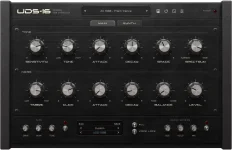
The Lel UDS uses two independent percussion channels, each built around a triangle-wave tone generator, noise source, envelopes, and pad-trigger input. It was designed as an electronic percussion module rather than a preset rhythm machine, so most of its personality comes from shaping each hit by hand.
Each channel follows the same broad layout, which makes the front panel easier to understand than old photos suggest. Tone supplies the pitched body, noise supplies the rougher broadband layer, and a separate click circuit gives the attack more definition.
Its basic architecture matters again because TapeChild’s UDS-16 drum synthesizer models two voicings of the Lel channel instead of treating the Soviet hardware as a fixed collection of sampled hits. The original machine is far simpler than a modern sixteen-voice plugin, but the important ingredients are already there.
Tone comes from a voltage-controlled oscillator producing a triangle waveform. Its pitch can move with an envelope, so the body of a hit can drop quickly from a higher initial pitch into a lower thump rather than sitting on one static note. Electronic percussion engineers were using related ideas in triggered drum synthesis circuits by the early 1980s, combining triangle oscillators, decay envelopes, and noise to shape drum-like transients.
Noise has its own envelope and timbre controls, including spectrum and tone shaping on documented units. Mixing it against the pitched oscillator changes the job of the voice quite dramatically. Low noise levels lean toward toms and rounded kicks, while heavier noise pushes the same channel toward snares, metallic knocks, and less tidy electronic percussion.
The click section is not merely another noise control. It receives the trigger alongside the other paths and produces a short attack component, giving the ear a sharper event before the longer tone and noise envelopes unfold. You can therefore change apparent punch without simply making the whole hit brighter or louder.
In practical terms, the pitched body wants to arrive quickly even when its pitch movement is being softened. You are not dealing with two perfectly symmetrical layers despite the front panel making tone and noise look like close partners. This small circuit decision helps explain why the instrument can keep a defined low-frequency body while the noisy part smears into a slower, softer entrance.
The tone and noise sections each pass through voltage-controlled amplification before being combined by the balance control. Channel level then determines how much of each complete voice reaches the shared output, so the machine behaves less like a collection of fixed drum types and more like two reusable percussion building blocks.
Both voices finally meet in one output mixer on only one of the two main boards. The second board feeds the first, where the combined signal passes through the last amplifier and DC-blocking stage. Separate channel outputs were not the stock arrangement, which is why later modifications sometimes add a second amplifier before splitting the voices.
Surviving units and technical write-ups also show why modern owners often talk about servicing before sound design. The hardware uses two near-identical voice boards stacked inside the case, with extensive direct wiring and soldered interconnections that can make routine access awkward. Aging capacitors and old connectors can matter as much as oscillator settings when you are dealing with an original unit decades after manufacture.
Two surviving schematic versions also appear to differ around the input-stage reference voltage. One documented repair notes a reference supply used by the input amplifier in its unit, while another available schematic omits it. Small revisions like this matter if you are restoring or cloning the hardware because a control label can stay the same while the circuitry behind it shifts, so component-level claims should be treated as version-specific unless the exact board revision is known.
Each channel follows the same broad layout, which makes the front panel easier to understand than old photos suggest. Tone supplies the pitched body, noise supplies the rougher broadband layer, and a separate click circuit gives the attack more definition.
Its basic architecture matters again because TapeChild’s UDS-16 drum synthesizer models two voicings of the Lel channel instead of treating the Soviet hardware as a fixed collection of sampled hits. The original machine is far simpler than a modern sixteen-voice plugin, but the important ingredients are already there.
Each channel builds a drum from separate layers
A Lel UDS hit begins with a trigger signal entering a sensitivity-controlled preamp. The circuit strips away the DC component, keeps the useful positive part of the incoming hit, then sends the resulting pulse toward the tone, noise, and click sections.Tone comes from a voltage-controlled oscillator producing a triangle waveform. Its pitch can move with an envelope, so the body of a hit can drop quickly from a higher initial pitch into a lower thump rather than sitting on one static note. Electronic percussion engineers were using related ideas in triggered drum synthesis circuits by the early 1980s, combining triangle oscillators, decay envelopes, and noise to shape drum-like transients.
Noise has its own envelope and timbre controls, including spectrum and tone shaping on documented units. Mixing it against the pitched oscillator changes the job of the voice quite dramatically. Low noise levels lean toward toms and rounded kicks, while heavier noise pushes the same channel toward snares, metallic knocks, and less tidy electronic percussion.
The click section is not merely another noise control. It receives the trigger alongside the other paths and produces a short attack component, giving the ear a sharper event before the longer tone and noise envelopes unfold. You can therefore change apparent punch without simply making the whole hit brighter or louder.
The controls hide an unusual envelope design
Old descriptions often flatten the Lel UDS into a familiar set of attack and decay knobs, but the schematic shows a stranger detail. The noise path really does use an attack-forming network for its amplitude envelope, while the corresponding tone control changes the oscillator’s frequency envelope rather than giving the tone amplitude a slow fade-in.In practical terms, the pitched body wants to arrive quickly even when its pitch movement is being softened. You are not dealing with two perfectly symmetrical layers despite the front panel making tone and noise look like close partners. This small circuit decision helps explain why the instrument can keep a defined low-frequency body while the noisy part smears into a slower, softer entrance.
The tone and noise sections each pass through voltage-controlled amplification before being combined by the balance control. Channel level then determines how much of each complete voice reaches the shared output, so the machine behaves less like a collection of fixed drum types and more like two reusable percussion building blocks.
Pad triggering shaped the instrument’s behavior
The sensitivity controls make more sense once you remember the Lel UDS was intended to work with physical drum pads. A stronger or weaker incoming pulse has to cross the input stage cleanly, and the two channels can be adjusted independently rather than trusting every pad or external trigger to arrive at the same level.Both voices finally meet in one output mixer on only one of the two main boards. The second board feeds the first, where the combined signal passes through the last amplifier and DC-blocking stage. Separate channel outputs were not the stock arrangement, which is why later modifications sometimes add a second amplifier before splitting the voices.
Surviving units and technical write-ups also show why modern owners often talk about servicing before sound design. The hardware uses two near-identical voice boards stacked inside the case, with extensive direct wiring and soldered interconnections that can make routine access awkward. Aging capacitors and old connectors can matter as much as oscillator settings when you are dealing with an original unit decades after manufacture.
Two surviving schematic versions also appear to differ around the input-stage reference voltage. One documented repair notes a reference supply used by the input amplifier in its unit, while another available schematic omits it. Small revisions like this matter if you are restoring or cloning the hardware because a control label can stay the same while the circuitry behind it shifts, so component-level claims should be treated as version-specific unless the exact board revision is known.