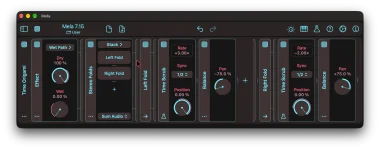
Mela 7.15 lets Vel-to-Amp run from -60 to +60 dB, so harder notes can now become quieter than softer ones. Negative Range flips the usual velocity relationship instead of merely reducing how strongly velocity affects level.
The Mela 7.15 Vel-to-Amp change matters because 7.14 had already replaced the old Curve control with Range. The newer bipolar range makes the direction explicit, with positive values favoring hard notes, negative values favoring soft notes, and 0 dB removing Vel-to-Amp's level response entirely.
Vel-to-Amp originally arrived with Collection 4 as a quick way to make audio respond to note velocity. The 7.15 change does not turn it into a different kind of processor. It simply gives the same velocity-to-level mapping a reverse gear.
A setting near 0 dB keeps the effect restrained. Push farther into negative values, and the contrast grows, up to the new -60 dB limit. You can use a mild negative Range when you only want harder playing to tuck a layer back, while a large negative value can make the response deliberately extreme.
Zero deserves its own mention because it is useful for troubleshooting. At 0 dB, Vel-to-Amp stops changing audio level according to velocity, but velocity can still matter elsewhere in the patch. Another module could still use it for modulation or MIDI processing elsewhere in the patch.
MIDI velocity is not a universal loudness knob in the first place. Roger Dannenberg's paper on MIDI velocity interpretation documents how different synthesizers map velocity to amplitude very differently, with measured dynamic ranges varying by more than 60 dB. Mela's Range control gives you an explicit level difference, but the perceived result still depends on the sound feeding it.
For a polyphonic instrument, keeping Vel-to-Amp in the Poly part of the patch lets the module work from the velocity carried by each Note signal. Once the signal path becomes Mono, the module looks at incoming MIDI instead. If the response seems detached from the notes you expected, checking the module's signal mode is a better first move than cranking Range harder.
Mela also has a separate Velocity module, and the two jobs are easy to mix up. Velocity changes incoming MIDI note velocities with controls such as Offset, random addition, minimum, and maximum values. Vel-to-Amp leaves the velocity message as the control source and changes the audio level from it.
The difference becomes handy when building layered sounds. One layer can use a normal positive Range while another uses a negative Range, so the balance shifts as you play harder without rewriting the original MIDI velocities. A quiet support layer can come forward on soft notes and duck back on hard accents while the main layer does the opposite.
Low smoothing keeps the response immediate, which suits parts where each attack should reflect the incoming velocity clearly. More smoothing can make large jumps in velocity feel less abrupt, especially when a negative Range is exaggerating the difference between neighboring notes.
This is also where extreme settings can get messy. A -60 dB Range gives you a huge span, so small performance differences can produce a much larger level contrast than you actually need. Starting closer to 0 dB makes it easier to hear whether inverted dynamics are helping the part before you widen the range.
If the patch already uses velocity for filter movement, FM depth, or another internal target, flipping only Vel-to-Amp can create opposing responses inside one sound. Hard notes can become quieter at the output while another velocity-sensitive stage becomes more intense. Keep an eye on where each velocity response happens, because a negative amplitude mapping does not automatically invert every other velocity-controlled part of the patch.
The Mela 7.15 Vel-to-Amp change matters because 7.14 had already replaced the old Curve control with Range. The newer bipolar range makes the direction explicit, with positive values favoring hard notes, negative values favoring soft notes, and 0 dB removing Vel-to-Amp's level response entirely.
Vel-to-Amp originally arrived with Collection 4 as a quick way to make audio respond to note velocity. The 7.15 change does not turn it into a different kind of processor. It simply gives the same velocity-to-level mapping a reverse gear.
Negative Range flips the usual velocity response
Range sets the level difference between the lowest and highest note velocities. With a positive value, higher velocities come out louder and lower velocities quieter. Move Range below 0 dB and the relationship reverses, so the high-velocity end becomes quieter than the low-velocity end by the chosen amount.A setting near 0 dB keeps the effect restrained. Push farther into negative values, and the contrast grows, up to the new -60 dB limit. You can use a mild negative Range when you only want harder playing to tuck a layer back, while a large negative value can make the response deliberately extreme.
Zero deserves its own mention because it is useful for troubleshooting. At 0 dB, Vel-to-Amp stops changing audio level according to velocity, but velocity can still matter elsewhere in the patch. Another module could still use it for modulation or MIDI processing elsewhere in the patch.
MIDI velocity is not a universal loudness knob in the first place. Roger Dannenberg's paper on MIDI velocity interpretation documents how different synthesizers map velocity to amplitude very differently, with measured dynamic ranges varying by more than 60 dB. Mela's Range control gives you an explicit level difference, but the perceived result still depends on the sound feeding it.
Mono and Poly modes read velocity differently
Vel-to-Amp takes its velocity source from the Note signal when the module is running in Poly mode. In Mono mode, it reads velocity from MIDI instead. The distinction matters in a modular patch because those signals live at different points in Mela's processing structure.For a polyphonic instrument, keeping Vel-to-Amp in the Poly part of the patch lets the module work from the velocity carried by each Note signal. Once the signal path becomes Mono, the module looks at incoming MIDI instead. If the response seems detached from the notes you expected, checking the module's signal mode is a better first move than cranking Range harder.
Mela also has a separate Velocity module, and the two jobs are easy to mix up. Velocity changes incoming MIDI note velocities with controls such as Offset, random addition, minimum, and maximum values. Vel-to-Amp leaves the velocity message as the control source and changes the audio level from it.
The difference becomes handy when building layered sounds. One layer can use a normal positive Range while another uses a negative Range, so the balance shifts as you play harder without rewriting the original MIDI velocities. A quiet support layer can come forward on soft notes and duck back on hard accents while the main layer does the opposite.
Smooth controls the transition between notes
Vel-to-Amp's Smooth parameter sets the time constant for level changes between notes. It does not reverse the mapping or alter the Range amount. Its job is to soften how quickly the gain moves when successive notes arrive with different velocities.Low smoothing keeps the response immediate, which suits parts where each attack should reflect the incoming velocity clearly. More smoothing can make large jumps in velocity feel less abrupt, especially when a negative Range is exaggerating the difference between neighboring notes.
This is also where extreme settings can get messy. A -60 dB Range gives you a huge span, so small performance differences can produce a much larger level contrast than you actually need. Starting closer to 0 dB makes it easier to hear whether inverted dynamics are helping the part before you widen the range.
If the patch already uses velocity for filter movement, FM depth, or another internal target, flipping only Vel-to-Amp can create opposing responses inside one sound. Hard notes can become quieter at the output while another velocity-sensitive stage becomes more intense. Keep an eye on where each velocity response happens, because a negative amplitude mapping does not automatically invert every other velocity-controlled part of the patch.