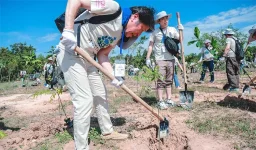
Hundreds of volunteers gathered at Cambodia's famous Angkor Archaeological Park on July 5 for a massive tree-planting mission. The group of 800 people came from Japan and Cambodia to plant 10,000 young trees across five hectares of land. Japanese volunteers made up 450 of the workers, with 350 Cambodians joining the effort. The planting happened east of Prey Temple, one of the ancient sites that draws tourists from around the world. AEON Environmental Foundation from Japan teamed up with Cambodia's APSARA National Authority to make this happen.
AEON has been planting trees around Cambodia since 2002 to protect the country's historic temples. The foundation fights against soil erosion that threatens these ancient buildings. Board member Noya Okada says the group has already planted more than 34,000 trees with over 4,200 volunteers helping out. They have worked at different spots around Angkor Wat, temple areas, museums, and wildlife centers. The total number of trees AEON has planted across Cambodia reaches 64,409 with 8,692 volunteers taking part.
Trees play a huge role in keeping Cambodia's ancient temples standing strong. Many temples sit on sandy ground that needs stable water levels to survive. The trees pull rain from the sky, hold groundwater steady, and create shade for visitors and animals. They also protect the old stone buildings from storms, floods, and climate damage. Over 20 years, more than two million trees have been planted around Angkor Park.
AEON has been planting trees around Cambodia since 2002 to protect the country's historic temples. The foundation fights against soil erosion that threatens these ancient buildings. Board member Noya Okada says the group has already planted more than 34,000 trees with over 4,200 volunteers helping out. They have worked at different spots around Angkor Wat, temple areas, museums, and wildlife centers. The total number of trees AEON has planted across Cambodia reaches 64,409 with 8,692 volunteers taking part.
Trees play a huge role in keeping Cambodia's ancient temples standing strong. Many temples sit on sandy ground that needs stable water levels to survive. The trees pull rain from the sky, hold groundwater steady, and create shade for visitors and animals. They also protect the old stone buildings from storms, floods, and climate damage. Over 20 years, more than two million trees have been planted around Angkor Park.