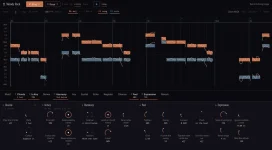
Melody Rack uses a neural model to turn sung audio into notes, while its later harmony and MIDI processing runs on deterministic music-theory rules. The split is unusually clear for a tool sold in a market where “AI” often gets pasted across an entire workflow.
Your voice does not arrive as neat note names. It slides into pitch, wobbles around a center, and can hang between semitones long enough to confuse a detector. Research on neural audio-to-MIDI transcription tackles this same job by estimating note events from continuous audio.
Melody Rack uses the model at this listening stage. Once the sung phrase has become notes, the job changes from recognizing sound to manipulating symbolic musical information. The distinction is easy to miss in Melody Rack’s harmony-aware MIDI processing because transcription and the later transformations happen inside one plugin.
Two different problems get mixed here. A detector may assign the wrong MIDI note to an ambiguous pitch, while a singer may deliberately lean flat for color. Melody Rack lets you treat transcription cleanup and performance correction as separate jobs instead of flattening every deviation.
Played MIDI skips the listening stage entirely because the note data already exists. A keyboard note already states its pitch as symbolic data, so no vocal pitch has to be inferred. You can still run it through correction or harmony processing, but the rack starts from a declared note rather than an acoustic estimate.
Incoming MIDI from an existing DAW clip behaves similarly. The rack receives note events instead of listening to a microphone, so the neural transcription stage has nothing to resolve. Any changes from there belong to correction, harmony, rhythm, or other MIDI processing.
Deterministic does not mean musically trivial, because results can still depend on beat position, the chord under a note, rack order, and your settings. The useful difference is repeatability across ordinary playback, editing, and export decisions inside the same session. Song Cage says the same take with the same settings gives the same result every time.
It also separates Melody Rack from a prompt-driven music generator. The neural component listens for note information in a performance you already made. It is not composing a progression, replacing your melody, or inventing a fresh arrangement whenever the session runs.
Repeatability matters when you are A/B testing tiny MIDI edits. Keep the take and settings unchanged, and a changed result should trace back to something you actually altered in the rack. You are not wondering whether a model quietly rolled another answer between passes.
The opposite case matters just as much. A correctly detected note can still clash with the current chord, especially when a strong non-chord tone lands on a prominent beat. Here, the transcription did its job, while harmony-aware correction is making a musical decision about already recognized MIDI.
The distinction also changes how you read expressive pitch. A scoop into a note is not automatically wrong, and a blue note is not automatically failed transcription. Melody Rack keeps the sung pitch curve around the MIDI note, letting later correction consider note identity separately from the movement around it.
Those two failure modes need different fixes, so a wrong piano-roll note points you toward transcription or a hand edit. If the note is right but the generated context feels wrong, inspect the key, chords, correction settings, or rack order. Calling all of it “AI” blurs a useful debugging boundary and wastes time.
Your voice does not arrive as neat note names. It slides into pitch, wobbles around a center, and can hang between semitones long enough to confuse a detector. Research on neural audio-to-MIDI transcription tackles this same job by estimating note events from continuous audio.
Melody Rack uses the model at this listening stage. Once the sung phrase has become notes, the job changes from recognizing sound to manipulating symbolic musical information. The distinction is easy to miss in Melody Rack’s harmony-aware MIDI processing because transcription and the later transformations happen inside one plugin.
The neural model stops once the notes are on the grid
Audio transcription contains uncertainty because software must infer note events from a moving signal. A held pitch can drift, while a scoop may cross several frequencies before settling. Melody Rack keeps frame-level pitch data around each detected note, giving its correction stage more context than a plain MIDI number.Two different problems get mixed here. A detector may assign the wrong MIDI note to an ambiguous pitch, while a singer may deliberately lean flat for color. Melody Rack lets you treat transcription cleanup and performance correction as separate jobs instead of flattening every deviation.
Played MIDI skips the listening stage entirely because the note data already exists. A keyboard note already states its pitch as symbolic data, so no vocal pitch has to be inferred. You can still run it through correction or harmony processing, but the rack starts from a declared note rather than an acoustic estimate.
Incoming MIDI from an existing DAW clip behaves similarly. The rack receives note events instead of listening to a microphone, so the neural transcription stage has nothing to resolve. Any changes from there belong to correction, harmony, rhythm, or other MIDI processing.
Music theory rules handle what happens after transcription
Once notes exist, the rack works on notes rather than raw audio. Chords derive a progression, while In Key can move notes according to key and harmonic context. Harmony builds another line through the changes, and Arp uses the progression as material.Deterministic does not mean musically trivial, because results can still depend on beat position, the chord under a note, rack order, and your settings. The useful difference is repeatability across ordinary playback, editing, and export decisions inside the same session. Song Cage says the same take with the same settings gives the same result every time.
It also separates Melody Rack from a prompt-driven music generator. The neural component listens for note information in a performance you already made. It is not composing a progression, replacing your melody, or inventing a fresh arrangement whenever the session runs.
Repeatability matters when you are A/B testing tiny MIDI edits. Keep the take and settings unchanged, and a changed result should trace back to something you actually altered in the rack. You are not wondering whether a model quietly rolled another answer between passes.
The split makes editing less mysterious
A bad transcription can throw off every processor that follows it, especially when one sung note lands a semitone away from what you intended. Changing chords or adding harmony will not cleanly repair the original recognition error, because those processors are acting on the note they received. Fix the note first, then let the later musical rules react to the corrected MIDI.The opposite case matters just as much. A correctly detected note can still clash with the current chord, especially when a strong non-chord tone lands on a prominent beat. Here, the transcription did its job, while harmony-aware correction is making a musical decision about already recognized MIDI.
The distinction also changes how you read expressive pitch. A scoop into a note is not automatically wrong, and a blue note is not automatically failed transcription. Melody Rack keeps the sung pitch curve around the MIDI note, letting later correction consider note identity separately from the movement around it.
Those two failure modes need different fixes, so a wrong piano-roll note points you toward transcription or a hand edit. If the note is right but the generated context feels wrong, inspect the key, chords, correction settings, or rack order. Calling all of it “AI” blurs a useful debugging boundary and wastes time.