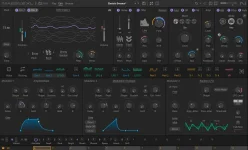
Native Instruments has launched Massive XL, a new version of its well-known wavetable synth. It keeps the raw sound of Massive X but adds new ways to make patches, shape tones, and work faster. The big change is how much more control users get without having to dig through menus.
One major addition is the Preset Generator. Producers can feed it an audio clip and get a playable synth patch that they can still edit. Stem separation is part of the process, giving users a way to pull apart audio and explore new sounds from it.
Then there is the Mutator, which makes fresh versions of a patch while keeping them close to the first sound. The Randomizer takes a less strict route, letting users change specific parts while leaving other settings as they are.
Movement gets more control as well. The updated Morpher and Animator let musicians shape changes over time, play them live, and save or move those patterns between patches.
For anyone who hates starting with a blank synth, Massive XL has ready-made templates. Users can also store custom curves for filters, effects, and modulation, which cuts down on repeat setup work.
The sound library has grown quite a bit. More than 100 wavetables join the lineup, with some from the first Massive and classic PPG content. There are also over 100 fresh noise tables for added texture.
Custom sounds are on the menu as well. Audio samples and sample libraries can serve as the basis for new wavetables, giving sound designers more material to work with.
Effects are built right into the synth. Raum, Replika Shimmer, and Tape Wobble are among the options, while polyphonic aftertouch lets compatible controllers shape notes one by one.
The interface has had a major refresh. Animated displays show modulation at work, making it easier to see how each control changes the sound. Users can also check which sources affect a single setting or view every active source in a patch.
More complex patches still get plenty of room. Drag-and-drop routing works with sidechains, envelopes, LFOs, Performers, and Trackers. Sixteen macros can be linked to controls, and DAW automation is supported.
Smaller workflow changes may be just as handy. Undo and redo are here, envelope points can be dragged, and parts of a patch can be saved for reuse. Custom user banks and built-in help also make the synth easier to manage.
Tim Adnitt, a senior product manager at Native Instruments, says the goal was to keep the sound and freedom of Massive while making it quicker for producers to reach the result they want.
On the system side, Windows 10 and newer versions are supported, along with macOS 14 and later. Plugin formats cover VST3, AU, and AAX.
Massive XL launches at £89 or €99, before moving to £179 or €199 at the regular rate. Massive X users can upgrade for £44 or €49 instead of £59 or €69, while first-generation Massive users pay £69 or €69 rather than £109 or €129. UK prices have VAT built in.