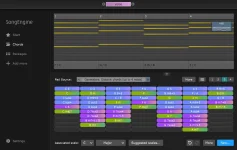
SongEngine’s Live Mode includes a Chords with bass setting that expects a dedicated bass note for every chord you play. FeelYourSound specifically recommends the mode for inversions and slash chords because SongEngine can identify which note should function as the bass.
A slash chord is not just a different spelling of the same voicing. C/E still contains a C major chord, but E is explicitly the bass, while F/G places a G underneath an F major structure even though G is not part of the F triad. In both cases, the note after the slash matters because the bass can change how the progression moves and how the harmony is heard.
SongEngine gives you several ways to alter chord notes, so keeping those jobs separate saves confusion. Moving notes into another inversion, changing a chord’s dedicated bass note, and asking Live Mode to recognize a chord with bass are related operations, but they are not interchangeable.
Consider C major in root position and C/E in first inversion. Both use C, E, and G, yet the second version puts E in the bass. Generic chord recognition can still identify the pitch collection as C major, while a dedicated bass input tells SongEngine which note you intend to sit underneath it.
This matters once generated phrases and basslines begin reacting to the progression. A wrong root guess may still produce musically plausible material, but plausible is not the same as the bass movement you intended. A descending line built around C, B, A, and G depends on those bass notes remaining deliberate rather than being treated as disposable voicing details.
Controlled experiments have found that listeners respond to both chord pitch content and bass patterns when judging harmonic expectation. Research on chord inversion and bass patterns found different responses to root-position targets, inverted versions of the same harmony, and chords that preserved the bass while changing the other pitches. Bass information is doing real perceptual work.
The fallback is convenient for ordinary root-position material. It becomes less attractive when a progression depends on inversions, pedal bass, or a carefully stepped bassline, because the lowest harmonic decision may be part of the composition rather than something you want software to infer.
Imported files also need to stay focused. SongEngine’s current guidance calls for chord-only MIDI, one MIDI channel containing data, and notes quantized to sixteenth-note positions. Those constraints reduce unrelated information before chord analysis begins, while dedicated bass notes preserve the part of the harmony most likely to become ambiguous in slash-chord material.
Once you start using SongEngine’s expanded chord pad options, richer voicings make bass-note decisions easier to overlook. Seven-note material can contain several plausible chord tones below or above the root, so the lowest note and the theoretical root should not be treated as synonyms.
The distinction becomes useful with slash chords whose bass note is outside the basic chord. F/G is not simply an inversion of F major because G is not one of the F major triad tones. Trying to reach it by cycling ordinary inversions misses the point, since the upper chord and the specified bass are separate pieces of information.
A similar issue appears when you like an inversion visually but want another bass underneath it. SongEngine lets you edit note placement without assuming the lowest visible chord tone must always define your intended bass relationship. For live playing, Chords with bass makes the same separation explicit at input time.
When a progression relies on a bass walk, inversion, or slash chord, define the bass before judging the generated material. Leaving SongEngine to guess is reasonable for sketches, but a deliberate bass line deserves the same precision as the chord above it.
A slash chord is not just a different spelling of the same voicing. C/E still contains a C major chord, but E is explicitly the bass, while F/G places a G underneath an F major structure even though G is not part of the F triad. In both cases, the note after the slash matters because the bass can change how the progression moves and how the harmony is heard.
SongEngine gives you several ways to alter chord notes, so keeping those jobs separate saves confusion. Moving notes into another inversion, changing a chord’s dedicated bass note, and asking Live Mode to recognize a chord with bass are related operations, but they are not interchangeable.
Chords with bass removes a useful ambiguity
Standard chord recognition only needs the chord you play. Chords with bass asks for one more piece of information: a dedicated bass note for each chord, which gives SongEngine an explicit answer when the lowest-note choice carries musical meaning.Consider C major in root position and C/E in first inversion. Both use C, E, and G, yet the second version puts E in the bass. Generic chord recognition can still identify the pitch collection as C major, while a dedicated bass input tells SongEngine which note you intend to sit underneath it.
This matters once generated phrases and basslines begin reacting to the progression. A wrong root guess may still produce musically plausible material, but plausible is not the same as the bass movement you intended. A descending line built around C, B, A, and G depends on those bass notes remaining deliberate rather than being treated as disposable voicing details.
Controlled experiments have found that listeners respond to both chord pitch content and bass patterns when judging harmonic expectation. Research on chord inversion and bass patterns found different responses to root-position targets, inverted versions of the same harmony, and chords that preserved the bass while changing the other pitches. Bass information is doing real perceptual work.
MIDI imports can force SongEngine to guess
FeelYourSound recommends dedicated bass notes when you import MIDI chord progressions into SongEngine. The import can still work without them, but SongEngine will choose bass notes for you when the source progression does not provide dedicated ones.The fallback is convenient for ordinary root-position material. It becomes less attractive when a progression depends on inversions, pedal bass, or a carefully stepped bassline, because the lowest harmonic decision may be part of the composition rather than something you want software to infer.
Imported files also need to stay focused. SongEngine’s current guidance calls for chord-only MIDI, one MIDI channel containing data, and notes quantized to sixteenth-note positions. Those constraints reduce unrelated information before chord analysis begins, while dedicated bass notes preserve the part of the harmony most likely to become ambiguous in slash-chord material.
Once you start using SongEngine’s expanded chord pad options, richer voicings make bass-note decisions easier to overlook. Seven-note material can contain several plausible chord tones below or above the root, so the lowest note and the theoretical root should not be treated as synonyms.
Editing an inversion is not the same as setting bass
SongEngine separates several chord-editing actions on the Chords page. The up and down arrow keys invert the active chord notes, while a right-click on a chord gives you an option to change its bass note directly. One operation rearranges voicing. The other tells SongEngine what bass note the chord should use.The distinction becomes useful with slash chords whose bass note is outside the basic chord. F/G is not simply an inversion of F major because G is not one of the F major triad tones. Trying to reach it by cycling ordinary inversions misses the point, since the upper chord and the specified bass are separate pieces of information.
A similar issue appears when you like an inversion visually but want another bass underneath it. SongEngine lets you edit note placement without assuming the lowest visible chord tone must always define your intended bass relationship. For live playing, Chords with bass makes the same separation explicit at input time.
When a progression relies on a bass walk, inversion, or slash chord, define the bass before judging the generated material. Leaving SongEngine to guess is reasonable for sketches, but a deliberate bass line deserves the same precision as the chord above it.