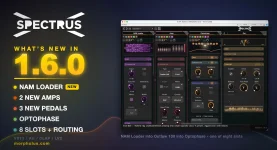
Spectrus Optophase uses eight all-pass stages driven by a modeled incandescent lamp and photocells, with a sweep range of 0.03 to 4 Hz. The regular Phaser reaches from 0.01 to 10 Hz and lets you choose anywhere from one to twelve stages, so these two effects overlap less than their names suggest.
The Spectrus vintage opto phaser is built around the shape of its sweep rather than a long menu of modulation choices. Lamp is the decisive control. At 0 percent, the movement is clean and symmetric, while higher settings bring in thermal lag and the nonlinear response of the modeled photocells.
Spectrus does not treat the Lamp knob as a wet and dry crossfade between two finished sounds. Intermediate settings alter the motion itself, so 40 percent Lamp is a different sweep shape rather than a quieter serving of the full vintage behavior. This distinction is easy to miss if you approach it like a character or mix control.
Older electronic designs used the same broad idea in hardware. A 1968 patent for lamp-driven phase shifting with light-dependent resistors describes cascaded phase-shifting stages whose variable resistors respond to a lamp driven at the modulation rate. Spectrus is not presented as a recreation of that circuit, but the patent makes the lamp and photocell relationship less mysterious.
Rate controls the lamp drive cycle from 0.03 to 4 Hz, while Depth sets how far the notches travel. Turn Depth down and the sweep stays concentrated around a narrower region instead of roaming through the full movement. Sync can take over the timing entirely, and the free-running Rate control is ignored while tempo sync is active.
The regular Phaser gives you more direct control over the geometry. Its Center Freq moves the sweep focus between 100 and 5000 Hz, Stages changes the number of all-pass sections, and five modulation shapes let you move beyond a simple repeating curve. Stereo Width can also offset the modulation between channels, which Optophase does not expose as a separate control.
Spectrus keeps the runaway behavior bounded, so 100 percent Feedback can howl without behaving like an unrestricted feedback loop. It is still a setting to treat deliberately. The plugin's output safety system can mute dangerously loud conditions elsewhere in Spectrus, and high-feedback effects are exactly the sort of material that can reach it.
Wet and Dry also work differently from a single conventional mix knob. Wet contains the original signal plus the swept cascade, because combining those paths is what creates the moving notches. Dry then adds another clean path in parallel, so increasing Dry makes the notches shallower instead of simply turning down the whole phased result.
A useful starting move is to set Lamp first, then Feedback, then Depth. Changing all three together makes it hard to hear whether the character comes from asymmetric movement, stronger resonance, or a wider sweep. Small Lamp changes are especially revealing on sustained guitars, pads, electric piano, and other sounds that leave enough harmonic material for the notches to travel through.
The distinction becomes obvious on rhythm parts. A tempo-synced Optophase can keep the cycle locked while the lamp model bends the internal rise and fall, which preserves rhythmic placement without making the motion perfectly symmetrical. A standard Phaser can sound tighter when the arrangement needs a more predictable repeated shape.
Neither effect makes the other redundant. Optophase gives up several conventional phaser controls in exchange for one unusually consequential parameter, while Phaser gives you a wider rate range and more control over how the notches are built and moved. Choosing between them is less about vintage versus modern and more about whether you want character baked into the motion or detailed authority over the motion itself.
The Spectrus vintage opto phaser is built around the shape of its sweep rather than a long menu of modulation choices. Lamp is the decisive control. At 0 percent, the movement is clean and symmetric, while higher settings bring in thermal lag and the nonlinear response of the modeled photocells.
Spectrus does not treat the Lamp knob as a wet and dry crossfade between two finished sounds. Intermediate settings alter the motion itself, so 40 percent Lamp is a different sweep shape rather than a quieter serving of the full vintage behavior. This distinction is easy to miss if you approach it like a character or mix control.
The lamp changes the sweep before feedback does
An incandescent filament does not heat and cool at identical speeds. Spectrus models the faster rise, brief hold near the top, and slower fall, which gives Optophase a lopsided cycle even when the underlying tempo is perfectly steady. The result is movement that can feel less mechanically even without adding random modulation.Older electronic designs used the same broad idea in hardware. A 1968 patent for lamp-driven phase shifting with light-dependent resistors describes cascaded phase-shifting stages whose variable resistors respond to a lamp driven at the modulation rate. Spectrus is not presented as a recreation of that circuit, but the patent makes the lamp and photocell relationship less mysterious.
Rate controls the lamp drive cycle from 0.03 to 4 Hz, while Depth sets how far the notches travel. Turn Depth down and the sweep stays concentrated around a narrower region instead of roaming through the full movement. Sync can take over the timing entirely, and the free-running Rate control is ignored while tempo sync is active.
The regular Phaser gives you more direct control over the geometry. Its Center Freq moves the sweep focus between 100 and 5000 Hz, Stages changes the number of all-pass sections, and five modulation shapes let you move beyond a simple repeating curve. Stereo Width can also offset the modulation between channels, which Optophase does not expose as a separate control.
Feedback turns movement into a resonant instrument
Optophase Feedback is not merely an intensity knob. Up to roughly 80 percent, the loop stays below unity, and the sweep becomes more hollow and vocal. Push farther and sustained notes begin to ring, with the top of the range crossing into controlled self-oscillation.Spectrus keeps the runaway behavior bounded, so 100 percent Feedback can howl without behaving like an unrestricted feedback loop. It is still a setting to treat deliberately. The plugin's output safety system can mute dangerously loud conditions elsewhere in Spectrus, and high-feedback effects are exactly the sort of material that can reach it.
Wet and Dry also work differently from a single conventional mix knob. Wet contains the original signal plus the swept cascade, because combining those paths is what creates the moving notches. Dry then adds another clean path in parallel, so increasing Dry makes the notches shallower instead of simply turning down the whole phased result.
A useful starting move is to set Lamp first, then Feedback, then Depth. Changing all three together makes it hard to hear whether the character comes from asymmetric movement, stronger resonance, or a wider sweep. Small Lamp changes are especially revealing on sustained guitars, pads, electric piano, and other sounds that leave enough harmonic material for the notches to travel through.
The regular Phaser wins when control matters
Optophase is the better choice when you want eight-stage movement with a fixed identity. The normal Phaser is the better tool when you need to place the sweep precisely, pick a stage count, use square or random modulation, push the rate past 4 Hz, or create stereo movement through an explicit channel offset.The distinction becomes obvious on rhythm parts. A tempo-synced Optophase can keep the cycle locked while the lamp model bends the internal rise and fall, which preserves rhythmic placement without making the motion perfectly symmetrical. A standard Phaser can sound tighter when the arrangement needs a more predictable repeated shape.
Neither effect makes the other redundant. Optophase gives up several conventional phaser controls in exchange for one unusually consequential parameter, while Phaser gives you a wider rate range and more control over how the notches are built and moved. Choosing between them is less about vintage versus modern and more about whether you want character baked into the motion or detailed authority over the motion itself.