Mike Stringer has said roughly 90 percent of the guitar sound on Spiritbox’s “Soft Spine” comes from an EarthQuaker Devices Rainbow Machine switching in and out. The riff is heavy before the pedal does anything, but the part people remember is the nasty pitch movement cutting across it.
A lot of recreations start in the wrong place. People chase amp settings, extra gain, or a huge detuned tone, then wonder why the strange little bursts still sound too clean and predictable. Stringer built the song around the ugly behavior of one effect, so the useful target is not his entire rig. It is the way the Rainbow Machine bends, delays, repeats, and then gets out of the way.
His 2026 touring board makes the picture look busier because it also carries two Whammy Ricochets, a Freeze, delays, and two Rainbow Machines. Still, Stringer has been pretty specific about “Soft Spine.” The Rainbow Machine is the main character here, not a generic whammy sound hiding somewhere else on the board.
Primary controls how loud the warped harmony is, while Secondary adds another voice an octave above or below it depending on where Pitch sits. Tracking matters just as much. Turn it up and the wet sound follows the dry guitar more tightly. Back it off, and a little lag opens between them, turning the pitch-shifted note into something closer to a twitchy repeat than a neatly stacked harmony.
This timing piece is easy to overlook when recreating the sound in software. Small moving delays change how doubled and shifted material smears against the dry note, which sits in the same basic territory as delay-line modulation behavior. You do not need a long echo. A short offset is enough to stop the processed note from feeling glued perfectly to the pick attack.
Direction matters too. With Pitch above noon, lingering repeats tend to climb. Below noon, they tend to fall. Small changes can therefore turn the same riff from a quick metallic chirp into a rising squeal that keeps trying to escape the beat. It is less about finding one perfect knob position and more about getting the feedback to misbehave for exactly long enough.
Stringer’s real trick is restraint. He described the Rainbow Machine as going on and off through most of the guitar sound, which explains why leaving a recreation permanently active usually feels wrong. The clean attack and the processed burst need to trade places. Constant weirdness quickly becomes background texture. Brief weirdness punches holes through the riff.
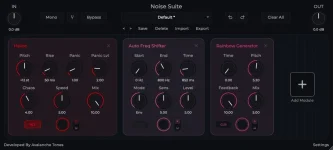
The same logic applies if you are working inside a DAW instead of with the pedal. Noise Suite’s pitch and feedback tools can cover parts of this territory because the important ingredients are available as separate processes. A pitch shift by itself will not get you there. The movement comes from what happens after the shift, how quickly the repeat returns, and whether the feedback keeps being repitched.
Automation is where the software version can get closer to the record’s stop-start feel. Bring the unstable chain in for the taps or accents that need it, then kill it before the next chunk of riff loses definition. You can automate bypass, wet level, feedback, or a macro that moves several parameters together. The exact method matters less than keeping the effect rhythmic.
Do not flatten every burst into the same shape either. Slight differences in pitch position, tracking lag, and regeneration make the effect feel twitchy instead of copied and pasted. Keep the dry guitar doing the heavy lifting, then let the warped layer bite into selected notes. Once the feedback hangs around too long, the riff stops sounding hostile and starts sounding washed out.
A lot of recreations start in the wrong place. People chase amp settings, extra gain, or a huge detuned tone, then wonder why the strange little bursts still sound too clean and predictable. Stringer built the song around the ugly behavior of one effect, so the useful target is not his entire rig. It is the way the Rainbow Machine bends, delays, repeats, and then gets out of the way.
His 2026 touring board makes the picture look busier because it also carries two Whammy Ricochets, a Freeze, delays, and two Rainbow Machines. Still, Stringer has been pretty specific about “Soft Spine.” The Rainbow Machine is the main character here, not a generic whammy sound hiding somewhere else on the board.
The Rainbow Machine is doing more than shifting pitch
The Rainbow Machine starts with a polyphonic pitch-warped harmony. Its Pitch control moves from a fourth below the input to a third above, with all the slightly wrong intervals between those points available too. Noon sits at unison, which is why the same pedal can also drift into warped chorus territory instead of sounding like a normal harmonizer.Primary controls how loud the warped harmony is, while Secondary adds another voice an octave above or below it depending on where Pitch sits. Tracking matters just as much. Turn it up and the wet sound follows the dry guitar more tightly. Back it off, and a little lag opens between them, turning the pitch-shifted note into something closer to a twitchy repeat than a neatly stacked harmony.
This timing piece is easy to overlook when recreating the sound in software. Small moving delays change how doubled and shifted material smears against the dry note, which sits in the same basic territory as delay-line modulation behavior. You do not need a long echo. A short offset is enough to stop the processed note from feeling glued perfectly to the pick attack.
Magic turns the ugly part into the useful part
The pedal gets properly unstable when Magic enters the picture. Magic feeds the shifted voices back into the processing path, so the sound can regenerate instead of appearing once and disappearing. Push it harder, and the result can climb or fall in pitch, wobble around the note, spit out aliasing, or lean toward self-oscillation.Direction matters too. With Pitch above noon, lingering repeats tend to climb. Below noon, they tend to fall. Small changes can therefore turn the same riff from a quick metallic chirp into a rising squeal that keeps trying to escape the beat. It is less about finding one perfect knob position and more about getting the feedback to misbehave for exactly long enough.
Stringer’s real trick is restraint. He described the Rainbow Machine as going on and off through most of the guitar sound, which explains why leaving a recreation permanently active usually feels wrong. The clean attack and the processed burst need to trade places. Constant weirdness quickly becomes background texture. Brief weirdness punches holes through the riff.
A convincing recreation needs movement, not a preset
Start with the riff sounding solid without the special effect. Add a polyphonic pitch shifter, keep the shifted voice clearly audible, then put a very short delay or tracking offset around it. Feed some of the processed signal back into the chain. If the result sounds polite, the feedback is probably too controlled, or the shifted voice is sitting too neatly on the dry guitar.The same logic applies if you are working inside a DAW instead of with the pedal. Noise Suite’s pitch and feedback tools can cover parts of this territory because the important ingredients are available as separate processes. A pitch shift by itself will not get you there. The movement comes from what happens after the shift, how quickly the repeat returns, and whether the feedback keeps being repitched.
Automation is where the software version can get closer to the record’s stop-start feel. Bring the unstable chain in for the taps or accents that need it, then kill it before the next chunk of riff loses definition. You can automate bypass, wet level, feedback, or a macro that moves several parameters together. The exact method matters less than keeping the effect rhythmic.
Do not flatten every burst into the same shape either. Slight differences in pitch position, tracking lag, and regeneration make the effect feel twitchy instead of copied and pasted. Keep the dry guitar doing the heavy lifting, then let the warped layer bite into selected notes. Once the feedback hangs around too long, the riff stops sounding hostile and starts sounding washed out.