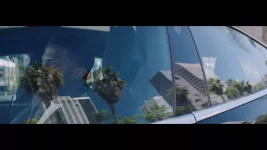
J. Cole and Scott Lazer directed “Kevin’s Heart,” released April 24, 2018, with Kevin Hart carrying almost the entire five-minute video. The headline credits are familiar, but the finished piece came from a much larger production team whose names rarely appear in write-ups about the clip.
Pomp&Clout and Dreamville are credited as the production companies, placing the video inside both a specialist visual-production setup and Cole’s own creative operation. Ryen Bartlett served as executive producer, Jefferis Gray as producer, Dustin Highbridge as co-producer, and Kevin Staake as head of production.
Those jobs matter because a music video this size is not simply two directors pointing a camera at a famous performer. Locations, schedules, extras, art direction, camera crews, post-production, and dozens of practical decisions have to move together before Hart can make an ordinary grocery run feel like a complete screen narrative.
Cole barely occupies the screen compared with Hart, appearing briefly during the stroller-store sequence. Keeping the artist in a small role leaves Hart to carry the performance while the directors organize the encounters around him. The arrangement also separates the song’s performer from the person embodying its public fallout.
The production credits make the scale clearer. Jefferis Gray’s producer role sat below Bartlett’s executive-producer credit, while Dustin Highbridge handled co-producing duties and Kevin Staake headed production. Deryck Highbridge worked as production supervisor, Preston Clay Reed as production coordinator, and a long group of assistants supported the office, set, and driving work.
None of those names change Kevin Hart’s public reckoning inside the video, but they explain how the concept became something shootable. The familiar scenes depended on logistics that most coverage skips entirely.
Miles Ford Mullin received the production-designer credit. His department included an art coordinator, leadman, prop master, set dressers, carpenters, and art assistants, showing how much physical preparation sat behind spaces designed to register as normal parts of Hart’s day. The camera and production design crew gave those spaces their finished visual character before editing or effects entered the process.
Susan Deming handled casting, with Extras on Avail credited for extras casting. Supporting performers filled small but necessary roles around Hart, including shoppers, dinner guests, a bathroom encounter, and people in the baby-store material. Their screen time may be brief, but the video depends on a believable flow of strangers around its central performer.
The full credit roll also lists assistant directors and production staff who kept the shoot moving between setups. Music-video articles rarely preserve this layer because it is less glamorous than naming a celebrity cameo, yet it is precisely the machinery required when a concept depends on repeated public encounters rather than one controlled performance stage.
Editorial went through Work Editorial, with Adam Robinson credited as editor and Erik Vogt-Nilsen as assistant editor. Marlo Baird served as executive producer on the post side, while Brian Scharwath handled post producing. Editing is especially important here because Hart’s performance is spread across separate errands and encounters rather than one continuous location.
Beacon Street Studios handled the sound mix. Rommel Molina is credited as mixer, Vivi Rojas as mix assistant, and Kate Vadnais as mix producer, giving the video its own post-production sound team beyond the finished J. Cole recording itself. Dialogue, environmental sound, and the music all had to coexist once the picture was locked. The separate mix credits show the soundtrack was treated as its own post-production job rather than simply dropping the finished song under the cut.
Pomp&Clout and Dreamville are credited as the production companies, placing the video inside both a specialist visual-production setup and Cole’s own creative operation. Ryen Bartlett served as executive producer, Jefferis Gray as producer, Dustin Highbridge as co-producer, and Kevin Staake as head of production.
Those jobs matter because a music video this size is not simply two directors pointing a camera at a famous performer. Locations, schedules, extras, art direction, camera crews, post-production, and dozens of practical decisions have to move together before Hart can make an ordinary grocery run feel like a complete screen narrative.
Cole and Scott Lazer led a much larger set
Cole already had an established working relationship with Scott Lazer when they made “Kevin’s Heart.” The pair also worked together on other Cole visuals, while Lazer’s own portfolio identifies the project among his commissioned directing work. Full production credits name both Cole and Lazer as directors.Cole barely occupies the screen compared with Hart, appearing briefly during the stroller-store sequence. Keeping the artist in a small role leaves Hart to carry the performance while the directors organize the encounters around him. The arrangement also separates the song’s performer from the person embodying its public fallout.
The production credits make the scale clearer. Jefferis Gray’s producer role sat below Bartlett’s executive-producer credit, while Dustin Highbridge handled co-producing duties and Kevin Staake headed production. Deryck Highbridge worked as production supervisor, Preston Clay Reed as production coordinator, and a long group of assistants supported the office, set, and driving work.
None of those names change Kevin Hart’s public reckoning inside the video, but they explain how the concept became something shootable. The familiar scenes depended on logistics that most coverage skips entirely.
The camera and art departments shaped the ordinary world
Isiah Donté Lee served as director of photography, the senior camera credit responsible for translating the directors’ visual plan into photographed scenes. His presence is easy to miss because contemporary coverage largely concentrated on Hart, Cole, and Lazer rather than the crew behind the lens.Miles Ford Mullin received the production-designer credit. His department included an art coordinator, leadman, prop master, set dressers, carpenters, and art assistants, showing how much physical preparation sat behind spaces designed to register as normal parts of Hart’s day. The camera and production design crew gave those spaces their finished visual character before editing or effects entered the process.
Susan Deming handled casting, with Extras on Avail credited for extras casting. Supporting performers filled small but necessary roles around Hart, including shoppers, dinner guests, a bathroom encounter, and people in the baby-store material. Their screen time may be brief, but the video depends on a believable flow of strangers around its central performer.
The full credit roll also lists assistant directors and production staff who kept the shoot moving between setups. Music-video articles rarely preserve this layer because it is less glamorous than naming a celebrity cameo, yet it is precisely the machinery required when a concept depends on repeated public encounters rather than one controlled performance stage.
Postproduction finished what the set could not
Pomp&Clout also handled visual effects, with Pete Puskas credited as VFX supervisor and lead. Aaron Vinton handled graphic design, while Blacksmith received the 2D credit. Those jobs sat after principal photography, where visual material could be refined, composited, or prepared for the final sequence without asking the live-action shoot to solve every screen element.Editorial went through Work Editorial, with Adam Robinson credited as editor and Erik Vogt-Nilsen as assistant editor. Marlo Baird served as executive producer on the post side, while Brian Scharwath handled post producing. Editing is especially important here because Hart’s performance is spread across separate errands and encounters rather than one continuous location.
Beacon Street Studios handled the sound mix. Rommel Molina is credited as mixer, Vivi Rojas as mix assistant, and Kate Vadnais as mix producer, giving the video its own post-production sound team beyond the finished J. Cole recording itself. Dialogue, environmental sound, and the music all had to coexist once the picture was locked. The separate mix credits show the soundtrack was treated as its own post-production job rather than simply dropping the finished song under the cut.