ADR replaces production dialogue with a newly recorded performance while picture timing, vocal character, and scene continuity still have to feel intact. The awkward case is not a bad line sitting alone. It is a bad line tangled with a good performance from another actor.
Replacing the whole moment throws away something you may already have. A co-star's timing, breath, interruption, or reaction can be exactly right even when the other line is unusable. Treating both voices as one disposable clip turns a repair into a second performance problem.
The cleaner approach is selective. Keep the usable actor whenever the recording allows it, isolate the line that needs replacement, and build the ADR around the surviving production performance rather than rebuilding the entire exchange.
Keep the production recording available as a guide even after you have chosen the ADR cue. It carries timing, stress, breath placement, and the exact point where the actors step on each other's words. Muting it too early makes the replacement easier to hear in isolation and harder to judge inside the scene.
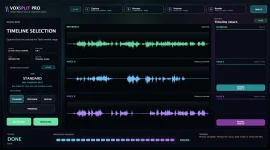
When both voices are printed into the same recording, a short overlapping-dialogue separation workflow can give the editor a cleaner version of the actor being preserved. Process only as much material as the collision demands. Leaving clean production before and after the overlap untouched reduces the amount of reconstructed audio you have to trust.
Speaker separation is not transparent by default. Modern systems can pull individual talkers from a mixture, but separation artifacts can survive into downstream speech processing, which matters just as much in an editorial context. Listen for softened consonants, unstable ambience, bits of the replaced actor leaking through, or tiny pieces of the preserved actor disappearing.
Do not solve every timing mismatch with aggressive stretching. Small timing adjustments are normal, but pushing a line until its rhythm technically fits can alter consonants, breath spacing, and vocal motion. A better take often beats a heavily forced one, especially when the production actor is still audible directly beside it.
The overlap itself gives you useful sync landmarks. A plosive, laugh, inhalation, head turn, or interruption point can anchor the new performance more naturally than staring at waveform peaks alone. Keep those moments intact where possible because they belong to the interaction, not merely to one isolated voice.
Nonverbal sounds deserve their own attention. Production breaths, lip noises, exertion, and tiny reactions often bridge the seam between original and replaced speech. If the ADR session captured wild breaths or alternate efforts, place them where the production performance needs them rather than forcing the spoken take to carry every detail.
Room character also needs to follow the scene instead of the edit. The preserved actor may already carry location ambience and reflections, while the ADR arrives clean and close. Match the replacement to the production perspective without washing both voices through one corrective treatment just because they share a moment.
Keep the separated production stem, the original mixed clip, and the ADR on distinct tracks until the decision is stable. This makes it easy to recover a consonant from the original, shorten the processed section, or abandon a damaged separation without rebuilding the cue. Printed composites hide those choices precisely when you still need them.
Finish by listening in context, not only in solo. The preserved actor should still sound like the same production performance, while the replacement should enter and leave without calling attention to the edit. If the separation damage becomes more noticeable than the original overlap, use less of it and let the untouched production carry more of the scene.
Replacing the whole moment throws away something you may already have. A co-star's timing, breath, interruption, or reaction can be exactly right even when the other line is unusable. Treating both voices as one disposable clip turns a repair into a second performance problem.
The cleaner approach is selective. Keep the usable actor whenever the recording allows it, isolate the line that needs replacement, and build the ADR around the surviving production performance rather than rebuilding the entire exchange.
The original overlap defines the edit
Start by deciding which performance actually failed and why. Noise, a clipped word, a costume hit, a changed script line, or a director's performance note all lead to ADR, but they do not require the same edit. Technical damage may affect only a few words, while a performance change can make the complete line the replacement target.Keep the production recording available as a guide even after you have chosen the ADR cue. It carries timing, stress, breath placement, and the exact point where the actors step on each other's words. Muting it too early makes the replacement easier to hear in isolation and harder to judge inside the scene.
When both voices are printed into the same recording, a short overlapping-dialogue separation workflow can give the editor a cleaner version of the actor being preserved. Process only as much material as the collision demands. Leaving clean production before and after the overlap untouched reduces the amount of reconstructed audio you have to trust.
Speaker separation is not transparent by default. Modern systems can pull individual talkers from a mixture, but separation artifacts can survive into downstream speech processing, which matters just as much in an editorial context. Listen for softened consonants, unstable ambience, bits of the replaced actor leaking through, or tiny pieces of the preserved actor disappearing.
ADR has to follow the surviving performance
Record the replacement against the picture and the original guide, but judge it against the actor you are keeping. If the preserved speaker interrupts halfway through a word, the new line has to leave room for that interruption. A replacement that sounds polished on its own can still ruin the exchange by arriving late or holding a vowel too long.Do not solve every timing mismatch with aggressive stretching. Small timing adjustments are normal, but pushing a line until its rhythm technically fits can alter consonants, breath spacing, and vocal motion. A better take often beats a heavily forced one, especially when the production actor is still audible directly beside it.
The overlap itself gives you useful sync landmarks. A plosive, laugh, inhalation, head turn, or interruption point can anchor the new performance more naturally than staring at waveform peaks alone. Keep those moments intact where possible because they belong to the interaction, not merely to one isolated voice.
Nonverbal sounds deserve their own attention. Production breaths, lip noises, exertion, and tiny reactions often bridge the seam between original and replaced speech. If the ADR session captured wild breaths or alternate efforts, place them where the production performance needs them rather than forcing the spoken take to carry every detail.
The final blend should not erase the production actor
Build the transition before reaching for heavy EQ or reverb. Cut the ADR tightly enough to replace the failed material, then compare it against the preserved actor and the untouched production on both sides. Long crossfades can create audible doubling when remnants of the original target voice are still present.Room character also needs to follow the scene instead of the edit. The preserved actor may already carry location ambience and reflections, while the ADR arrives clean and close. Match the replacement to the production perspective without washing both voices through one corrective treatment just because they share a moment.
Keep the separated production stem, the original mixed clip, and the ADR on distinct tracks until the decision is stable. This makes it easy to recover a consonant from the original, shorten the processed section, or abandon a damaged separation without rebuilding the cue. Printed composites hide those choices precisely when you still need them.
Finish by listening in context, not only in solo. The preserved actor should still sound like the same production performance, while the replacement should enter and leave without calling attention to the edit. If the separation damage becomes more noticeable than the original overlap, use less of it and let the untouched production carry more of the scene.