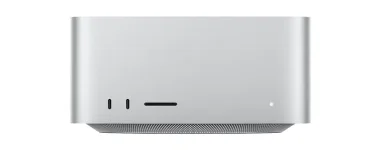
Apple Mac Studio uses M5-series chips across both configurations. The standard version gets M5 Max, while the higher-end machine carries M5 Ultra. macOS 27 Golden Gate ships installed, although musicians may still want to check app and plugin support before moving production work across.
Logic Pro testing showed the 18-core M5 Max system handling 604 stereo tracks automatically and 660 with every CPU core active. An M4 Max MacBook Pro managed 572 and 622 under the same setups, putting the newer desktop about 6 percent ahead in this workload.
AI audio showed a much wider gap. Logic Pro Stem Splitter processed a nearly hour-long, 2GB, 24-bit/96kHz file into six stems in 108 seconds on M5 Max. M4 Max needed 232 seconds, M3 Ultra took 177, and M4 Pro required roughly six and a half minutes.
GPU activity dominated during that job, while CPU use stayed low. Apple’s Neural Accelerators appear especially relevant here, since modern AI audio processing leans heavily on parallel matrix calculations.
Logic Pro testing showed the 18-core M5 Max system handling 604 stereo tracks automatically and 660 with every CPU core active. An M4 Max MacBook Pro managed 572 and 622 under the same setups, putting the newer desktop about 6 percent ahead in this workload.
AI audio showed a much wider gap. Logic Pro Stem Splitter processed a nearly hour-long, 2GB, 24-bit/96kHz file into six stems in 108 seconds on M5 Max. M4 Max needed 232 seconds, M3 Ultra took 177, and M4 Pro required roughly six and a half minutes.
GPU activity dominated during that job, while CPU use stayed low. Apple’s Neural Accelerators appear especially relevant here, since modern AI audio processing leans heavily on parallel matrix calculations.