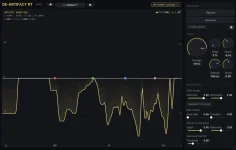
Intrect says de-artifacting can move an AI detector probability slightly either way, but the processor is not designed to lower the score. It is an audio cleanup tool, not a provenance switch.
The distinction matters because audible ugliness and forensic evidence are not the same thing. A metallic vocal, watery cymbal tail, or grainy high end can be reduced while the underlying signal still carries patterns a detector associates with generated audio.
The Intrect de-artifact audio cleanup workflow is therefore useful for sound quality on its own terms. Treating a cleaner bounce as proof that a track should now look human to an AI music detector mixes two separate jobs.
An AI-generated music detector is making a classification instead. Artifact-based systems can look at residual spectral structure, codec reconstruction behavior, time-frequency patterns, or combinations of learned features that do not map neatly to whatever sounds annoying in your monitors.
A track can therefore sound cleaner while remaining easy for a detector to classify. The reverse is possible too. A messy human recording can contain compression damage, denoising scars, clipped transients, or strange spectral shapes without becoming AI-generated just because a model dislikes them.
This is where people get tripped up by the word artifact. Restoration uses it to mean unwanted sound. Forensics may use subtle artifacts as evidence, and some of those clues can sit below the level where a listener would ever complain about them.
The recent edited-audio hard negatives in AI music detection work makes the problem even messier. Ordinary edits can introduce spectral changes that overlap with synthetic fingerprints, which means a processed human track can become a tougher classification case without having any generated music in it.
None of this means a lower number proves the audio became human. It also means a higher number after cleanup does not prove the processor somehow made the song more synthetic. The recording history did not change just because the classifier moved.
Intrect makes this separation explicit with ArtifactNet and de-artifact. Detection minutes and cleaning minutes are even treated as different services because one estimates whether audio is AI-generated while the other tries to make damaged audio sound better.
Codec handling is a good example of why scores need context. A detector trained to stay stable across WAV, MP3, AAC, and Opus is trying to avoid mistaking delivery compression for origin evidence. Real-world systems still have to deal with new codecs, new generators, mastering changes, and processing they did not see during training.
Chasing one detector number after every EQ move is therefore a bad way to judge a master. You can end up making the audio worse while learning almost nothing about where it came from. Use your ears for cleanup and treat forensic output as forensic output.
Keep the untouched export when provenance matters. Session files, dated stems, raw recordings, earlier bounces, generation records, and editing history can show what happened before the final master existed. A single processed WAV cannot carry all of that context by itself.
Comparing the original and cleaned files can still be useful diagnostically. If a detector score shifts, the change tells you the model is sensitive to something in the processing path, not that one version is suddenly more authentic than the other.
Hybrid tracks make the boundary even less tidy. A human production can contain one generated stem, while an AI-generated song can receive substantial human editing afterward. A binary label compresses all of that into one result, so the underlying production history still matters.
Clean the audio because the hiss, smear, ringing, or codec residue sounds bad. Keep the provenance evidence because authorship and production history are separate facts, and neither one becomes clearer by trying to make a detector score behave like a mastering meter.
The distinction matters because audible ugliness and forensic evidence are not the same thing. A metallic vocal, watery cymbal tail, or grainy high end can be reduced while the underlying signal still carries patterns a detector associates with generated audio.
The Intrect de-artifact audio cleanup workflow is therefore useful for sound quality on its own terms. Treating a cleaner bounce as proof that a track should now look human to an AI music detector mixes two separate jobs.
Cleanup and detection measure different things
De-artifacting listens for residue it can remove without wrecking the music. Its job is practical and audible. If a sustain has digital grit or a master has codec-like haze, the processor tries to reduce the unwanted part while leaving the performance alone.An AI-generated music detector is making a classification instead. Artifact-based systems can look at residual spectral structure, codec reconstruction behavior, time-frequency patterns, or combinations of learned features that do not map neatly to whatever sounds annoying in your monitors.
A track can therefore sound cleaner while remaining easy for a detector to classify. The reverse is possible too. A messy human recording can contain compression damage, denoising scars, clipped transients, or strange spectral shapes without becoming AI-generated just because a model dislikes them.
This is where people get tripped up by the word artifact. Restoration uses it to mean unwanted sound. Forensics may use subtle artifacts as evidence, and some of those clues can sit below the level where a listener would ever complain about them.
The recent edited-audio hard negatives in AI music detection work makes the problem even messier. Ordinary edits can introduce spectral changes that overlap with synthetic fingerprints, which means a processed human track can become a tougher classification case without having any generated music in it.
Detector scores can move without changing provenance
A probability score is an output from a model presented with one version of a file. Change the file, and you change the input. Cleanup, transcoding, limiting, sample-rate conversion, stem extraction, or another render can all shift the features available to the detector.None of this means a lower number proves the audio became human. It also means a higher number after cleanup does not prove the processor somehow made the song more synthetic. The recording history did not change just because the classifier moved.
Intrect makes this separation explicit with ArtifactNet and de-artifact. Detection minutes and cleaning minutes are even treated as different services because one estimates whether audio is AI-generated while the other tries to make damaged audio sound better.
Codec handling is a good example of why scores need context. A detector trained to stay stable across WAV, MP3, AAC, and Opus is trying to avoid mistaking delivery compression for origin evidence. Real-world systems still have to deal with new codecs, new generators, mastering changes, and processing they did not see during training.
Chasing one detector number after every EQ move is therefore a bad way to judge a master. You can end up making the audio worse while learning almost nothing about where it came from. Use your ears for cleanup and treat forensic output as forensic output.
False positives need evidence beyond one processed file
The awkward case is a human-made track that gets flagged after heavy editing. Throwing another restoration pass at it is not a reliable fix because the detector may be reacting to features unrelated to the audible defect you are trying to remove.Keep the untouched export when provenance matters. Session files, dated stems, raw recordings, earlier bounces, generation records, and editing history can show what happened before the final master existed. A single processed WAV cannot carry all of that context by itself.
Comparing the original and cleaned files can still be useful diagnostically. If a detector score shifts, the change tells you the model is sensitive to something in the processing path, not that one version is suddenly more authentic than the other.
Hybrid tracks make the boundary even less tidy. A human production can contain one generated stem, while an AI-generated song can receive substantial human editing afterward. A binary label compresses all of that into one result, so the underlying production history still matters.
Clean the audio because the hiss, smear, ringing, or codec residue sounds bad. Keep the provenance evidence because authorship and production history are separate facts, and neither one becomes clearer by trying to make a detector score behave like a mastering meter.