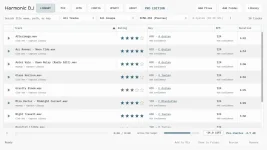
APU Harmonic DJ Community uses the same detector, key profiles, default ranking, and audio Library as the paid Pro edition. Paying changes what you can build and keep, not the underlying analysis quality.
Community is therefore much more than a crippled demo. You can scan an unlimited local library, search and organize it, rate tracks, audition audio, choose key profiles, use groups, and work through the full Mix settings surface without creating an account.
The expanded Harmonic DJ feature set may make Pro look like the edition where the serious analysis happens. It is not. The dividing line sits around persistence, scale, and transition discovery.
Nothing about moving to Pro swaps in a better key detector. The distinction matters because modern musical key estimation research measures detector accuracy as an algorithmic problem. APU simply does not reserve its detector for paying users.
Community also keeps several tools that are easy to assume would be paid-only. You can open the Mix Map, import and export Mix files, manage transition presets, copy or publish a Tracklist Preview, and drag playable local tracks from Mixes and Gems into other applications.
Existing Pro work is not hidden from a Community user either. Saved Pro Mixes and Gems remain readable and auditionable when Pro is inactive, so dropping back to the free edition does not turn previous work into an opaque locked file.
Community can also drag playable tracks from those existing documents into another application even though it cannot reshape the saved Pro Mix itself. The restriction is on Pro editing and creation, not access to your local audio or the ability to audition the work you already made.
The practical limit appears when you want the preview to become a durable working document. Community gives you one temporary five-track workspace. Pro turns it into named Mix documents that auto-save and can carry a larger, deliberately structured tracklist.
Persistent undo and redo is another less flashy difference that becomes useful once a set stops being disposable. Harmonic DJ stores complete document revisions, and those revisions survive a clean relaunch instead of disappearing with the current session.
Pro also unlocks Gem Finder. Rather than generating a complete route, Gem Finder starts from one track's outgoing harmonic evidence and lets you investigate a specific incoming key and mode, audition candidates, and decide which directed pairing is worth keeping.
Saved Gems make those decisions reusable. A pairing is directional, so approving track A into track B does not silently claim that B into A works equally well. Pro can save, rate, browse, and place those relationships back into later Mixes.
This is where the paid edition starts to make sense for repeated set planning. The upgrade is less about receiving more analysis and more about turning temporary exploration into a library of named Mixes, remembered revisions, and transitions you have personally vetted.
If Pro becomes active while a non-empty Community preview is open or still finishing, Harmonic DJ saves that preview as its own named Mix. A previously open saved Mix is left alone, which avoids an upgrade turning into an accidental overwrite.
Trial expiry is similarly conservative. Harmonic DJ returns to Community, but the Library, saved Mix documents, Gems, shared collections, and transition presets remain stored. Existing Pro Mixes and Gems can still be opened and auditioned even though Pro-only creation and editing controls stop working.
A license change during a long generation also avoids committing a half-finished result over the saved Mix. The existing document stays unchanged if access changes before the operation completes.
Community is therefore much more than a crippled demo. You can scan an unlimited local library, search and organize it, rate tracks, audition audio, choose key profiles, use groups, and work through the full Mix settings surface without creating an account.
The expanded Harmonic DJ feature set may make Pro look like the edition where the serious analysis happens. It is not. The dividing line sits around persistence, scale, and transition discovery.
Community already gives you the real analyzer
The free edition lets you create an editable Tracklist Preview of up to five tracks. Within those five positions, you can seed from the Library, generate a route, lock tracks you want to keep, replace alternatives, remove weak choices, apply exclusions, and regenerate the open positions.Nothing about moving to Pro swaps in a better key detector. The distinction matters because modern musical key estimation research measures detector accuracy as an algorithmic problem. APU simply does not reserve its detector for paying users.
Community also keeps several tools that are easy to assume would be paid-only. You can open the Mix Map, import and export Mix files, manage transition presets, copy or publish a Tracklist Preview, and drag playable local tracks from Mixes and Gems into other applications.
Existing Pro work is not hidden from a Community user either. Saved Pro Mixes and Gems remain readable and auditionable when Pro is inactive, so dropping back to the free edition does not turn previous work into an opaque locked file.
Community can also drag playable tracks from those existing documents into another application even though it cannot reshape the saved Pro Mix itself. The restriction is on Pro editing and creation, not access to your local audio or the ability to audition the work you already made.
The practical limit appears when you want the preview to become a durable working document. Community gives you one temporary five-track workspace. Pro turns it into named Mix documents that auto-save and can carry a larger, deliberately structured tracklist.
Pro mainly buys persistence and deeper editing
A Pro Mix can target an exact number of tracks above five rather than stopping at the Community ceiling. You can place tracks arbitrarily, keep separate named Mixes, duplicate them, rename them, switch between them, and return later with their planning settings intact.Persistent undo and redo is another less flashy difference that becomes useful once a set stops being disposable. Harmonic DJ stores complete document revisions, and those revisions survive a clean relaunch instead of disappearing with the current session.
Pro also unlocks Gem Finder. Rather than generating a complete route, Gem Finder starts from one track's outgoing harmonic evidence and lets you investigate a specific incoming key and mode, audition candidates, and decide which directed pairing is worth keeping.
Saved Gems make those decisions reusable. A pairing is directional, so approving track A into track B does not silently claim that B into A works equally well. Pro can save, rate, browse, and place those relationships back into later Mixes.
This is where the paid edition starts to make sense for repeated set planning. The upgrade is less about receiving more analysis and more about turning temporary exploration into a library of named Mixes, remembered revisions, and transitions you have personally vetted.
Losing Pro does not erase the work
The trial follows the same model as paid Pro and does not require a payment card. Activating it unlocks the local Pro features inside the existing application rather than installing a separate analyzer or forcing you to rebuild the Library.If Pro becomes active while a non-empty Community preview is open or still finishing, Harmonic DJ saves that preview as its own named Mix. A previously open saved Mix is left alone, which avoids an upgrade turning into an accidental overwrite.
Trial expiry is similarly conservative. Harmonic DJ returns to Community, but the Library, saved Mix documents, Gems, shared collections, and transition presets remain stored. Existing Pro Mixes and Gems can still be opened and auditioned even though Pro-only creation and editing controls stop working.
A license change during a long generation also avoids committing a half-finished result over the saved Mix. The existing document stays unchanged if access changes before the operation completes.