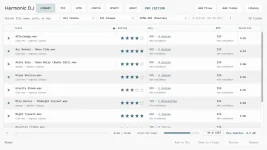
APU Harmonic DJ analyzes the first and second complete halves of a track separately when its default start and end key matching is active. The first half becomes incoming evidence, while the second half becomes outgoing evidence.
A transition from track A into track B therefore compares the end of A with the beginning of B. Reverse the order, and Harmonic DJ evaluates a different pair of harmonic states, so the result can change even though the same two files are involved.
The Harmonic DJ harmonic mixing update mentions revised key behavior, but the useful part is the directionality underneath it. One global key label cannot describe every track that shifts mode, tonic, or harmonic emphasis between its opening and closing sections.
This becomes noticeable with songs whose intros and later sections pull toward different tonal centers. A track may enter comfortably after one song yet leave cleanly for a completely different key family, and Harmonic DJ can keep both sides available instead of forcing one compromise label across the whole file.
Direction also affects saved Gems and generated routes. Approving A into B does not approve B into A, because the reverse transition would compare B's outgoing evidence with A's incoming evidence. Two tracks can be a useful pair in one direction and a poor choice in the other without any contradiction.
Mix Map makes the direction visible too. Its solid route segment runs from the previous track's outgoing key to the next track's incoming key, while numbered nodes identify the incoming state used for each track.
You can abandon the split when a single stable summary suits the job better. Whole-track matching recombines the two analyzed halves in proportion to their analyzed duration, detects one key, and uses it at both boundaries. Doing so also removes the separate start and end relationship control from the decision. For tracks with a stable tonal center, the simpler model can be cleaner and easier to reason about.
A modal key can also be viewed through its parent Ionian pitch collection. Two tracks may share the same parent collection while emphasizing different tonics, or keep a modal tonic while moving between parent collections. Harmonic DJ uses those relationships when its transition profiles decide which directed movements are acceptable.
This is one reason a familiar wheel-style key label does not tell the whole story here. Harmonic DJ can describe movement between modes as well as movement between roots, and its Mix Map plots both dimensions instead of reducing a route to a single ring of neighboring labels.
Local key research also gives some context for why one song-wide answer can be limiting. Research on local musical key estimation has shown that key labeling inside a recording can involve genuine ambiguity and disagreement, especially when musically related alternatives compete. Harmonic DJ does not claim to eliminate that ambiguity.
Key profiles can change the derived result without rescanning the audio. Harmonic DJ retains underlying calibrated harmonic evidence, then lets the selected contour and reference level shape how that evidence contributes to key detection and harmonic-detail ranking. Switching profiles can therefore expose a different interpretation of the same stored scan.
The start and end relationship setting adds another layer. You can require, prefer, ignore, discourage, or require a key change within each track, with preferences acting after transition quality while requirements filter newly selected tracks. A route can therefore favor internal harmonic stability without pretending every track must begin and finish in the same state.
Harmonic detail remains softer still. It reranks transitions that have already passed the active rules using fuller outgoing and incoming harmonic distributions, but it cannot make a rejected transition legal. The software keeps detection evidence, transition eligibility, and final listening judgment as separate decisions.
A transition from track A into track B therefore compares the end of A with the beginning of B. Reverse the order, and Harmonic DJ evaluates a different pair of harmonic states, so the result can change even though the same two files are involved.
The Harmonic DJ harmonic mixing update mentions revised key behavior, but the useful part is the directionality underneath it. One global key label cannot describe every track that shifts mode, tonic, or harmonic emphasis between its opening and closing sections.
Start and end keys answer different mixing jobs
Incoming evidence describes the harmonic material Harmonic DJ expects to meet when a track arrives. Outgoing evidence describes what another track will meet when the current one leaves. The split is coarse rather than phrase-level, but it preserves more transition information than flattening the entire file into one label.This becomes noticeable with songs whose intros and later sections pull toward different tonal centers. A track may enter comfortably after one song yet leave cleanly for a completely different key family, and Harmonic DJ can keep both sides available instead of forcing one compromise label across the whole file.
Direction also affects saved Gems and generated routes. Approving A into B does not approve B into A, because the reverse transition would compare B's outgoing evidence with A's incoming evidence. Two tracks can be a useful pair in one direction and a poor choice in the other without any contradiction.
Mix Map makes the direction visible too. Its solid route segment runs from the previous track's outgoing key to the next track's incoming key, while numbered nodes identify the incoming state used for each track.
You can abandon the split when a single stable summary suits the job better. Whole-track matching recombines the two analyzed halves in proportion to their analyzed duration, detects one key, and uses it at both boundaries. Doing so also removes the separate start and end relationship control from the decision. For tracks with a stable tonal center, the simpler model can be cleaner and easier to reason about.
Modal labels carry more detail than major and minor
Harmonic DJ's default modal detector distinguishes six modes rather than collapsing everything into major or minor. Each detected state contains both a tonic root and a mode, giving transition rules more room to preserve one musical property while changing another.A modal key can also be viewed through its parent Ionian pitch collection. Two tracks may share the same parent collection while emphasizing different tonics, or keep a modal tonic while moving between parent collections. Harmonic DJ uses those relationships when its transition profiles decide which directed movements are acceptable.
This is one reason a familiar wheel-style key label does not tell the whole story here. Harmonic DJ can describe movement between modes as well as movement between roots, and its Mix Map plots both dimensions instead of reducing a route to a single ring of neighboring labels.
Local key research also gives some context for why one song-wide answer can be limiting. Research on local musical key estimation has shown that key labeling inside a recording can involve genuine ambiguity and disagreement, especially when musically related alternatives compete. Harmonic DJ does not claim to eliminate that ambiguity.
Confidence is context rather than a verdict
The confidence value is not a calibrated probability that the detected key is correct. APU describes it as a separation heuristic showing how strongly the chosen category stood apart from nearby alternatives inside the active model. A low number is therefore context for inspection, not an automatic rejection threshold.Key profiles can change the derived result without rescanning the audio. Harmonic DJ retains underlying calibrated harmonic evidence, then lets the selected contour and reference level shape how that evidence contributes to key detection and harmonic-detail ranking. Switching profiles can therefore expose a different interpretation of the same stored scan.
The start and end relationship setting adds another layer. You can require, prefer, ignore, discourage, or require a key change within each track, with preferences acting after transition quality while requirements filter newly selected tracks. A route can therefore favor internal harmonic stability without pretending every track must begin and finish in the same state.
Harmonic detail remains softer still. It reranks transitions that have already passed the active rules using fuller outgoing and incoming harmonic distributions, but it cannot make a rejected transition legal. The software keeps detection evidence, transition eligibility, and final listening judgment as separate decisions.