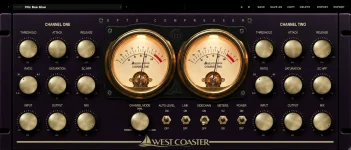
M Media Audio’s West Coaster sets automatic release from the previous sample’s gain reduction instead of using one fixed recovery time. The detail matters because “Auto” can look universal on a compressor panel, even when two plugins are making very different decisions.
Release controls how quickly gain returns after compression has pushed it down. Set it too fast, and the level can surge between closely spaced peaks, which may create pumping or extra distortion. Set it too slowly, and one loud event can leave the next quieter passage pinned down longer than you intended.
Automatic release exists because music rarely gives a compressor one neat recovery problem at a time. A snare transient may need the gain to return quickly, while a dense chorus or sustained bass note can behave better with slower recovery. The useful part is not automation itself, but the rule the compressor uses to choose between those behaviors.
Classic compressor designs already showed why variable recovery can work. Universal Audio documents program-dependent behavior where short transients recover differently from sustained high-level material. Faster recovery helps avoid prolonged dropouts after peaks, while a slower state can reduce repeated attack-release cycling during heavier compression.
Research on dynamic-range processing also treats fixed fast, fixed slow, and adaptive recovery as different compressor systems. Recent adaptive-release compression research evaluated those approaches separately, which reinforces a useful engineering point. The study concerns hearing-related compression rather than mix-bus tone, so it cannot tell you what sounds better on drums.
Other compressors put different machinery behind similar labels. Avid’s D3 disables its normal Release control in Auto mode and substitutes program-dependent timing. Apple’s Compressor keeps the Release value involved when Auto is active, so the manual value still participates in the result.
Waves C1 takes another route through its Program Dependent Release control. It can shorten recovery for transients below a user-defined duration while retaining the longer release behavior for longer events. Same broad promise, different decision rule.
Those differences matter more than the word printed beside the knob. One design may respond to duration, another may use gain-reduction history, and another may blend automation with a user-set baseline. Two Auto modes can therefore recover differently from the same kick pattern even when threshold, ratio, and visible gain reduction look similar.
A useful comparison is to loop the same eight or sixteen bars and switch only the release mode. Keep threshold and ratio unchanged, then watch whether gain returns before the next major transient or remains partly engaged. The exercise exposes recovery logic without letting louder output fool you into preferring one mode.
Listen to the gain-reduction meter after a loud transient instead of judging only the deepest dip. The shape of the return often tells you more about Auto mode than the peak number does. If the meter races back between hits, listen for level swells, low-end movement, and a mix that seems to inhale on every beat.
Slow recovery creates a different warning sign. Gain reduction may still be hanging around when the next snare, vocal phrase, or chord arrives, which can make the mix feel smaller without obvious pumping. The compressor is not necessarily overworking in peak terms, but its recovery curve is occupying too much musical time.
Manual release still wins when you want repeatable timing tied closely to a groove or when an automatic curve fights the envelope you want. Auto becomes useful when one fixed recovery value keeps becoming wrong as the arrangement changes. Treat it as a specific detector-and-envelope behavior, not a smarter version of the same knob.
Release controls how quickly gain returns after compression has pushed it down. Set it too fast, and the level can surge between closely spaced peaks, which may create pumping or extra distortion. Set it too slowly, and one loud event can leave the next quieter passage pinned down longer than you intended.
Automatic release exists because music rarely gives a compressor one neat recovery problem at a time. A snare transient may need the gain to return quickly, while a dense chorus or sustained bass note can behave better with slower recovery. The useful part is not automation itself, but the rule the compressor uses to choose between those behaviors.
Auto release solves a moving recovery problem
A fixed release gives you a known time constant, which helps when the groove and gain reduction stay fairly predictable. Problems appear when a setting that works on isolated peaks becomes twitchy during sustained material. A smoother setting can then solve the pumping but hang over the next transient and blunt its impact.Classic compressor designs already showed why variable recovery can work. Universal Audio documents program-dependent behavior where short transients recover differently from sustained high-level material. Faster recovery helps avoid prolonged dropouts after peaks, while a slower state can reduce repeated attack-release cycling during heavier compression.
Research on dynamic-range processing also treats fixed fast, fixed slow, and adaptive recovery as different compressor systems. Recent adaptive-release compression research evaluated those approaches separately, which reinforces a useful engineering point. The study concerns hearing-related compression rather than mix-bus tone, so it cannot tell you what sounds better on drums.
The label hides very different control logic
M Media Audio’s West Coaster and Howdy Compressor release makes one implementation unusually clear. West Coaster offers a 40 to 2000 millisecond manual release range plus an Auto detent. Its published description says the automatic timing is derived from the previous sample’s gain reduction rather than a hidden fixed millisecond setting.Other compressors put different machinery behind similar labels. Avid’s D3 disables its normal Release control in Auto mode and substitutes program-dependent timing. Apple’s Compressor keeps the Release value involved when Auto is active, so the manual value still participates in the result.
Waves C1 takes another route through its Program Dependent Release control. It can shorten recovery for transients below a user-defined duration while retaining the longer release behavior for longer events. Same broad promise, different decision rule.
Those differences matter more than the word printed beside the knob. One design may respond to duration, another may use gain-reduction history, and another may blend automation with a user-set baseline. Two Auto modes can therefore recover differently from the same kick pattern even when threshold, ratio, and visible gain reduction look similar.
Bus compression exposes the differences quickly
A mix bus is a rough place to assume Auto means “safe.” Kick, bass, vocal, cymbals, and sustained instruments all feed the detector, so the recovery decision keeps changing with the arrangement. A setting that sounds calm in a sparse verse may start breathing once the chorus stacks sustained energy behind the drums.A useful comparison is to loop the same eight or sixteen bars and switch only the release mode. Keep threshold and ratio unchanged, then watch whether gain returns before the next major transient or remains partly engaged. The exercise exposes recovery logic without letting louder output fool you into preferring one mode.
Listen to the gain-reduction meter after a loud transient instead of judging only the deepest dip. The shape of the return often tells you more about Auto mode than the peak number does. If the meter races back between hits, listen for level swells, low-end movement, and a mix that seems to inhale on every beat.
Slow recovery creates a different warning sign. Gain reduction may still be hanging around when the next snare, vocal phrase, or chord arrives, which can make the mix feel smaller without obvious pumping. The compressor is not necessarily overworking in peak terms, but its recovery curve is occupying too much musical time.
Manual release still wins when you want repeatable timing tied closely to a groove or when an automatic curve fights the envelope you want. Auto becomes useful when one fixed recovery value keeps becoming wrong as the arrangement changes. Treat it as a specific detector-and-envelope behavior, not a smarter version of the same knob.