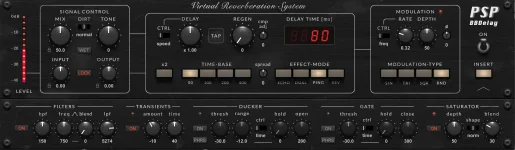
PSP BBDelay's Reverb mode starts with two initial taps at minimum regeneration, then grows denser as feedback keeps the BBD structure circulating. It is deliberately not built like a conventional room reverb. PSP even warns against reading too much into the mode name because the sound comes from a set of modeled bucket-brigade chips rather than a complex reverberation network.
The distinction matters more than the label. The original PSP BBDelay's BBD ambience engine already gives you regeneration, chip spread, modulation, damping, dirt, and compander behavior, so Reverb mode is really another routing personality for those parts. You still hear the delay hardware idea underneath the wash.
A normal algorithmic reverb usually works hard to make individual reflections disappear into a believable field. BBDelay can leave more of the machinery audible. The tail may smear and thicken, but it can also retain little timing quirks, tonal decay, and uneven movement that make it feel closer to strange electronic ambience than a virtual room.
BBDelay takes a less polite route. PSP describes its Reverb mode as having increasing density and an interesting tap pattern, but the source remains a set of BBD chips. No claim is made that it reconstructs the reflection behavior of a hall, plate, chamber, or room.
Regeneration is where the mode begins to stretch out. At the minimum setting, PSP says Reverb mode produces two initial taps rather than the single tap used by the standard mono delay. Raise regeneration and more processed material cycles back through the system, extending the ambience while giving the BBD character more chances to accumulate.
This also explains why the decay can feel animated without needing a separate diffusion knob. Each cycle can encounter the modeled chip behavior, tone losses, modulation, compander character, and any enabled insert processing again. The tail is being worked as it survives.
Small changes can loosen the relationship between the internal delay events. Push farther, and the ambience becomes less rigid because those modeled chips are no longer lining up as neatly. You are changing the timing structure feeding the dense tail, not simply turning up a left-right widening effect afterward.
The Time Base control deserves similar caution. Its printed values are only approximate, and PSP specifically notes that Reverb mode produces a more complicated result than the straightforward timings found in mono or dual-mono operation. Treating the selected time base as an exact prediction of the audible reflection pattern can therefore send you chasing numbers that were never meant to describe the whole pattern.
Use the Delay control when the timing character needs fine adjustment. Slower and faster BBD clock settings alter the internal timing behavior, while regeneration determines how long material keeps returning. Spread then decides how orderly those internal chip delays remain around each other.
The high-pass control works on the same recursive idea at the bottom end. Repeated low-frequency loss can stop a long BBD ambience from building into a muddy floor, while the resonant bell filter can leave a chosen region more prominent as everything else changes around it. This is closer to sculpting the decay process than EQing a finished reverb return.
Dirt and compander misalignment can push the tail farther from conventional reverb behavior. Every extra cycle gives those nonlinearities another chance to become audible, especially at lower levels where the tail is already breaking apart. Clean settings keep the pattern easier to read, while rougher settings can make the decay fray at the edges.
For a useful test, feed Reverb mode a short snare, rimshot, or muted synth stab and pull regeneration fully down. Listen to the two opening events first. Raise regeneration gradually, then add Spread without touching the wet level, and the change from a sparse BBD tap pattern into a denser, less orderly ambience becomes much easier to hear.
The distinction matters more than the label. The original PSP BBDelay's BBD ambience engine already gives you regeneration, chip spread, modulation, damping, dirt, and compander behavior, so Reverb mode is really another routing personality for those parts. You still hear the delay hardware idea underneath the wash.
A normal algorithmic reverb usually works hard to make individual reflections disappear into a believable field. BBDelay can leave more of the machinery audible. The tail may smear and thicken, but it can also retain little timing quirks, tonal decay, and uneven movement that make it feel closer to strange electronic ambience than a virtual room.
BBD taps build the space differently
Artificial reverb has always had an echo-density problem. Sparse repeated delays sound like echoes, while enough closely spaced events start to register as a continuous tail. Classic high-density artificial reverberation work tackled this with delay structures designed to raise echo density while avoiding obvious flutter and heavy coloration.BBDelay takes a less polite route. PSP describes its Reverb mode as having increasing density and an interesting tap pattern, but the source remains a set of BBD chips. No claim is made that it reconstructs the reflection behavior of a hall, plate, chamber, or room.
Regeneration is where the mode begins to stretch out. At the minimum setting, PSP says Reverb mode produces two initial taps rather than the single tap used by the standard mono delay. Raise regeneration and more processed material cycles back through the system, extending the ambience while giving the BBD character more chances to accumulate.
This also explains why the decay can feel animated without needing a separate diffusion knob. Each cycle can encounter the modeled chip behavior, tone losses, modulation, compander character, and any enabled insert processing again. The tail is being worked as it survives.
Spread changes the tail instead of just widening it
Spread is easy to misread as a stereo-width control because it can create timing differences between channels in Dual Delay mode. Reverb mode uses it differently. PSP says randomized timing spread between the individual BBD chips changes the character of the reverb tail itself.Small changes can loosen the relationship between the internal delay events. Push farther, and the ambience becomes less rigid because those modeled chips are no longer lining up as neatly. You are changing the timing structure feeding the dense tail, not simply turning up a left-right widening effect afterward.
The Time Base control deserves similar caution. Its printed values are only approximate, and PSP specifically notes that Reverb mode produces a more complicated result than the straightforward timings found in mono or dual-mono operation. Treating the selected time base as an exact prediction of the audible reflection pattern can therefore send you chasing numbers that were never meant to describe the whole pattern.
Use the Delay control when the timing character needs fine adjustment. Slower and faster BBD clock settings alter the internal timing behavior, while regeneration determines how long material keeps returning. Spread then decides how orderly those internal chip delays remain around each other.
Each processing cycle can age the ambience
The insert filters become especially useful here because PSP applies their losses on every reverb processing cycle. A low-pass setting does not merely darken the final wet output once. High-frequency energy can be reduced repeatedly as the ambience circulates, making later parts of the tail softer than the first arrivals.The high-pass control works on the same recursive idea at the bottom end. Repeated low-frequency loss can stop a long BBD ambience from building into a muddy floor, while the resonant bell filter can leave a chosen region more prominent as everything else changes around it. This is closer to sculpting the decay process than EQing a finished reverb return.
Dirt and compander misalignment can push the tail farther from conventional reverb behavior. Every extra cycle gives those nonlinearities another chance to become audible, especially at lower levels where the tail is already breaking apart. Clean settings keep the pattern easier to read, while rougher settings can make the decay fray at the edges.
For a useful test, feed Reverb mode a short snare, rimshot, or muted synth stab and pull regeneration fully down. Listen to the two opening events first. Raise regeneration gradually, then add Spread without touching the wet level, and the change from a sparse BBD tap pattern into a denser, less orderly ambience becomes much easier to hear.