Abbey Road was already using eight or more microphones on some sessions by the mid-1950s, before British rock had settled on a studio language. By the 1960s, four-track tape, live-room bleed, limited processing, and fast decisions were shaping drum sounds as much as the kits themselves.
You can hear the period change from decade to decade. Early British pop and rock often kept the kit compact, dry, and relatively contained, while later records let rooms, distance mics, compression, and aggressive ambience become part of the performance rather than something to hide.
Damping does plenty of the work. Shorter kick and tom resonance, controlled cymbals, and a snare that does not ring forever can put you closer to the period before you touch an EQ, while mono or narrow ambience often feels more believable than a huge modern stereo wash.
The recording chain matters too, but not because vintage gear has some secret spell. Older desks, tape, limiters, and simple EQ stages pushed engineers toward commitment, and the restricted track counts meant a drum balance often had to survive as a finished idea much earlier in the session.
Modern sessions make it easy to overbuild this sound. Twelve close mics, wide overheads, stereo rooms, parallel compression, sample reinforcement, and surgical cleanup can leave you with a cleaner drum mix that feels less like the record you were chasing.
The famous Led Zeppelin records pushed the room idea further. On "When the Levee Breaks," John Bonham's kit was placed in the entrance hall at Headley Grange, while distant microphones up the stairway captured the building around the drums rather than just the drums themselves.
You do not need a manor house to learn from that choice. A close mic tells you what a drum is doing at the head, while a distant mic tells you how the hit develops after it leaves the kit, and those two views can be balanced for weight instead of stacked automatically.
Cymbals complicate the picture because they do not radiate sound evenly in every direction. The measured cymbal radiation patterns show why moving an overhead changes more than stereo position, since angle and height can alter the balance of attack, body, and high-frequency energy before any processing happens.
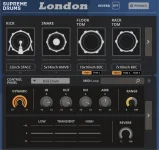
A British rock drum library built around several kit colors gives you options, but the production decision still comes first. If you want early British pop, start tighter and drier, while a 1970s rock part usually tolerates more room, more decay, and more physical weight.
Engineer Bill Price used ambient microphones around the room and keyed their ambience with early gates. The trick let the room hit hard without leaving a long uncontrolled tail, which gives the record a different kind of size from the open decay heard on many 1970s rock sessions.
This distinction matters when you are building drums now. A long room can make a slower groove feel enormous, but the same decay can blur fast eighth-note guitars, busy fills, or a bass line that already owns the low mids.
For punkier material, shorten the room before you brighten the snare. Keep enough ambience to make the kit feel physical, then trim the tail until the groove stops dragging behind itself, because the sense of aggression often comes from how quickly the room gets out of the way.
British rock drums make more sense once you stop treating the style as a preset. The useful choices are specific to the song, with damping, room length, microphone distance, cymbal balance, and compression changing according to the decade and the arrangement in front of you.
You can hear the period change from decade to decade. Early British pop and rock often kept the kit compact, dry, and relatively contained, while later records let rooms, distance mics, compression, and aggressive ambience become part of the performance rather than something to hide.
British drum sound started with tighter choices
A convincing 1960s British drum sound usually begins with fewer moving parts. The kit needs to feel like one instrument, so overheads and room balance matter more than building a separate polished channel for every shell.Damping does plenty of the work. Shorter kick and tom resonance, controlled cymbals, and a snare that does not ring forever can put you closer to the period before you touch an EQ, while mono or narrow ambience often feels more believable than a huge modern stereo wash.
The recording chain matters too, but not because vintage gear has some secret spell. Older desks, tape, limiters, and simple EQ stages pushed engineers toward commitment, and the restricted track counts meant a drum balance often had to survive as a finished idea much earlier in the session.
Modern sessions make it easy to overbuild this sound. Twelve close mics, wide overheads, stereo rooms, parallel compression, sample reinforcement, and surgical cleanup can leave you with a cleaner drum mix that feels less like the record you were chasing.
Room sound became part of the instrument
By the late 1960s and 1970s, British rock drums could become much larger without requiring dozens of microphones. Glyn Johns became associated with a sparse setup built around a strong whole-kit picture, with microphone distance and phase relationships doing work that many modern sessions hand to plugins.The famous Led Zeppelin records pushed the room idea further. On "When the Levee Breaks," John Bonham's kit was placed in the entrance hall at Headley Grange, while distant microphones up the stairway captured the building around the drums rather than just the drums themselves.
You do not need a manor house to learn from that choice. A close mic tells you what a drum is doing at the head, while a distant mic tells you how the hit develops after it leaves the kit, and those two views can be balanced for weight instead of stacked automatically.
Cymbals complicate the picture because they do not radiate sound evenly in every direction. The measured cymbal radiation patterns show why moving an overhead changes more than stereo position, since angle and height can alter the balance of attack, body, and high-frequency energy before any processing happens.
A British rock drum library built around several kit colors gives you options, but the production decision still comes first. If you want early British pop, start tighter and drier, while a 1970s rock part usually tolerates more room, more decay, and more physical weight.
Punk made ambience short and violent
British punk did not simply throw away the big-room idea. The Sex Pistols' "Anarchy in the U.K." was recorded at Wessex Studios in 1976 with Paul Cook placed in the middle of the room, while other instruments were screened off so the drum ambience could be captured more freely.Engineer Bill Price used ambient microphones around the room and keyed their ambience with early gates. The trick let the room hit hard without leaving a long uncontrolled tail, which gives the record a different kind of size from the open decay heard on many 1970s rock sessions.
This distinction matters when you are building drums now. A long room can make a slower groove feel enormous, but the same decay can blur fast eighth-note guitars, busy fills, or a bass line that already owns the low mids.
For punkier material, shorten the room before you brighten the snare. Keep enough ambience to make the kit feel physical, then trim the tail until the groove stops dragging behind itself, because the sense of aggression often comes from how quickly the room gets out of the way.
British rock drums make more sense once you stop treating the style as a preset. The useful choices are specific to the song, with damping, room length, microphone distance, cymbal balance, and compression changing according to the decade and the arrangement in front of you.