Electro-Harmonix describes the Freeze as a real-time sample-capture effect that can hold a note or chord indefinitely while you keep playing. Where you place a freeze effect therefore decides what gets captured and what remains free to move afterward.
A normal pedalboard order gives you a decent starting point, but experimental heavy guitar gets more interesting once you stop treating it as law. Pitch, glitch, freeze, and delay can all work in several positions. The useful question is what signal you want each processor to receive.
Once you think in those terms, the chain gets easier to build. You are not hunting for one approved order. You are choosing where the rig takes its snapshot, where pitch analysis happens, and which sounds are allowed to keep changing.
Reverse the order and the pitch shifter receives the sustained layer after capture. Now you can hold a plain chord and move its pitch while it continues. The same idea works with modulation, filtering, distortion, and other processors. Effects before freeze get baked into the captured material. Effects after freeze can keep reshaping it.
Glitch processing makes the difference more obvious. A stutter or buffer effect placed before freeze can create a mangled fragment that gets captured as a steady texture. Put the glitch processor after freeze and the held material remains available as a continuous source for chopping, retriggering, or muting.
The exact result depends on how a pedal or plugin mixes dry and wet signals, so do not assume every freeze device routes identically. Still, the basic signal-flow principle holds. Work on effect-chain recognition has even treated order as a defining part of the resulting sound because cascaded processors are not generally interchangeable, which is the useful point behind order-aware audio effect chains.
Creative pitch effects are different. Bad tracking can become part of the sound. Moving a shifter after distortion, modulation, or delay can produce rougher attacks, unstable intervals, and little digital slips that would be annoying in a clean transpose patch but useful in a glitch chain.
This is where generic pedal-order charts start running out of road. A clean pitch shifter before gain answers one problem. A pitch processor deliberately fed a smeared or distorted signal answers another. Neither placement is universally correct because the desired failure mode is different.
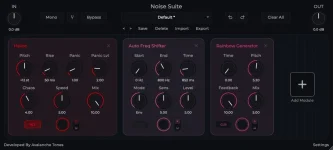
The modular layout behind Noise Suite’s rearrangeable effect chains matters for exactly this reason. Moving pitch, freeze, frequency shifting, glitch processing, and feedback-heavy delay changes what reaches the next stage without requiring a completely different rig.
Delay before freeze gives you another behavior. The freeze captures whatever combination of direct guitar and delay tail happens to exist at the input at that moment. Once captured, the held sound no longer needs the upstream delay to keep evolving. You have effectively grabbed one frame from a moving echo pattern.
Glitch effects follow the same logic. Before freeze, the glitch becomes source material. After freeze, the sustained layer becomes source material for the glitch. Put delay after both, and the chopped pieces can repeat. Put delay before the glitch, and each repeat becomes fresh material for chopping.
For heavy guitar, start with a simple chain and move one block at a time. Keep the version that makes the riff clearer or more violent in the way you actually want. Signal order stops feeling mysterious once every move has a concrete job.
A normal pedalboard order gives you a decent starting point, but experimental heavy guitar gets more interesting once you stop treating it as law. Pitch, glitch, freeze, and delay can all work in several positions. The useful question is what signal you want each processor to receive.
Once you think in those terms, the chain gets easier to build. You are not hunting for one approved order. You are choosing where the rig takes its snapshot, where pitch analysis happens, and which sounds are allowed to keep changing.
Freeze placement decides what gets trapped
Freeze behaves like a memory point in the chain. Put pitch shifting before it, and the frozen layer contains the shifted sound. Bypass or move the pitch effect afterward and the held layer stays based on whatever entered the freeze when you captured it.Reverse the order and the pitch shifter receives the sustained layer after capture. Now you can hold a plain chord and move its pitch while it continues. The same idea works with modulation, filtering, distortion, and other processors. Effects before freeze get baked into the captured material. Effects after freeze can keep reshaping it.
Glitch processing makes the difference more obvious. A stutter or buffer effect placed before freeze can create a mangled fragment that gets captured as a steady texture. Put the glitch processor after freeze and the held material remains available as a continuous source for chopping, retriggering, or muting.
The exact result depends on how a pedal or plugin mixes dry and wet signals, so do not assume every freeze device routes identically. Still, the basic signal-flow principle holds. Work on effect-chain recognition has even treated order as a defining part of the resulting sound because cascaded processors are not generally interchangeable, which is the useful point behind order-aware audio effect chains.
Pitch gets cleaner early and stranger later
Polyphonic pitch shifters usually behave best when they receive a relatively clean guitar signal. Heavy distortion, modulation, and overlapping repeats give the tracking stage more complicated material to analyze. Put the shifter early when the job is convincing drop tuning, tight harmonies, or a stable octave.Creative pitch effects are different. Bad tracking can become part of the sound. Moving a shifter after distortion, modulation, or delay can produce rougher attacks, unstable intervals, and little digital slips that would be annoying in a clean transpose patch but useful in a glitch chain.
This is where generic pedal-order charts start running out of road. A clean pitch shifter before gain answers one problem. A pitch processor deliberately fed a smeared or distorted signal answers another. Neither placement is universally correct because the desired failure mode is different.
The modular layout behind Noise Suite’s rearrangeable effect chains matters for exactly this reason. Moving pitch, freeze, frequency shifting, glitch processing, and feedback-heavy delay changes what reaches the next stage without requiring a completely different rig.
Delay and glitch decide what keeps moving
Delay after freeze repeats the held texture after it has been captured. The frozen layer can stay constant while repeats decay, filter, distort, or feed back around it. Add live guitar to the same downstream delay and both the held sound and new playing may enter the echo path, depending on the routing.Delay before freeze gives you another behavior. The freeze captures whatever combination of direct guitar and delay tail happens to exist at the input at that moment. Once captured, the held sound no longer needs the upstream delay to keep evolving. You have effectively grabbed one frame from a moving echo pattern.
Glitch effects follow the same logic. Before freeze, the glitch becomes source material. After freeze, the sustained layer becomes source material for the glitch. Put delay after both, and the chopped pieces can repeat. Put delay before the glitch, and each repeat becomes fresh material for chopping.
For heavy guitar, start with a simple chain and move one block at a time. Keep the version that makes the riff clearer or more violent in the way you actually want. Signal order stops feeling mysterious once every move has a concrete job.