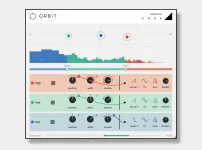
SoundGhost Orbit can use a live envelope follower to drive Position, Width, or Volume from the changing level of each frequency band. Unlike a repeating LFO, the follower has no fixed cycle, so the movement changes when the performance changes.
A loud snare hit can produce more movement than a ghost note. A vocal phrase can lean farther as the singer pushes harder, then settle back when the level drops. The timing comes from the audio rather than a bar division or rate knob.
This makes SoundGhost Orbit's live envelope follower useful for movement that needs to stay attached to the source. Orbit follows each band's own signal, which matters because low, mid, and high energy rarely rise and fall together.
Panning makes the result easy to hear because the detector is no longer hidden behind gain reduction. Set a fast attack and a drum transient can shove the assigned band toward its modulation extreme almost immediately. Slow the attack and the first crack can pass with less movement while the body of the hit pulls the image afterward.
Release controls the return trip. A short release lets the pan position recover quickly between separate hits, which can make busy percussion produce sharp spatial gestures. A longer release keeps the control value hanging between hits, smoothing several peaks into one slower movement.
Louder events can also create more modulation than quieter ones. An LFO does not care whether the source whispers or slams. An envelope follower does, so two performances with identical notes and timing can create different stereo movement purely because their dynamics differ.
A low threshold on a compressed vocal can keep the pan control active through nearly every word, leaving little contrast between ordinary syllables and peaks. Raise it, and the spatial change can concentrate around accents, louder vowels, or phrases where the singer actually pushes.
Percussion behaves differently because its envelope has harder edges. A threshold that barely reacts to room spill may still respond strongly when the snare lands, while a longer release lets the position drift back between hits. Push the threshold too low, and cymbal wash or background noise can keep the follower moving.
Band splitting adds another useful layer. If the low band contains kick and bass weight, its envelope can remain fairly steady while the high band responds sharply to hats, pick noise, consonants, or bright percussion. Independent followers can create motion from changes inside the spectrum instead of making the whole signal chase one broadband level curve.
A dynamic source gives the follower more to work with. Drum loops, plucked instruments, expressive vocals, picked guitars, and articulated bass parts tend to produce clearer changes because their levels present distinct peaks and decays. Smoother material can still work, but attack, release, and threshold need more deliberate adjustment.
Watch for movement that fights the musical center. If every loud syllable yanks a vocal hard to one side, the effect can make phrasing harder to follow. Reduce the modulation amount first, then adjust threshold and timing so the movement traces the performance without turning every peak into a stereo event.
Bipolar and unipolar movement change the feel too. A bipolar assignment can swing around the resting position as the envelope changes, while a unipolar assignment can keep motion on one side of that resting value. The second option works when louder moments should lean farther in one direction without making quieter moments bounce equally far the other way.
Attack defines how quickly movement arrives, release controls how long it lingers, threshold decides which level changes reach the full range, and modulation amount keeps the spatial shift proportionate to the part.
A loud snare hit can produce more movement than a ghost note. A vocal phrase can lean farther as the singer pushes harder, then settle back when the level drops. The timing comes from the audio rather than a bar division or rate knob.
This makes SoundGhost Orbit's live envelope follower useful for movement that needs to stay attached to the source. Orbit follows each band's own signal, which matters because low, mid, and high energy rarely rise and fall together.
Envelope followers turn level into motion
An envelope follower measures changing signal level and converts it into a smoother control signal. Attack determines how quickly the control rises when the input gets louder, while release determines how quickly it falls after the input gets quieter. The same detector idea appears throughout dynamics processing, and level-detector timing analysis shows how attack and release control the speed of a changing level estimate.Panning makes the result easy to hear because the detector is no longer hidden behind gain reduction. Set a fast attack and a drum transient can shove the assigned band toward its modulation extreme almost immediately. Slow the attack and the first crack can pass with less movement while the body of the hit pulls the image afterward.
Release controls the return trip. A short release lets the pan position recover quickly between separate hits, which can make busy percussion produce sharp spatial gestures. A longer release keeps the control value hanging between hits, smoothing several peaks into one slower movement.
Louder events can also create more modulation than quieter ones. An LFO does not care whether the source whispers or slams. An envelope follower does, so two performances with identical notes and timing can create different stereo movement purely because their dynamics differ.
Threshold decides how much of the performance matters
Orbit replaces Rate and Sync with Attack, Release, and Threshold when Envelope mode is active. Its threshold determines how loud the current band needs to become before the modulator reaches full swing. Lower settings make quieter material push farther, while higher settings reserve the strongest movement for louder moments.A low threshold on a compressed vocal can keep the pan control active through nearly every word, leaving little contrast between ordinary syllables and peaks. Raise it, and the spatial change can concentrate around accents, louder vowels, or phrases where the singer actually pushes.
Percussion behaves differently because its envelope has harder edges. A threshold that barely reacts to room spill may still respond strongly when the snare lands, while a longer release lets the position drift back between hits. Push the threshold too low, and cymbal wash or background noise can keep the follower moving.
Band splitting adds another useful layer. If the low band contains kick and bass weight, its envelope can remain fairly steady while the high band responds sharply to hats, pick noise, consonants, or bright percussion. Independent followers can create motion from changes inside the spectrum instead of making the whole signal chase one broadband level curve.
Reactive panning needs dynamics worth following
Envelope-driven movement gets dull when the source has almost no level contrast. Heavy limiting, clipped loops, sustained pads, and dense distortion can leave the follower with little useful rise and fall to track. The control may sit near one value, making an envelope setting feel static even though nothing is malfunctioning.A dynamic source gives the follower more to work with. Drum loops, plucked instruments, expressive vocals, picked guitars, and articulated bass parts tend to produce clearer changes because their levels present distinct peaks and decays. Smoother material can still work, but attack, release, and threshold need more deliberate adjustment.
Watch for movement that fights the musical center. If every loud syllable yanks a vocal hard to one side, the effect can make phrasing harder to follow. Reduce the modulation amount first, then adjust threshold and timing so the movement traces the performance without turning every peak into a stereo event.
Bipolar and unipolar movement change the feel too. A bipolar assignment can swing around the resting position as the envelope changes, while a unipolar assignment can keep motion on one side of that resting value. The second option works when louder moments should lean farther in one direction without making quieter moments bounce equally far the other way.
Attack defines how quickly movement arrives, release controls how long it lingers, threshold decides which level changes reach the full range, and modulation amount keeps the spatial shift proportionate to the part.