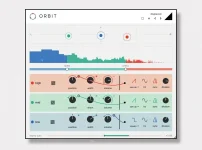
SoundGhost Orbit splits stereo audio at two crossover points, with default boundaries of 250 Hz and 2.5 kHz. At first, it sounds like a small variation on ordinary auto-pan until you stop treating a sound as one block moving between two speakers. A bass-heavy synth, vocal texture, drum loop, or resampled phrase can have its weight, body, and edge moving on different paths.
A conventional auto-panner normally gives the whole signal one movement pattern. Push it left, and the lows, mids, and highs travel left together, then travel back together when the modulation swings the other way. The result can be clean and useful, especially when you want the listener to notice the source itself changing position.
Multiband panning changes the job. Instead of asking where the whole sound should sit, you decide which parts of its spectrum deserve movement and which parts should stay relatively planted, which is the practical difference behind SoundGhost Orbit's three-band auto-panning architecture.
The key distinction is spectral consistency. One side may be louder than the other at a given moment, but the bass, midrange, and top end are still being steered by the same pan movement. You are changing lateral placement without deliberately separating the sound's low-end weight from its upper texture.
Dense material is where full-band auto-pan starts getting clumsy. A pad may have a centered low foundation you want to keep steady, plus noisy highs that could move much harder without making the whole patch feel unstable. Moving everything together gives you one answer for two different jobs.
Multiband processing lets you stop making that compromise. The low band can barely move, the midrange can drift slowly, and the high band can travel farther or at a different rate. Same source, different spatial behavior inside it.
A harmonically rich sound makes this easy to hear. Keep the lowest band near the center and move only the upper band, and the sound can retain a stable core while its brightness appears more restless. Reverse the setup and the result can feel stranger because the spectral weight is moving while the detail stays put.
Independent band movement also changes the moment-to-moment tonal balance arriving from each speaker, not merely the apparent position of one unchanged sound. When the highs lean left while the lows stay centered, the left side temporarily carries a brighter version of the overall spectrum.
Crossover placement therefore matters before you touch modulation depth. Orbit starts at 250 Hz and 2.5 kHz, but those values are just starting points because the useful split depends on the source. A bass patch, guitar loop, vocal stack, and cymbal-heavy drum bus distribute their important harmonics in very different places.
Start smaller. Let one band do most of the moving while the other two stay restrained. On a pad, leave the lows almost fixed and let the upper band wander, or keep a percussion hit's body steady while its brighter range moves just enough to create width.
Rate matters too. Identical pan depth can feel completely different when one band crawls over several beats and another changes direction several times inside the same space. Separate rates create internal motion because the frequency regions keep changing their relationship to each other.
Listen in the full mix before making the movement wider. Solo playback makes dramatic panning easy to love because there is nothing else competing for attention, while the arrangement reveals whether the moving band is creating space or just stealing it. A smaller upper-band sweep often reads more clearly once vocals, drums, bass, and effects are all playing.
The useful test is whether the source keeps a recognizable center of gravity while gaining motion where it actually helps. If the low foundation stays dependable and the moving detail creates contrast around it, multiband auto-pan is doing something ordinary full-band movement cannot do without taking the entire sound along for the ride.
A conventional auto-panner normally gives the whole signal one movement pattern. Push it left, and the lows, mids, and highs travel left together, then travel back together when the modulation swings the other way. The result can be clean and useful, especially when you want the listener to notice the source itself changing position.
Multiband panning changes the job. Instead of asking where the whole sound should sit, you decide which parts of its spectrum deserve movement and which parts should stay relatively planted, which is the practical difference behind SoundGhost Orbit's three-band auto-panning architecture.
Full-band auto-pan moves one spectrum together
Take a mono synth with a heavy fundamental and a bright stack of harmonics. With ordinary amplitude panning, the entire spectrum follows the same left-right level change, so the sound moves as a unit even if its tone is complicated. Slow movement feels broad and obvious, while faster movement can turn into rhythmic motion.The key distinction is spectral consistency. One side may be louder than the other at a given moment, but the bass, midrange, and top end are still being steered by the same pan movement. You are changing lateral placement without deliberately separating the sound's low-end weight from its upper texture.
Dense material is where full-band auto-pan starts getting clumsy. A pad may have a centered low foundation you want to keep steady, plus noisy highs that could move much harder without making the whole patch feel unstable. Moving everything together gives you one answer for two different jobs.
Multiband processing lets you stop making that compromise. The low band can barely move, the midrange can drift slowly, and the high band can travel farther or at a different rate. Same source, different spatial behavior inside it.
Frequency bands change the stereo picture
Human horizontal localization is frequency dependent, with lower and higher parts of the spectrum contributing differently to spatial judgment. The frequency-dependent localization cues behind hearing are more complicated than a DAW pan knob, so multiband panning should not be treated as a shortcut to realistic spatial audio. It does explain why moving separate frequency regions can feel different from dragging the whole spectrum across the stereo field.A harmonically rich sound makes this easy to hear. Keep the lowest band near the center and move only the upper band, and the sound can retain a stable core while its brightness appears more restless. Reverse the setup and the result can feel stranger because the spectral weight is moving while the detail stays put.
Independent band movement also changes the moment-to-moment tonal balance arriving from each speaker, not merely the apparent position of one unchanged sound. When the highs lean left while the lows stay centered, the left side temporarily carries a brighter version of the overall spectrum.
Crossover placement therefore matters before you touch modulation depth. Orbit starts at 250 Hz and 2.5 kHz, but those values are just starting points because the useful split depends on the source. A bass patch, guitar loop, vocal stack, and cymbal-heavy drum bus distribute their important harmonics in very different places.
Less motion can sound more intentional
The easiest way to make multiband panning annoying is to animate every band aggressively. Three independent movers can turn one coherent part into constant left-right activity, especially when each range runs at a different speed. Movement stops feeling intentional once nothing gives the ear a stable reference.Start smaller. Let one band do most of the moving while the other two stay restrained. On a pad, leave the lows almost fixed and let the upper band wander, or keep a percussion hit's body steady while its brighter range moves just enough to create width.
Rate matters too. Identical pan depth can feel completely different when one band crawls over several beats and another changes direction several times inside the same space. Separate rates create internal motion because the frequency regions keep changing their relationship to each other.
Listen in the full mix before making the movement wider. Solo playback makes dramatic panning easy to love because there is nothing else competing for attention, while the arrangement reveals whether the moving band is creating space or just stealing it. A smaller upper-band sweep often reads more clearly once vocals, drums, bass, and effects are all playing.
The useful test is whether the source keeps a recognizable center of gravity while gaining motion where it actually helps. If the low foundation stays dependable and the moving detail creates contrast around it, multiband auto-pan is doing something ordinary full-band movement cannot do without taking the entire sound along for the ride.