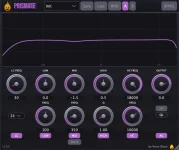
Prismate’s Q-Link tightens the mid-band bell as gain moves farther from zero, coupling bandwidth to the size of the EQ move. A small correction can stay broad, while a harder push becomes more focused around the selected frequency.
This is the basic idea behind proportional Q, but the name is easier to understand than the implementations are. Constant-Q designs try to keep bandwidth stable as gain changes, while proportional designs let bandwidth move with the amount of boost or cut. The catch is that two EQs can both use proportional behavior and still draw noticeably different curves.
The engineering distinction behind constant-Q bandwidth behavior grew from a very practical problem. Older proportional graphic EQs could become much broader at modest slider positions, so the response on the output did not always resemble the shape suggested by the controls. Constant-Q designs made the visual setting more predictable by keeping each band’s bandwidth steadier as level changed.
A proportional parametric EQ flips part of that relationship on purpose. Small moves can remain wide and gentle, while larger boosts or cuts tighten around the center frequency. You get a control that naturally shifts from broad tone shaping toward more concentrated correction as you push it.
None of this means proportional Q has one fixed formula. Plugin developers can choose different gain-to-Q mappings, bandwidth definitions, limits, and curve shapes. One EQ may narrow quickly after a few decibels, while another changes more gradually even when both controls show the same center frequency, gain, and nominal Q.
This can make fast tonal decisions feel less fiddly when, for example, a vocal needs a little more definition around the upper mids. A modest boost can affect a wider neighborhood, but pushing harder does not have to drag as much nearby material upward with it. The same interaction can make a deeper cut increasingly focused around an annoying resonance.
This also changes the familiar boost-and-sweep routine. If you hunt a resonance with a large boost and then pull the band back to a subtle correction, the bell can widen as gain falls. You are no longer hearing the same filter at a quieter level, because the target frequency may stay put while surrounding frequencies re-enter the mix.
There is a trade-off. If you are trying to reproduce an exact response from another equalizer, gain-dependent Q can get in the way because changing gain may also change width. Matching only the displayed Q number is unreliable even between ordinary parametric EQs, and proportional behavior adds another moving part.
For precise curve matching, compare the actual response rather than trusting a copied number. If the plugin lets you disable the linked behavior, a fixed-Q mode also makes controlled comparisons easier. This matters when recreating settings from measurements, transferring corrective filters between processors, or trying to null two EQ curves against each other.
A proportional bell also does not become more musical simply because it narrows with gain. Broad moves can be excellent for balance, and narrow moves can be exactly what a problem frequency needs, but either can sound clumsy when the center frequency or gain is wrong. The useful feature is the changing relationship between width and intensity, not a guarantee of taste.
On a vocal, a 1 dB upper-mid adjustment and a 6 dB corrective move do not always need to occupy the same width. Q-Link automates that distinction for Prismate’s mid band. Leave it active when you want gain and focus to travel together, and disable it when you need bandwidth to remain fixed while gain changes.
This is the basic idea behind proportional Q, but the name is easier to understand than the implementations are. Constant-Q designs try to keep bandwidth stable as gain changes, while proportional designs let bandwidth move with the amount of boost or cut. The catch is that two EQs can both use proportional behavior and still draw noticeably different curves.
Proportional Q is a behavior, not a universal curve
Q describes how concentrated a bell filter is around its center frequency. Higher Q usually means a narrower bell, while lower Q spreads the change across a wider part of the spectrum. On a constant-Q equalizer, moving gain should not substantially change the selected bandwidth.The engineering distinction behind constant-Q bandwidth behavior grew from a very practical problem. Older proportional graphic EQs could become much broader at modest slider positions, so the response on the output did not always resemble the shape suggested by the controls. Constant-Q designs made the visual setting more predictable by keeping each band’s bandwidth steadier as level changed.
A proportional parametric EQ flips part of that relationship on purpose. Small moves can remain wide and gentle, while larger boosts or cuts tighten around the center frequency. You get a control that naturally shifts from broad tone shaping toward more concentrated correction as you push it.
None of this means proportional Q has one fixed formula. Plugin developers can choose different gain-to-Q mappings, bandwidth definitions, limits, and curve shapes. One EQ may narrow quickly after a few decibels, while another changes more gradually even when both controls show the same center frequency, gain, and nominal Q.
Gain-dependent Q changes how you reach a target
With Prismate’s gain-linked mid-band behavior, the useful part is not some automatic claim of better sound. It is the way the control responds while you work. A 1 dB presence lift can stay broad enough to reshape a region, then a stronger move can tighten without requiring a separate Q adjustment every time.This can make fast tonal decisions feel less fiddly when, for example, a vocal needs a little more definition around the upper mids. A modest boost can affect a wider neighborhood, but pushing harder does not have to drag as much nearby material upward with it. The same interaction can make a deeper cut increasingly focused around an annoying resonance.
This also changes the familiar boost-and-sweep routine. If you hunt a resonance with a large boost and then pull the band back to a subtle correction, the bell can widen as gain falls. You are no longer hearing the same filter at a quieter level, because the target frequency may stay put while surrounding frequencies re-enter the mix.
There is a trade-off. If you are trying to reproduce an exact response from another equalizer, gain-dependent Q can get in the way because changing gain may also change width. Matching only the displayed Q number is unreliable even between ordinary parametric EQs, and proportional behavior adds another moving part.
For precise curve matching, compare the actual response rather than trusting a copied number. If the plugin lets you disable the linked behavior, a fixed-Q mode also makes controlled comparisons easier. This matters when recreating settings from measurements, transferring corrective filters between processors, or trying to null two EQ curves against each other.
Proportional Q does not automatically mean analog
“Analog-style” gets attached to proportional Q because plenty of classic equalizers changed bandwidth as gain changed. The label is still too broad to tell you how a modern plugin behaves. Analog hardware has used proportional, constant, fixed, stepped, asymmetric, and other filter arrangements, often with interactions that go well beyond a single Q rule.A proportional bell also does not become more musical simply because it narrows with gain. Broad moves can be excellent for balance, and narrow moves can be exactly what a problem frequency needs, but either can sound clumsy when the center frequency or gain is wrong. The useful feature is the changing relationship between width and intensity, not a guarantee of taste.
On a vocal, a 1 dB upper-mid adjustment and a 6 dB corrective move do not always need to occupy the same width. Q-Link automates that distinction for Prismate’s mid band. Leave it active when you want gain and focus to travel together, and disable it when you need bandwidth to remain fixed while gain changes.